Department of Geriatric Medicine, RWTH Aachen University Hospital, 52074 Aachen, Germany.
Nutrients. 2023 Aug 10;15(16):3529. doi: 10.3390/nu15163529.
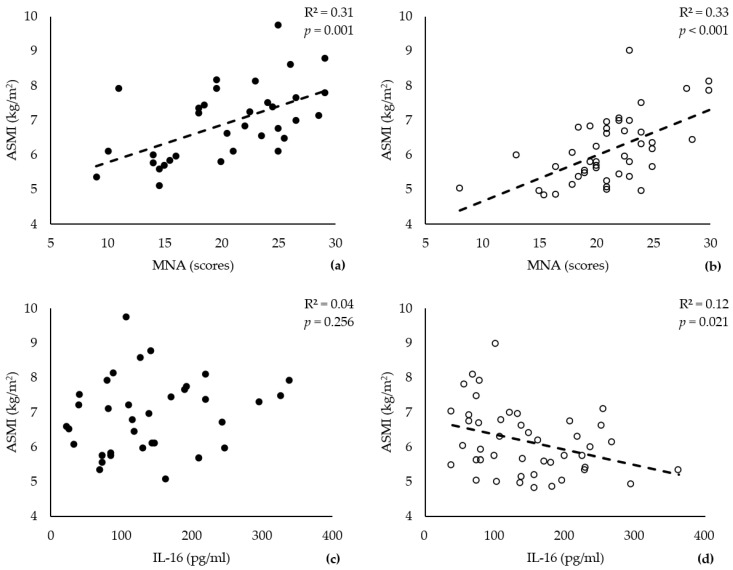
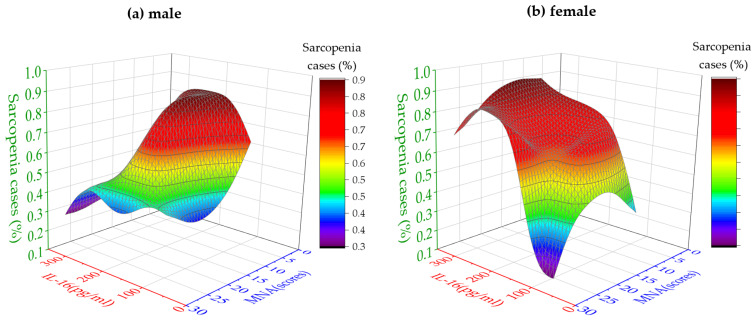
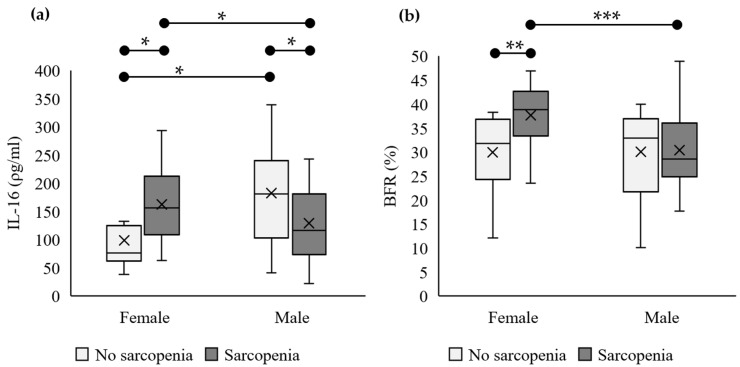
Epidemiological studies of older adults have suggested a differential sex-specific prevalence of sarcopenia, which is a condition characterized by a progressive loss of skeletal muscle mass and function. Recently, we collected serum samples from 80 fully evaluated older adults and identified CXCL12α as a sex-independent serum marker of sarcopenia. Here, we used this serum collection to find potential sex-specific serum markers via the simultaneous quantification of 34 inflammatory cytokines/chemokines. The appendicular skeletal muscle index (ASMI) was used as a decisive criterion for diagnosing sarcopenia. A Pearson correlation analysis revealed a negative correlation between ASMI and serum IL-16 in females only ( = 0.021). Moreover, women with sarcopenia exhibited significantly higher IL-16 ( = 0.025) serum levels than women in a control group. In contrast, males with sarcopenia had lower IL-16 ( = 0.013) levels than males in a control group. The further use of Fisher's exact test identified obesity ( = 0.027) and high serum levels of IL-16 ( = 0.029) as significant risk factors for sarcopenia in females. In male older adults, however, malnutrition ( = 0.028) and low serum levels of IL-16 ( = 0.031) were the most significant risk factors for sarcopenia. The differential sex-specific associations of IL-16 in older adults may contribute to the development of more precise regression models for future research and elucidate the role of IL-16 in the progression of sarcopenic obesity.
对老年人的流行病学研究表明,肌肉减少症存在性别特异性差异,这是一种以骨骼肌质量和功能进行性丧失为特征的疾病。最近,我们从 80 名经过全面评估的老年人中收集了血清样本,并确定 CXCL12α 是肌肉减少症的一种性别独立的血清标志物。在这里,我们使用这个血清集,通过同时定量 34 种炎症细胞因子/趋化因子,寻找潜在的性别特异性血清标志物。四肢骨骼肌指数(ASMI)被用作诊断肌肉减少症的决定性标准。皮尔逊相关分析显示,只有女性的 ASMI 与血清 IL-16 呈负相关( = 0.021)。此外,患有肌肉减少症的女性的血清 IL-16 水平显著高于对照组( = 0.025)。相比之下,患有肌肉减少症的男性的血清 IL-16 水平低于对照组( = 0.013)。进一步使用 Fisher 确切检验确定肥胖( = 0.027)和高血清 IL-16 水平( = 0.029)是女性肌肉减少症的显著危险因素。然而,在男性老年人中,营养不良( = 0.028)和低血清 IL-16 水平( = 0.031)是肌肉减少症的最显著危险因素。IL-16 在老年人群中的性别特异性差异可能有助于为未来的研究开发更精确的回归模型,并阐明 IL-16 在肌肉减少性肥胖进展中的作用。