Department of Psychiatry, Beth Israel Deaconess Medical Center, Boston, MA, USA.
Department of Psychological and Brain Science, Boston University, Boston, MA, USA.
Asian J Psychiatr. 2023 Oct;88:103750. doi: 10.1016/j.ajp.2023.103750. Epub 2023 Aug 22.
Transcranial electrical stimulation (tES) may improve psychosis symptoms, but few investigations have targeted brain regions causally linked to psychosis symptoms. We implemented a novel montage targeting the extrastriate visual cortex (eVC) previously identified by lesion network mapping in the manifestation of visual hallucinations.
To determine if lesion network guided High Definition-tES (HD-tES) to the eVC is safe and efficacious in reducing symptoms related to psychosis.
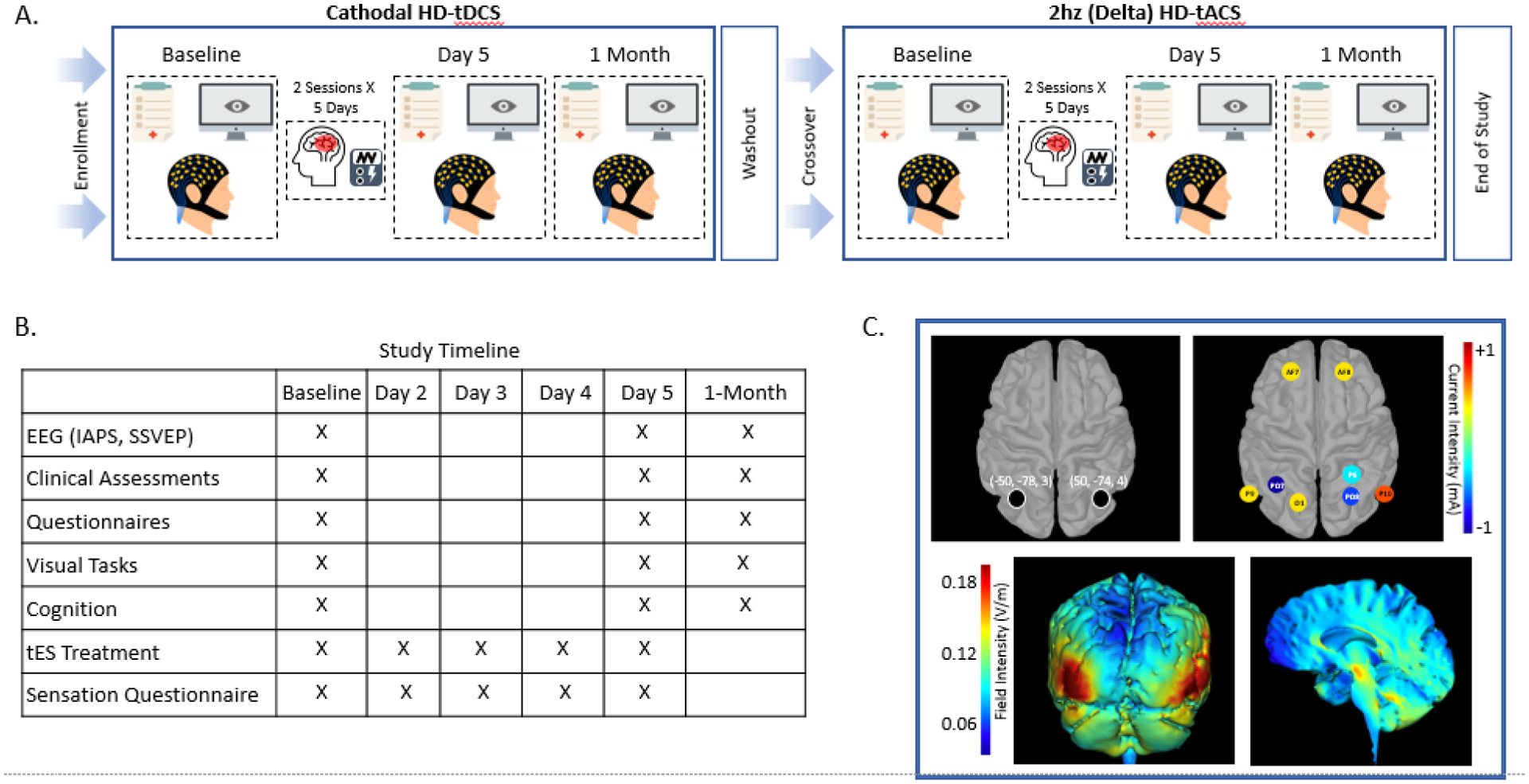
We conducted a single-blind crossover pilot study (NCT04870710) in patients with psychosis spectrum disorders. Participants first received HD-tDCS (direct current), followed by 4 weeks of wash out, then 2 Hz HD-tACS (alternating current). Participants received 5 days of daily (2×20 min) stimulation bilaterally to the eVC. Primary outcomes included the Positive and Negative Syndrome Scale (PANSS), biological motion task, and Event Related Potentials (ERP) from a steady state visual evoked potential (SSVEP) paradigm. Secondary outcomes included the Montgomery-Asperg Depression Rating Scale, Global Assessment of Functioning (GAF), velocity discrimination and visual working memory task, and emotional ERP.
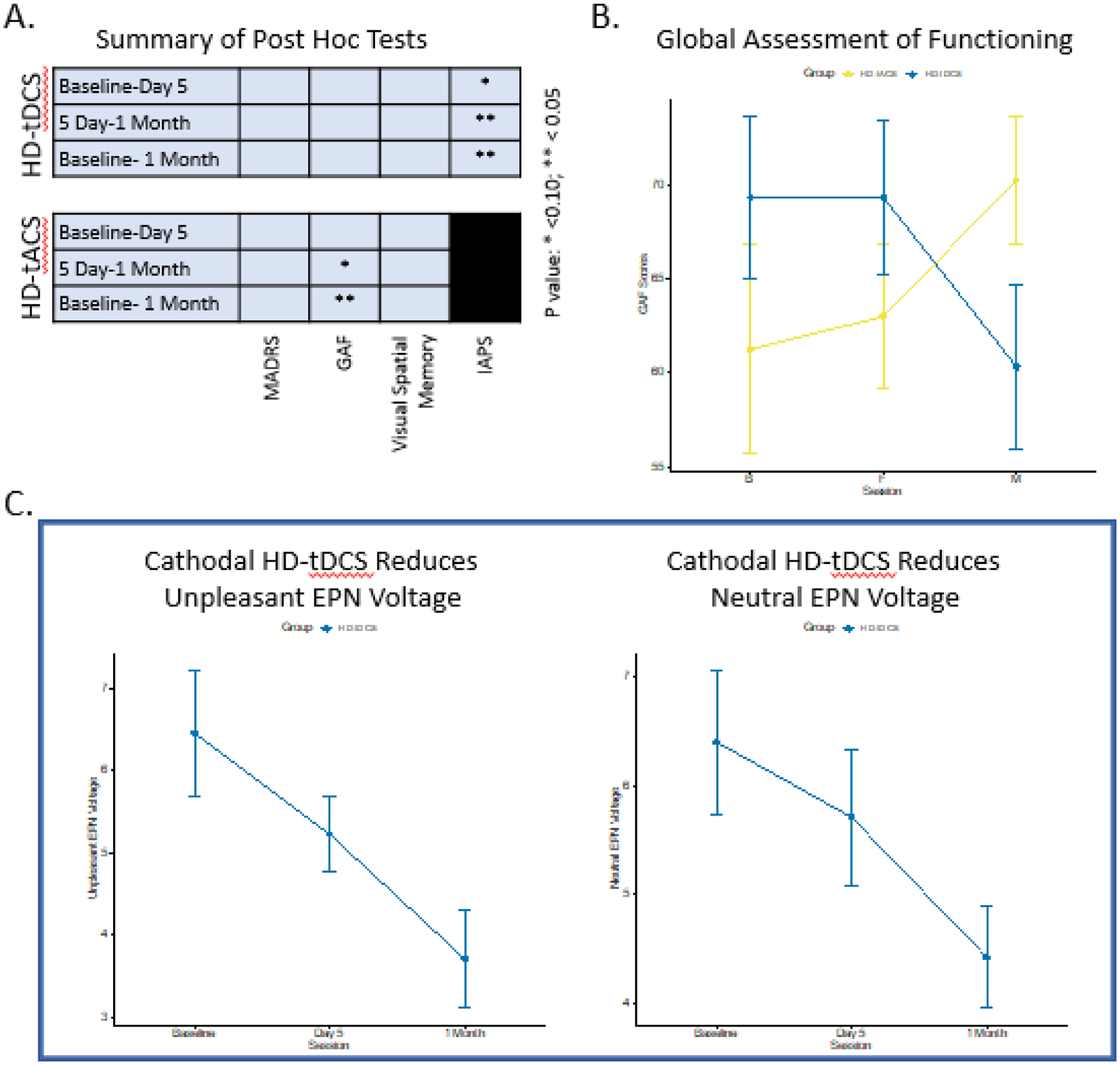
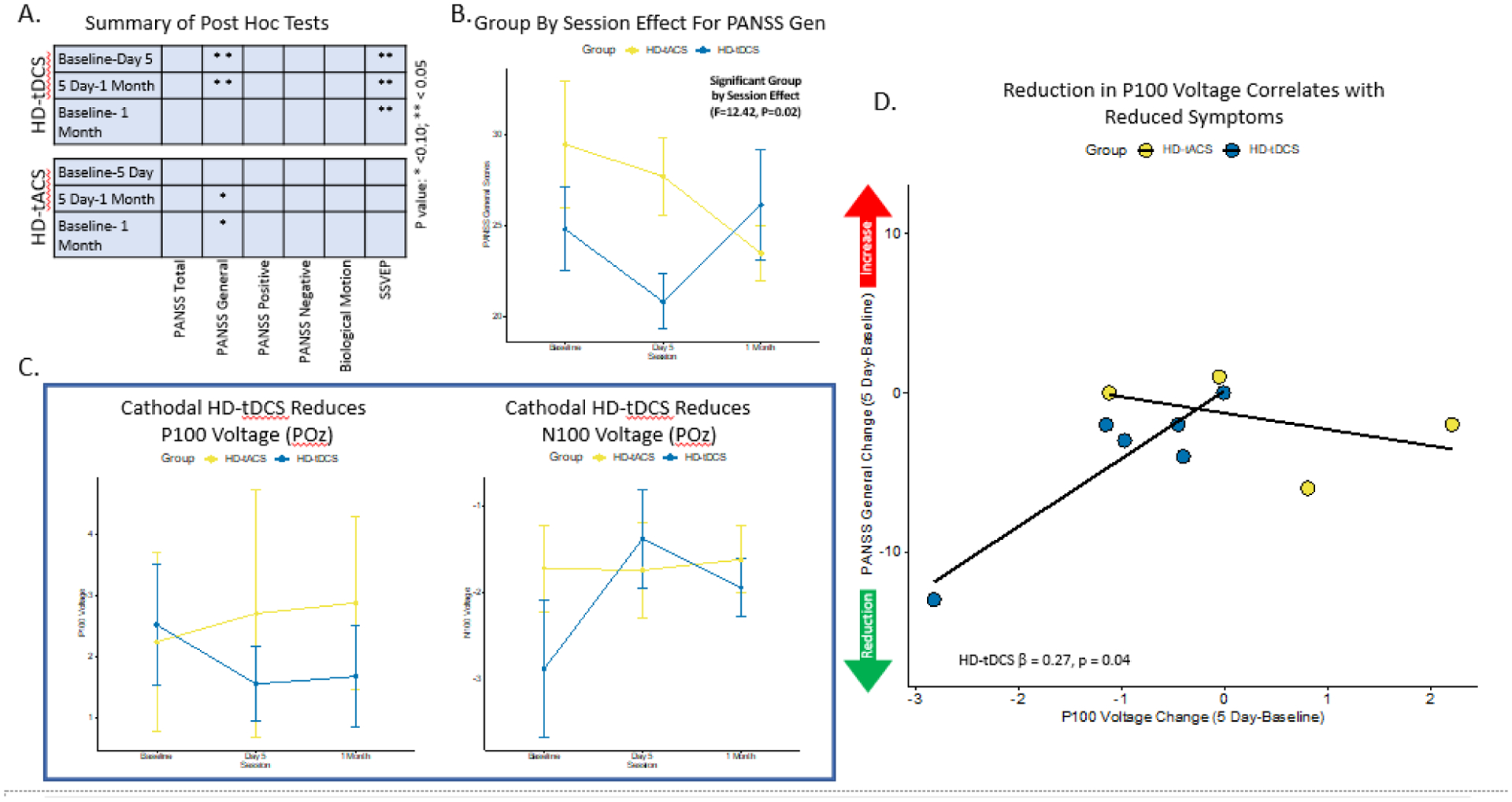
HD-tDCS improved PANSS general psychopathology in the short-term (d=0.47; p=0.03), with long-term improvements in general psychopathology (d=0.62; p=0.05) and GAF (d=-0.56; p=0.04) with HD-tACS. HD-tDCS reduced SSVEP P1 (d=0.25; p=0.005), which correlated with general psychopathology (β = 0.274, t = 3.59, p = 0.04). No significant differences in safety or tolerability measures were identified.
Lesion network guided HD-tES to the eVC is a safe, efficacious, and promising approach for reducing general psychopathology via changes in neuroplasticity. These results highlight the need for larger clinical trials implementing novel targeting methodologies for the treatments of psychosis.
经颅电刺激(tES)可能改善精神病症状,但很少有研究针对与精神病症状有因果关系的大脑区域。我们采用了一种新的刺激模式,针对外侧视觉皮层(eVC)进行刺激,该模式是通过病变网络映射在视觉幻觉表现中确定的。
确定病变网络引导的高清晰度经颅交流电刺激(HD-tES)到 eVC 是否安全有效,能否减轻与精神病相关的症状。
我们对精神病谱障碍患者进行了一项单盲交叉先导研究(NCT04870710)。参与者首先接受 HD-tDCS(直流电),然后进行 4 周的洗脱期,然后接受 2 Hz HD-tACS(交流电)。参与者接受双侧 eVC 每天 5 天的(2×20 分钟)刺激。主要结局包括阳性和阴性综合征量表(PANSS)、生物运动任务和稳态视觉诱发电位(SSVEP)范式的事件相关电位(ERP)。次要结局包括蒙哥马利-阿斯伯格抑郁评定量表、总体功能评估(GAF)、速度判别和视觉工作记忆任务以及情绪 ERP。
HD-tDCS 在短期内改善了 PANSS 一般精神病学(d=0.47;p=0.03),HD-tACS 可长期改善一般精神病学(d=0.62;p=0.05)和 GAF(d=-0.56;p=0.04)。HD-tDCS 降低了 SSVEP P1(d=0.25;p=0.005),这与一般精神病学相关(β=0.274,t=3.59,p=0.04)。未发现安全性或耐受性测量有显著差异。
病变网络引导的 eVC 高清晰度经颅交流电刺激是一种安全、有效且有前途的方法,可通过改变神经可塑性来减轻一般精神病学症状。这些结果强调需要进行更大规模的临床试验,以实施针对精神病治疗的新型靶向方法。