Clinical Trial Service Unit and Epidemiological Studies Unit, Nuffield Department of Population Health, University of Oxford, Oxford, UK.
Experimental Research Unit, Faculty of Medicine, National Autonomous University of Mexico, Mexico City, Mexico.
Lancet Public Health. 2023 Sep;8(9):e670-e679. doi: 10.1016/S2468-2667(23)00153-6.
Social inequalities in adult mortality have been reported across diverse populations, but there is no large-scale prospective evidence from Mexico. We aimed to quantify social, including educational, inequalities in mortality among adults in Mexico City.
The Mexico City Prospective Study recruited 150 000 adults aged 35 years and older from two districts of Mexico City between 1998 and 2004. Participants were followed up until Jan 1, 2021 for cause-specific mortality. Cox regression analysis yielded rate ratios (RRs) for death at ages 35-74 years associated with education and examined, in exploratory analyses, the mediating effects of lifestyle and related risk factors.
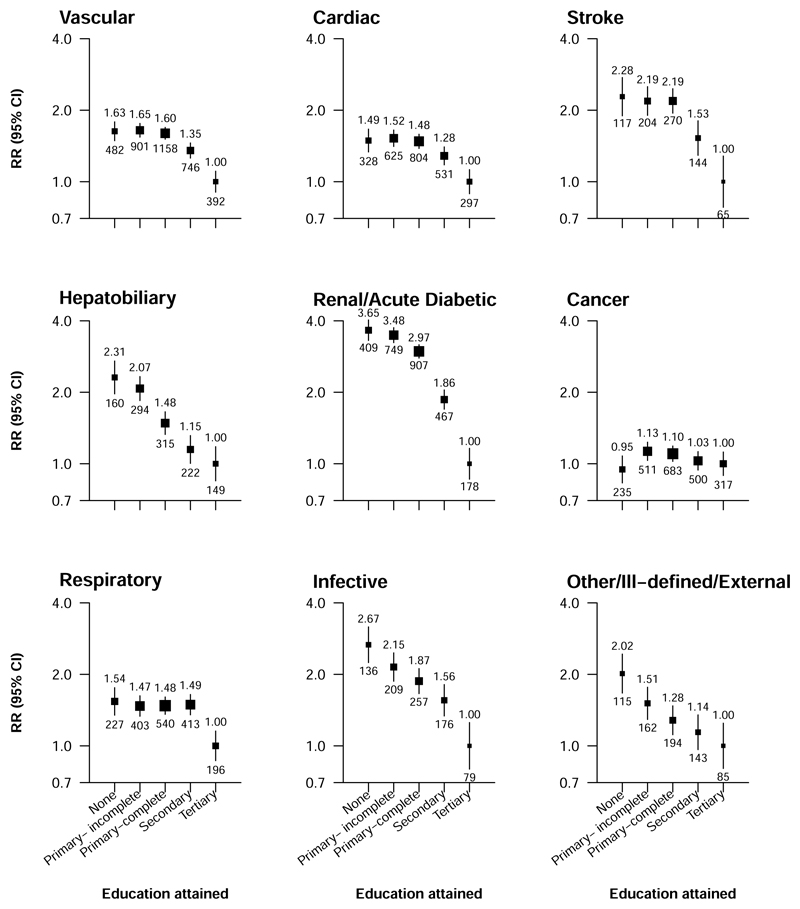
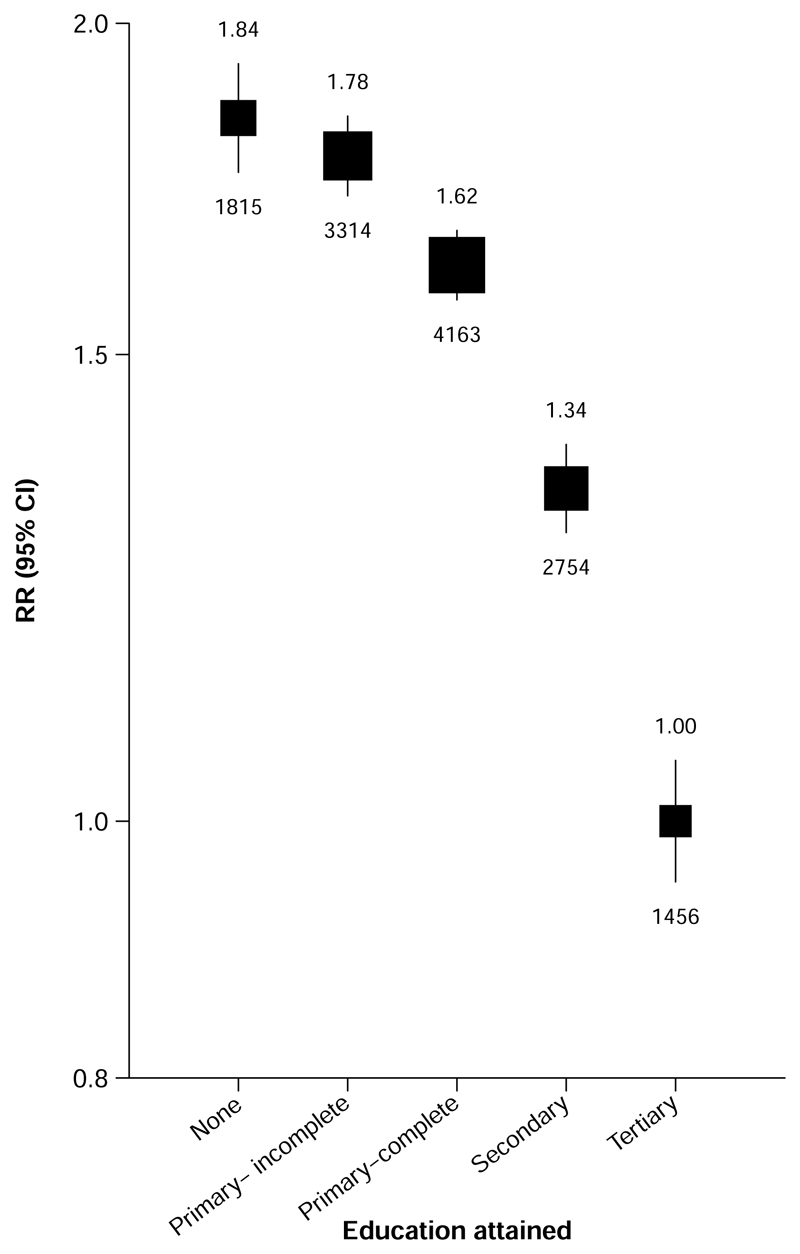
Among 143 478 participants aged 35-74 years, there was a strong inverse association of education with premature death. Compared with participants with tertiary education, after adjustment for age and sex, those with no education had about twice the mortality rate (RR 1·84; 95% CI 1·71-1·98), equivalent to approximately 6 years lower life expectancy, with an RR of 1·78 (1·67-1·90) among participants with incomplete primary, 1·62 (1·53-1·72) with complete primary, and 1·34 (1·25-1·42) with secondary education. Education was most strongly associated with death from renal disease and acute diabetic crises (RR 3·65; 95% CI 3·05-4·38 for no education vs tertiary education) and from infectious diseases (2·67; 2·00-3·56), but there was an apparent higher rate of death from all specific causes studied with lower education, with the exception of cancer for which there was little association. Lifestyle factors (ie, smoking, alcohol drinking, and leisure time physical activity) and related physiological correlates (ie, adiposity, diabetes, and blood pressure) accounted for about four-fifths of the association of education with premature mortality.
In this Mexican population there were marked educational inequalities in premature adult mortality, which appeared to largely be accounted for by lifestyle and related risk factors. Effective interventions to reduce these risk factors could reduce inequalities and have a major impact on premature mortality.
Wellcome Trust, the Mexican Health Ministry, the National Council of Science and Technology for Mexico, Cancer Research UK, British Heart Foundation, and the UK Medical Research Council Population Health Research Unit.
社会不平等导致成年人死亡率在不同人群中有所报道,但墨西哥没有大规模的前瞻性证据。我们旨在量化墨西哥城成年人死亡率方面的社会不平等,包括教育方面。
1998 年至 2004 年期间,墨西哥城前瞻性研究在墨西哥城的两个区招募了 15 万名 35 岁及以上的成年人。参与者在 2021 年 1 月 1 日之前因特定原因死亡进行随访。Cox 回归分析得出了与教育相关的 35-74 岁年龄段死亡的死亡率比(RR),并在探索性分析中研究了生活方式和相关风险因素的中介作用。
在 143478 名 35-74 岁的参与者中,教育与过早死亡呈强烈的反比关系。与接受过高等教育的参与者相比,在调整年龄和性别后,未接受过教育的参与者的死亡率几乎高出两倍(RR 1.84;95%CI 1.71-1.98),预期寿命约低 6 年,未接受过完整小学教育的参与者的 RR 为 1.78(1.67-1.90),接受过完整小学教育的参与者的 RR 为 1.62(1.53-1.72),接受过中学教育的参与者的 RR 为 1.34(1.25-1.42)。教育与肾脏疾病和急性糖尿病危象(RR 3.65;95%CI 3.05-4.38,与高等教育相比)和传染病(2.67;2.00-3.56)导致的死亡关系最为密切,但除了癌症外,受教育程度较低的人死于所有特定原因的比率似乎都明显较高,而癌症与受教育程度的关系则较小。生活方式因素(即吸烟、饮酒和闲暇时间体育活动)和相关的生理指标(即肥胖、糖尿病和血压)解释了教育与过早死亡之间约五分之四的关联。
在墨西哥人群中,成年人过早死亡存在明显的教育不平等现象,这似乎在很大程度上归因于生活方式和相关风险因素。减少这些风险因素的有效干预措施可以减少不平等现象,并对过早死亡产生重大影响。
惠康信托基金会、墨西哥卫生部、墨西哥国家科学技术委员会、英国癌症研究中心、英国心脏基金会、英国医学研究理事会人口健康研究中心。