Department of Epidemiology and Biostatistics, Urban Health Collaborative, Drexel Dornsife School of Public Health, Philadelphia, PA, USA.
Instituto de Salud Colectiva, Universidad Nacional de Lanús, Buenos Aires, Argentina.
Lancet Planet Health. 2019 Dec;3(12):e503-e510. doi: 10.1016/S2542-5196(19)30235-9. Epub 2019 Dec 10.
Latin America is one of the most unequal regions in the world, but evidence is lacking on the magnitude of health inequalities in urban areas of the region. Our objective was to examine inequalities in life expectancy in six large Latin American cities and its association with a measure of area-level socioeconomic status.
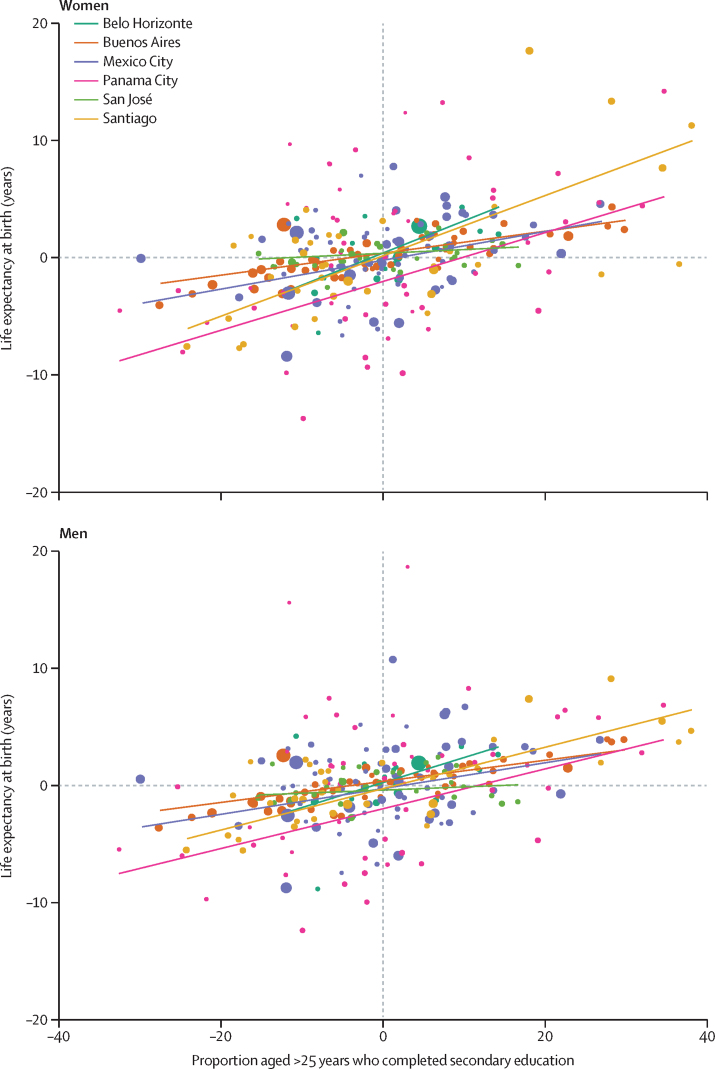
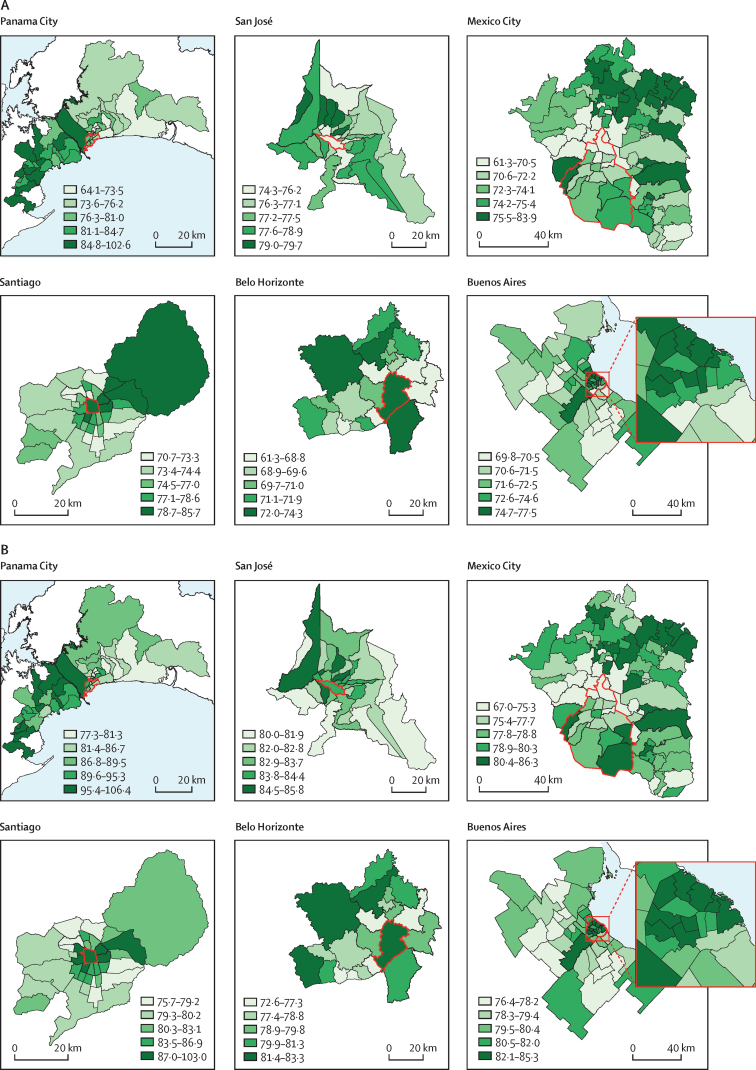
In this ecological analysis, we used data from the Salud Urbana en America Latina (SALURBAL) study on six large cities in Latin America (Buenos Aires, Argentina; Belo Horizonte, Brazil; Santiago, Chile; San José, Costa Rica; Mexico City, Mexico; and Panama City, Panama), comprising 266 subcity units, for the period 2011-15 (expect for Panama city, which was for 2012-16). We calculated average life expectancy at birth by sex and subcity unit with life tables using age-specific mortality rates estimated from a Bayesian model, and calculated the difference between the ninth and first decile of life expectancy at birth (P90-P10 gap) across subcity units in cities. We also analysed the association between life expectancy at birth and socioeconomic status at the subcity-unit level, using education as a proxy for socioeconomic status, and whether any geographical patterns existed in cities between subcity units.
We found large spatial differences in average life expectancy at birth in Latin American cities, with the largest P90-P10 gaps observed in Panama City (15·0 years for men and 14·7 years for women), Santiago (8·9 years for men and 17·7 years for women), and Mexico City (10·9 years for men and 9·4 years for women), and the narrowest in Buenos Aires (4·4 years for men and 5·8 years for women), Belo Horizonte (4·0 years for men and 6·5 years for women), and San José (3·9 years for men and 3·0 years for women). Higher area-level socioeconomic status was associated with higher life expectancy, especially in Santiago (change in life expectancy per P90-P10 change unit-level of educational attainment 8·0 years [95% CI 5·8-10·3] for men and 11·8 years [7·1-16·4] for women) and Panama City (7·3 years [2·6-12·1] for men and 9·0 years [2·4-15·5] for women). We saw an increase in life expectancy at birth from east to west in Panama City and from north to south in core Mexico City, and a core-periphery divide in Buenos Aires and Santiago. Whereas for San José the central part of the city had the lowest life expectancy and in Belo Horizonte the central part of the city had the highest life expectancy.
Large spatial differences in life expectancy in Latin American cities and their association with social factors highlight the importance of area-based approaches and policies that address social inequalities in improving health in cities of the region.
Wellcome Trust.
拉丁美洲是世界上最不平等的地区之一,但该地区城市地区卫生不平等的程度缺乏证据。我们的目的是研究六个拉丁美洲大城市的预期寿命不平等情况及其与衡量区域社会经济地位的指标之间的关联。
在这项生态分析中,我们使用了来自拉丁美洲六个大城市(阿根廷布宜诺斯艾利斯、巴西贝洛奥里藏特、智利圣地亚哥、哥斯达黎加圣何塞、墨西哥城和巴拿马城)的 Salud Urbana en America Latina(SALURBAL)研究的数据,这些数据涵盖了 2011-15 年期间的 266 个分城区单元(不包括巴拿马城,该城市的数据为 2012-16 年)。我们使用生命表根据贝叶斯模型估计的特定年龄死亡率计算出生时预期寿命的平均值,并计算出生时预期寿命第九和十分位数之间的差异(P90-P10 差距)在城市中的分城区单元之间。我们还使用教育作为社会经济地位的替代指标,分析了出生时预期寿命与分城区单元水平的社会经济地位之间的关联,以及城市中是否存在分城区单元之间的地理模式。
我们发现拉丁美洲城市的出生时预期寿命存在很大的空间差异,在巴拿马城(男性为 15.0 年,女性为 14.7 年)、圣地亚哥(男性为 8.9 年,女性为 17.7 年)和墨西哥城(男性为 10.9 年,女性为 9.4 年)观察到最大的 P90-P10 差距,而在布宜诺斯艾利斯(男性为 4.4 年,女性为 5.8 年)、贝洛奥里藏特(男性为 4.0 年,女性为 6.5 年)和圣何塞(男性为 3.9 年,女性为 3.0 年)观察到最小的差距。较高的区域社会经济地位与较高的预期寿命相关,特别是在圣地亚哥(每单位教育程度 P90-P10 变化,男性预期寿命变化 8.0 岁[5.8-10.3],女性预期寿命变化 11.8 岁[7.1-16.4])和巴拿马城(男性 7.3 岁[2.6-12.1],女性 9.0 岁[2.4-15.5])。我们观察到巴拿马城从东至西和墨西哥城核心地区从北至南的出生时预期寿命增加,以及布宜诺斯艾利斯和圣地亚哥的核心-外围鸿沟。而在圣何塞,城市的中心部分预期寿命最低,在贝洛奥里藏特,城市的中心部分预期寿命最高。
拉丁美洲城市预期寿命的巨大空间差异及其与社会因素的关联突出了基于区域的方法和政策的重要性,这些方法和政策旨在解决社会不平等问题,从而改善该地区城市的健康状况。
惠康信托基金会。