Li Chihua, Zhang Yuan, Noppert Grace, Al Hazzouri Adina Zeki, Gross Alden, Kobayashi Lindsay
Institute of Chinese Medical Sciences, University of Macau, Macao SAR, China.
Department of Epidemiology, School of Public Health, University of Michigan, Ann Arbor, MI, USA.
SSM Popul Health. 2024 Oct 11;28:101716. doi: 10.1016/j.ssmph.2024.101716. eCollection 2024 Dec.
The relationship between education and cardiometabolic biomarkers is contextually dependent on both inter-country and intra-country factors. This study aimed to examine educational differences in cardiometabolic biomarkers among middle-aged and older adults in the US, Mexico, China, and India, and whether this relationship is modified by urbanicity of residence.
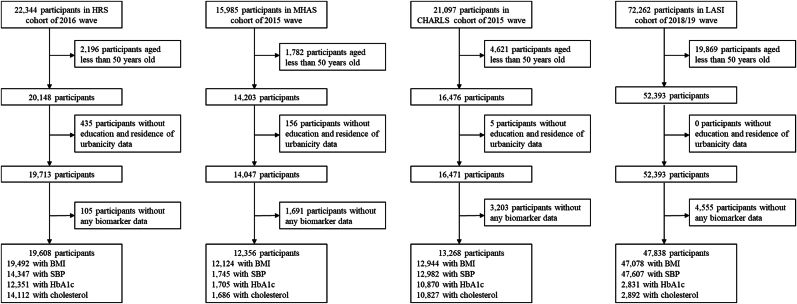
Data were from contemporary cross-sectional waves of the US Health and Retirement Study (HRS; 2016/17, n = 19,608), the Mexican Health and Aging Study (MHAS; 2015, n = 12,356), the China Health and Retirement Longitudinal Study (CHARLS; 2015/16, n = 13,268), and the Longitudinal Aging Study in India (LASI; 2017/19, n = 47,838). To account for substantial variations in educational distribution across the four countries, we measured education attainment in two ways: by categorizing education levels into binary classifications ('lower education: lower secondary education or below' vs. 'higher education: upper secondary education or above') to assess absolute education attainment, and by using within-country percentile ranks to capture relative education attainment. We assessed educational differences in four cardiometabolic biomarkers: body mass index (BMI), systolic blood pressure (SBP), glycated haemoglobin (HbA1c), and total cholesterol. We tested whether urbanicity of residence modified the relationship between education and these cardiometabolic biomarkers.
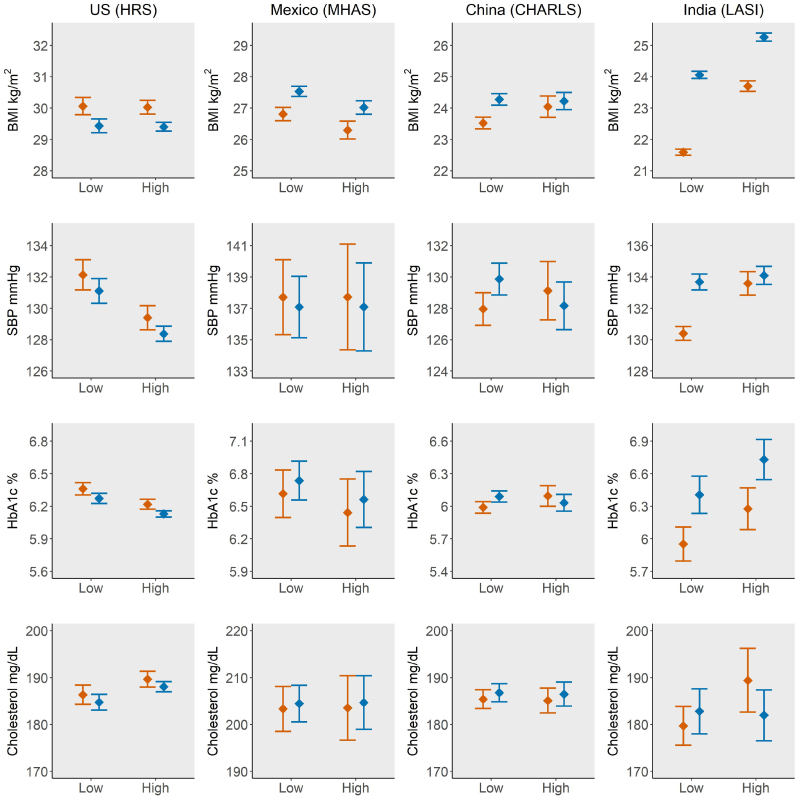
The proportion of individuals with higher education was 82.6% in the US, 15.6% in Mexico, 10.6% in China, and 16.8% in India. In the US, higher education was associated with lower SBP (-2.74 mmHg, 95% CI: -3.62, -1.86) and HbA1c (-0.14%, 95% CI: -0.20, -0.08), but higher total cholesterol (3.33 mg/dL, 95% CI: 1.41, 5.25). In Mexico, higher education was associated with lower BMI only (-0.51 kg/m, 95% CI: -0.76, -0.26). In China, higher education was not associated with any biomarker. In India, higher education was associated with higher BMI (1.61 kg/m, 95% CI: 1.49, 1.73), SBP (1.67 mmHg, 95% CI: 1.16, 2.18), and HbA1c (0.35%, 95% CI: 0.19, 0.51). The association between education and cardiometabolic biomarkers was modified by urbanicity in China and India but not in the US or Mexico. In both China and India, relationships between education and cardiometabolic biomarkers were stronger among rural residents compared to those among urban residents. Results based on relative education attainment showed similar patterns in terms of the direction of the effect estimates, despite some discrepancies in statistical significance.
There is a complex relationship between education and cardiometabolic biomarkers across countries and by urbanicity of residence. This complexity underscores the importance of accounting for contextual factors when devising strategies to enhance cardiometabolic health in various settings.
教育与心脏代谢生物标志物之间的关系在不同国家和同一国家内部的因素方面都存在背景依赖性。本研究旨在探讨美国、墨西哥、中国和印度中老年成年人在心脏代谢生物标志物方面的教育差异,以及这种关系是否会因居住城市程度而有所改变。
数据来自美国健康与退休研究(HRS;2016/17年,n = 19,608)、墨西哥健康与老龄化研究(MHAS;2015年,n = 12,356)、中国健康与养老追踪调查(CHARLS;2015/16年,n = 13,268)以及印度纵向老龄化研究(LASI;2017/19年,n = 47,838)的当代横断面数据。为了考虑四个国家教育分布的显著差异,我们通过两种方式衡量教育程度:将教育水平分类为二元类别(“低教育水平:初中及以下”与“高教育水平:高中及以上”)以评估绝对教育程度,并使用国家内部百分位数排名来获取相对教育程度。我们评估了四种心脏代谢生物标志物的教育差异:体重指数(BMI)、收缩压(SBP)、糖化血红蛋白(HbA1c)和总胆固醇。我们测试了居住城市程度是否改变了教育与这些心脏代谢生物标志物之间的关系。
美国高等教育人群的比例为82.6%,墨西哥为15.6%,中国为10.6%,印度为16.8%。在美国,高等教育与较低的收缩压(-2.74 mmHg,95%置信区间:-3.62,-1.86)和糖化血红蛋白(-0.14%,95%置信区间:-0.20,-0.08)相关,但与较高的总胆固醇(3.33 mg/dL,95%置信区间:1.41,5.25)相关。在墨西哥,高等教育仅与较低的体重指数相关(-0.51 kg/m,95%置信区间:-0.76,-0.26)。在中国,高等教育与任何生物标志物均无关联。在印度,高等教育与较高的体重指数(1.61 kg/m,95%置信区间:1.49,1.73)、收缩压(1.67 mmHg,95%置信区间:1.16,2.18)和糖化血红蛋白(0.35%,95%置信区间:0.19,0.51)相关。在中国和印度,教育与心脏代谢生物标志物之间的关联因城市程度而改变,但在美国和墨西哥则不然。在中国和印度,农村居民中教育与心脏代谢生物标志物之间的关系比城市居民更强。基于相对教育程度的结果在效应估计方向上显示出相似的模式,尽管在统计显著性上存在一些差异。
不同国家以及不同居住城市程度下,教育与心脏代谢生物标志物之间存在复杂的关系。这种复杂性凸显了在设计各种环境中促进心脏代谢健康的策略时考虑背景因素的重要性。