Hou Yuhuang, Michiels Joris, Kerschaver Céline V, Vandaele Mario, Majdeddin Maryam, Vossen Els, Degroote Jeroen
Laboratory of Animal Nutrition and Animal Product Quality (LANUPRO), Department of Animal Sciences and Aquatic Ecology, Ghent University, Ghent, Belgium.
Front Vet Sci. 2023 Aug 10;10:1220213. doi: 10.3389/fvets.2023.1220213. eCollection 2023.
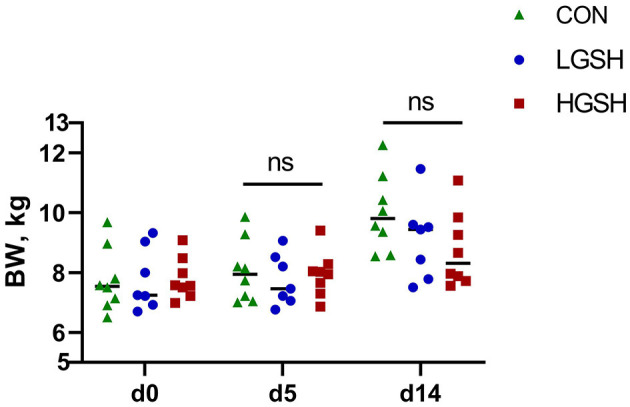
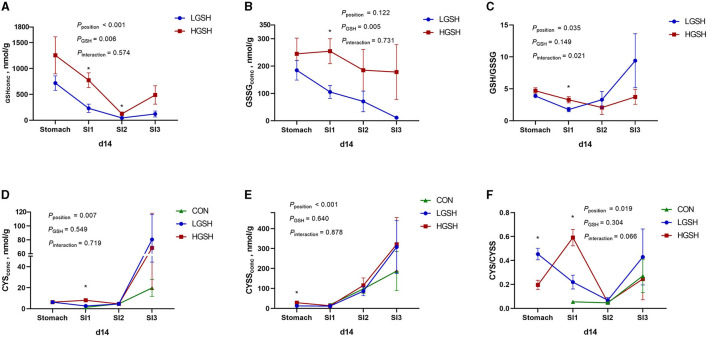
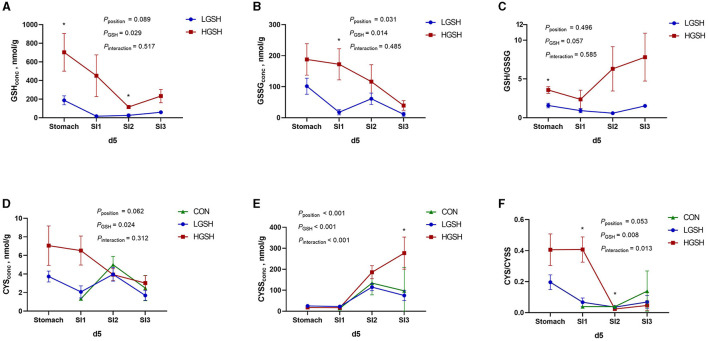
This study aimed to investigate the kinetics of dietary GSH in the gastrointestinal tract and the effect of GSH on the intestinal redox status of weaned piglets. Forty-eight piglets with an average age of 26 days and an average body weight of 7.7 kg were used in this study. The piglets were divided into three treatment groups including the control group with a basal diet (CON) and two GSH groups with a basal diet supplemented with 0.1% GSH (LGSH) and 1.0% GSH (HGSH), respectively. The basal diet did not contain any GSH. The experiment lasted for 14 days, with eight animals sampled from each group on d5 and 14. The parts of 0-5%, 5-75%, and 75-100% of the length of the small intestine were assigned to SI1, SI2, and SI3. The results showed that GSH almost completely disappeared from the digesta at SI2. However, no difference in the GSH level in mucosa, liver, and blood erythrocytes was found. The level of cysteine (CYS) in SI1 digesta was significantly higher in HGSH than CON and LGSH on d14, and similar findings were observed for cystine (CYSS) in SI3 digesta on d5. The CYSS level in HGSH was also significantly higher than LGSH in the stomach on d14, while no CYS or CYSS was detected in the stomach for control animals, indicating the breakdown of GSH to CYS already occurred in the stomach. Irrespective of the dietary treatment, the CYS level on d14 and the CYSS level on d5 and 14 were increased when moving more distally into the gastrointestinal tract. Furthermore, the mucosal CYS level was significantly increased at SI1 in the LGSH and HGSH group compared with CON on d5. Glutathione disulfide (GSSG) was recovered in the diets and digesta from the LGSH and HGSH group, which could demonstrate the auto-oxidation of GSH. It is, therefore, concluded that GSH supplementation could not increase the small intestinal mucosal GSH level of weaned piglets, and this could potentially relate to the kinetics of GSH in the digestive tract, where GSH seemed to be prone to the breakdown to CYS and CYSS and the auto-oxidation to GSSG.
本研究旨在探究日粮谷胱甘肽(GSH)在胃肠道中的动力学变化以及GSH对断奶仔猪肠道氧化还原状态的影响。本研究选用了48头平均日龄26天、平均体重7.7千克的仔猪。仔猪被分为三个处理组,包括基础日粮对照组(CON)以及分别添加0.1% GSH的低剂量GSH组(LGSH)和添加1.0% GSH的高剂量GSH组(HGSH)。基础日粮中不含任何GSH。试验持续14天,在第5天和第14天从每组中选取8只动物进行采样。将小肠长度的0 - 5%、5 - 75%和75 - 100%部分分别指定为SI1、SI2和SI3。结果表明,在SI2处,GSH几乎从消化物中完全消失。然而,在黏膜、肝脏和血液红细胞中的GSH水平未发现差异。在第14天,HGSH组SI1消化物中的半胱氨酸(CYS)水平显著高于CON组和LGSH组,并且在第5天,SI3消化物中的胱氨酸(CYSS)也有类似发现。在第14天,HGSH组胃中的CYSS水平也显著高于LGSH组,而对照组动物的胃中未检测到CYS或CYSS,这表明在胃中已经发生了GSH向CYS的分解。无论日粮处理如何,在胃肠道中越向远端移动,第14天的CYS水平以及第5天和第14天的CYSS水平都会升高。此外,在第5天,LGSH组和HGSH组SI1处的黏膜CYS水平与CON组相比显著升高。在LGSH组和HGSH组的日粮和消化物中检测到了谷胱甘肽二硫化物(GSSG),这可以证明GSH的自动氧化。因此,得出结论,补充GSH不能提高断奶仔猪小肠黏膜GSH水平,这可能与GSH在消化道中的动力学变化有关,在消化道中GSH似乎易于分解为CYS和CYSS以及自动氧化为GSSG。