Agriculture and Agri-Food Canada, Sherbrooke Research and Development Centre, Sherbrooke, Quebec, Canada.
Department of Animal Science, Universidade Estadual de Londrina, Londrina, Paraná, Brazil.
PLoS One. 2021 Feb 19;16(2):e0247188. doi: 10.1371/journal.pone.0247188. eCollection 2021.
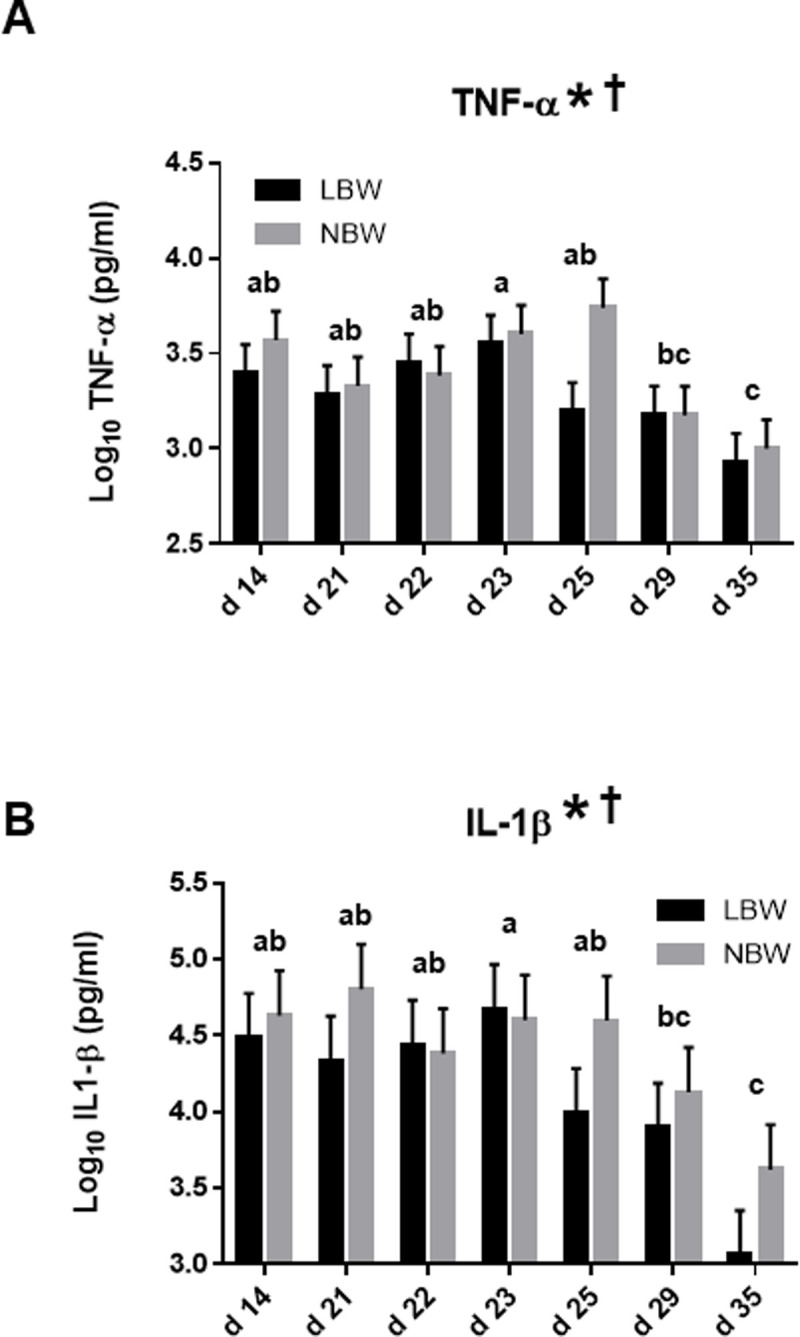
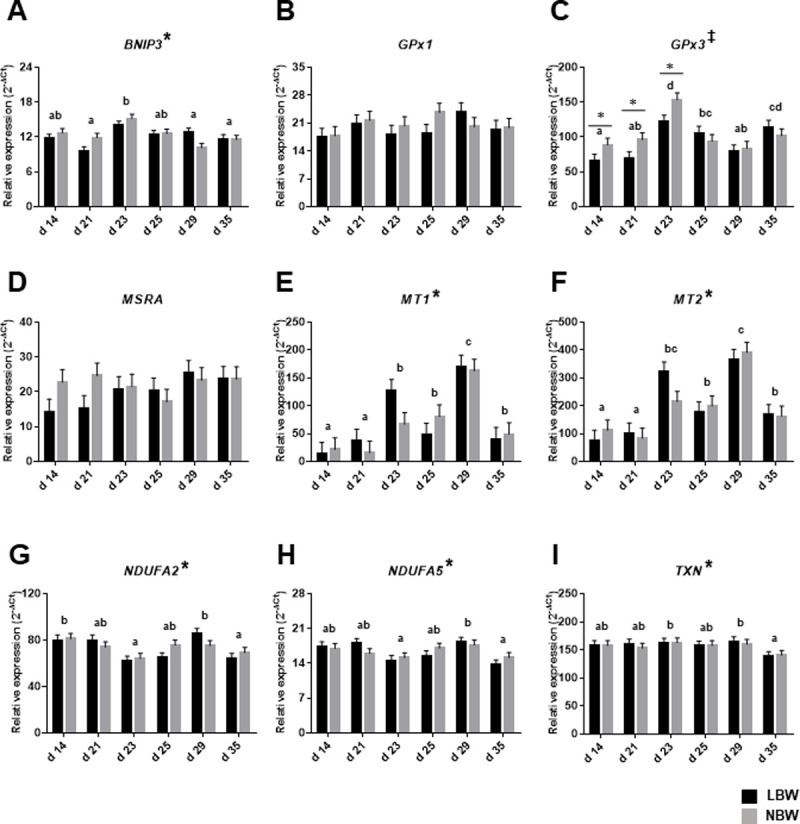
Weaning is associated with increased occurrence of infections and diseases in piglets. Recent findings indicate that weaning induces mitochondrial dysfunction and oxidative stress conditions that more severely impact smaller piglets. The objective of this study was to characterize the molecular mechanisms underlying these physiological consequences and the relation with systemic inflammatory status in both normal and low birth weight (NBW and LBW) piglets throughout the peri-weaning period. To conduct the study, 30 sows were inseminated, and specific piglets from their litters were assigned to one of two experimental groups: NBW (n = 60, 1.73 ± 0.01 kg,) and LBW piglets weighing less than 1.2 kg (n = 60, 1.01 ± 0.01 kg). Then, 10 piglets from each group were selected at 14, 21 (weaning), 23, 25, 29 and 35 days of age to collect organ and plasma samples. Specific porcine RT2 Profiler™ PCR Arrays related to mitochondrial function, oxidative stress, inflammation and apoptosis processes were first used to target genes that are modulated after weaning in NBW piglets (d 23 and d 35 vs. d 14). Expression of selected genes was evaluated by quantitative PCR. These analyses revealed that expression of inflammatory genes CXCL10 and CCL19 increased after weaning in intestinal mucosa, while expression of genes encoding subunits of the mitochondrial respiratory chain was downregulated in liver and kidney of both groups. Interestingly, major modulators of mitophagy (BNIP3), cell survival (BCL2A1) and antioxidant defense system (TXNRD2, GPx3, HMOX1) were found to be highly expressed in NBW piglets. The systemic levels of TNF-α and IL1-β significantly increased following weaning and were higher in NBW piglets. These results provide novel information about the molecular origin of mitochondrial dysfunction and oxidative stress observed in weaned piglets and suggest that clearance of dysfunctional mitochondria, antioxidant defenses and inflammatory response are compromised in LBW piglets.
断奶与仔猪感染和疾病的发生率增加有关。最近的研究结果表明,断奶会导致线粒体功能障碍和氧化应激,而这些变化对较小的仔猪影响更为严重。本研究的目的是描述这些生理后果的分子机制,并研究其与正常和低出生体重(NBW 和 LBW)仔猪在断奶期间全身炎症状态的关系。为了进行这项研究,30 头母猪接受了人工授精,然后根据其产仔情况将特定的仔猪分配到两个实验组之一:NBW(n=60,体重 1.73±0.01kg)和体重低于 1.2kg 的 LBW 仔猪(n=60,体重 1.01±0.01kg)。然后,在 14、21 天(断奶)、23、25、29 和 35 天时,每组选择 10 头仔猪采集器官和血浆样本。首先使用与线粒体功能、氧化应激、炎症和细胞凋亡过程相关的特定猪 RT2 Profiler™ PCR 阵列来确定 NBW 仔猪断奶后发生变化的基因(d23 和 d35 与 d14 相比)。通过定量 PCR 评估所选基因的表达。这些分析表明,CXCL10 和 CCL19 等炎症基因在肠道黏膜中的表达在断奶后增加,而两组肝脏和肾脏中呼吸链亚基编码基因的表达均下调。有趣的是,发现自噬(BNIP3)、细胞存活(BCL2A1)和抗氧化防御系统(TXNRD2、GPx3、HMOX1)的主要调节剂在 NBW 仔猪中高表达。断奶后,TNF-α 和 IL1-β 的全身水平显著增加,且在 NBW 仔猪中更高。这些结果提供了有关断奶仔猪观察到的线粒体功能障碍和氧化应激的分子起源的新信息,并表明 LBW 仔猪清除功能失调的线粒体、抗氧化防御和炎症反应的能力受损。