Dam Tien, Pagano Gennaro, Brumm Michael C, Gochanour Caroline, Poston Kathleen L, Weintraub Daniel, Chahine Lana M, Coffey Christopher, Tanner Caroline M, Kopil Catherine M, Xiao Yuge, Chowdhury Sohini, Concha-Marambio Luis, DiBiaso Peter, Foroud Tatiana, Frasier Mark, Jennings Danna, Kieburtz Karl, Merchant Kalpana, Mollenhauer Brit, Montine Thomas J, Nudelman Kelly, Seibyl John, Sherer Todd, Singleton Andrew, Stephenson Diane, Stern Matthew, Soto Claudio, Tolosa Eduardo, Siderowf Andrew, Dunn Billy, Simuni Tanya, Marek Kenneth
Biogen, Boston, MA, USA.
F. Hoffmann-La Roche Ltd., Basel, Switzerland.
NPJ Parkinsons Dis. 2024 Sep 27;10(1):178. doi: 10.1038/s41531-024-00789-w.
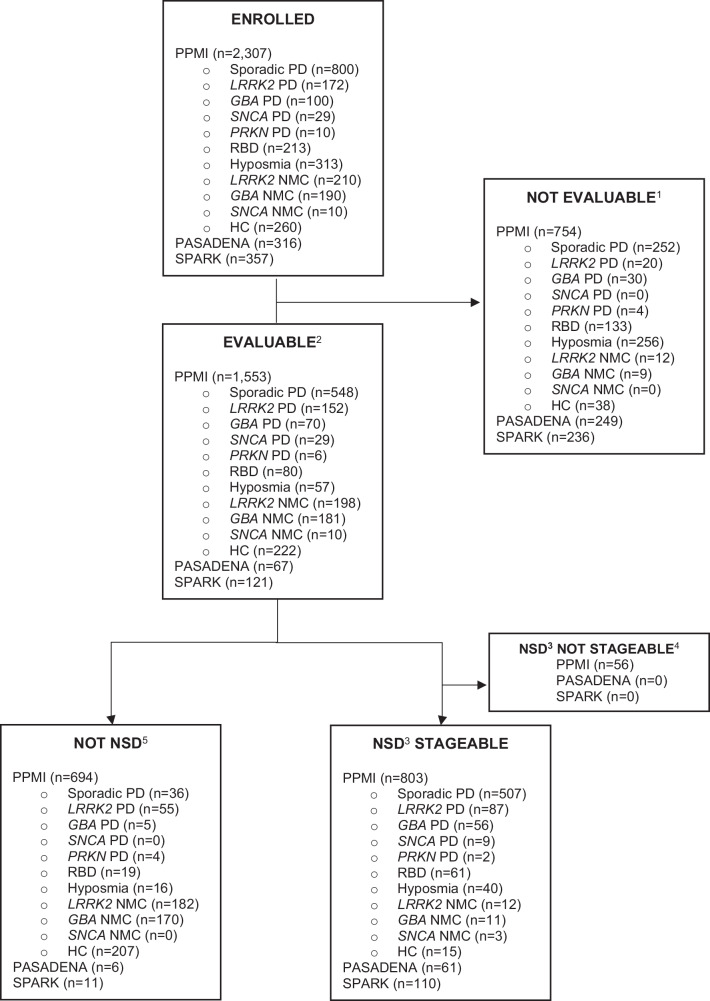
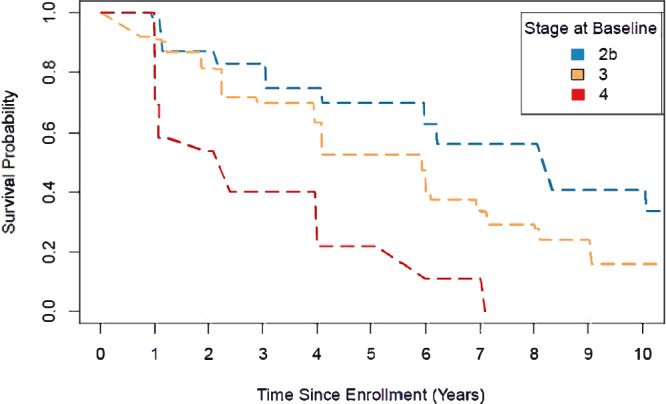
The Neuronal alpha-Synuclein Disease (NSD) biological definition and Integrated Staging System (NSD-ISS) provide a research framework to identify individuals with Lewy body pathology and stage them based on underlying biology and increasing degree of functional impairment. Utilizing data from the PPMI, PASADENA, and SPARK studies, we developed and applied biologic and clinical data-informed definitions for the NSD-ISS across the disease continuum. Individuals enrolled as Parkinson's disease, Prodromal, or Healthy Controls were defined and staged based on biological, clinical, and functional anchors at baseline. Across the three studies 1741 participants had SAA data and of these 1030 (59%) were S+ consistent with NSD. Among sporadic PD, 683/736 (93%) were NSD, and the distribution for Stages 2B, 3, and 4 was 25%, 63%, and 9%, respectively. Median (95% CI) time to developing a clinically meaningful outcome was 8.3 (6.2, 10.1), 5.9 (4.1, 6.0), and 2.4 (1.0, 4.0) years for baseline stage 2B, 3, and 4, respectively. We propose pilot biologic and clinical anchors for NSD-ISS. Our results highlight the baseline heterogeneity of individuals currently defined as early PD. Baseline stage predicts time to progression to clinically meaningful milestones. Further research on validation of the anchors in longitudinal cohorts is necessary.
神经元α-突触核蛋白病(NSD)的生物学定义和综合分期系统(NSD-ISS)提供了一个研究框架,用于识别患有路易体病理的个体,并根据潜在生物学特征和功能损害程度的增加对其进行分期。利用帕金森病进展标记物倡议(PPMI)、帕萨迪纳(PASADENA)和Spark研究的数据,我们针对疾病连续体开发并应用了基于生物学和临床数据的NSD-ISS定义。纳入帕金森病、前驱期或健康对照的个体在基线时根据生物学、临床和功能指标进行定义和分期。在这三项研究中,1741名参与者有血清淀粉样蛋白A(SAA)数据,其中1030名(59%)为S+,符合NSD。在散发性帕金森病中,683/736(93%)为NSD,2B期、3期和4期的分布分别为25%、63%和9%。基线2B期、3期和4期出现具有临床意义结局的中位(95%CI)时间分别为8.3(6.2,10.1)年、5.9(4.1,6.0)年和2.4(1.0,4.0)年。我们提出了NSD-ISS的试验性生物学和临床指标。我们的结果突出了目前定义为早期帕金森病个体的基线异质性。基线分期可预测进展到具有临床意义里程碑的时间。有必要对纵向队列中的指标进行进一步验证研究。