Cruz Roja Colombiana-Seccional Cundinamarca-Bogotá, Grupo de Investigación Emergencias, Desastres y Ayuda Humanitaria, Cruz Roja Cundinamarca y Bogotá, USA.
Grupo de Investigación COMPLEXUS (FUNDCLAS), Colombia.
Ann Glob Health. 2023 Aug 22;89(1):54. doi: 10.5334/aogh.3963. eCollection 2023.
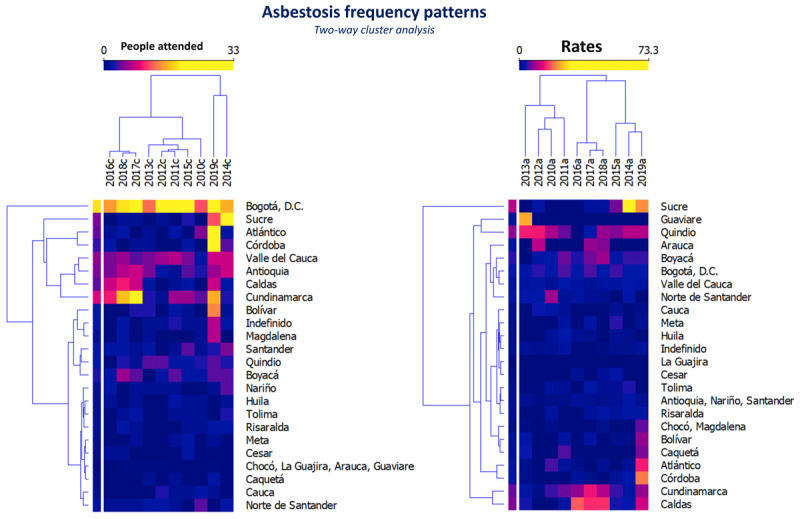
Asbestosis is a prevalent worldwide problem, but scarce data sourced from developing countries are available. We describe the sociodemographic characteristics and patterns in the occurrence of care provided for asbestosis in Colombia during the periods 2010-2014 and 2015-2019 to establish the behavior, trends, and variables associated with concentrations among people attended by asbestosis.
A retrospective descriptive study was carried out with data from the Integrated Social Protection Information System (SISPRO) for two 5-year periods. People attended by asbestosis (ICD-10: J61) were identified; the frequency of patient visits, sociodemographic characteristics, case distribution patterns, and trends in both five-year periods were described, as was the crude frequency (cFr, 95% CI) of asbestosis (1,000,000 people/year) in both five-year periods (cFr ratio, 95% CI).
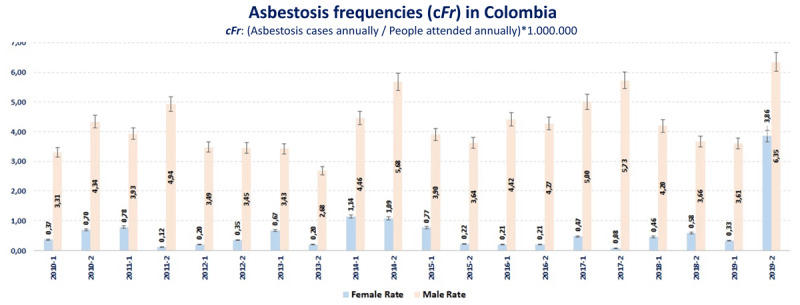
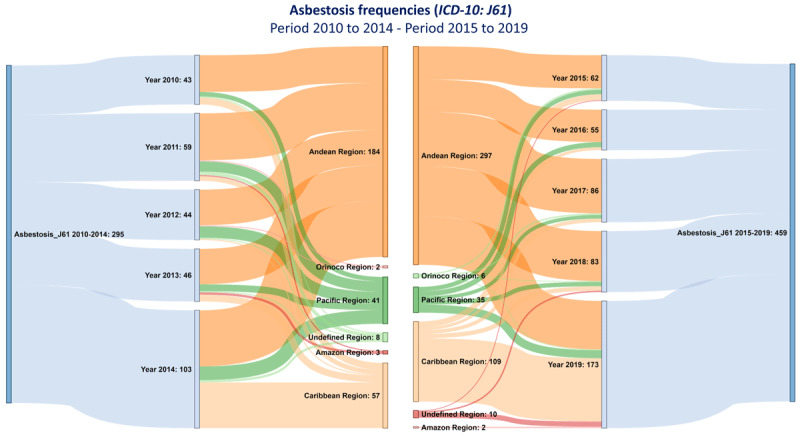
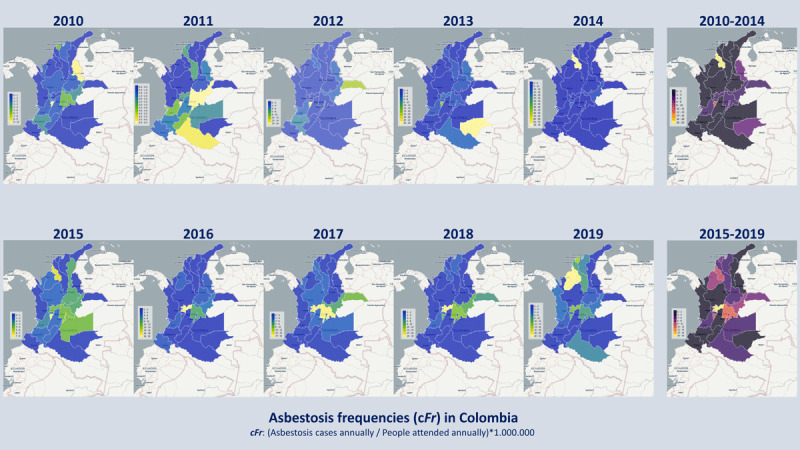
During the period 2010-2019, 765 people attended by asbestosis were identified; there were 308 people attended by asbestosis between 2010-2014 (cFr: 2.20, 1.96-2.47), and ther were 457 people attended by asbestos between 2015-2019 (cFr: 3.14, 2.92-3.50). In both periods, the estimated cFr in men was nine times the estimated cFr in women. The cFr increased in the 2015-2019 period (cFr_ratio: 1.23, 1.06-1.43). Compared with the 2010-2014 period, the cFr of asbestosis increased in women (cFr_ratio: 1.44, 1.03-2.01), in the Andean (cFr_ratio: 1.61, 1.35-1.95) and Caribbean regions (cFr_ratio: 1. 66, 1.21-2.30), in the urban area (cFr_ratio: 1.24, 1.05-1.48), and in the age groups 45-59 years (cFr_ratio: 1.34, 1.001-1.79) and ≥60 years (cFr_ratio: 1.43, 1.13-1.83).
During two five-year periods, the cFr of asbestosis was higher in men; between the first and second five-year periods, it increased significantly, especially in urbanized geographic areas and in populations aged ≥45 years. The estimates possibly reflect the effect of disease latency or the expected impact of public health policies to monitor asbestos exposure and complications.
石棉沉着病是一种在全球范围内普遍存在的问题,但来自发展中国家的相关数据却十分匮乏。本研究旨在描述哥伦比亚在 2010-2014 年和 2015-2019 年期间针对石棉沉着病提供的护理服务的社会人口统计学特征和发生模式,以确定人群中与石棉沉着病相关的行为、趋势和变量。
采用回顾性描述性研究方法,利用两个 5 年期间综合社会保护信息系统(SISPRO)的数据。确定患有石棉沉着病(ICD-10:J61)的患者;描述患者就诊频率、社会人口统计学特征、病例分布模式以及两个 5 年期间的趋势,以及两个 5 年期间石棉沉着病的粗频率(cFr,95%CI)(cFr 比,95%CI)。
在 2010-2019 年期间,共发现 765 例石棉沉着病患者;2010-2014 年期间有 308 例石棉沉着病患者(cFr:2.20,1.96-2.47),2015-2019 年期间有 457 例石棉沉着病患者(cFr:3.14,2.92-3.50)。在两个时期,男性的估计 cFr 均是女性的九倍。在 2015-2019 年期间,cFr 增加(cFr 比:1.23,1.06-1.43)。与 2010-2014 年相比,女性的石棉沉着病 cFr 增加(cFr 比:1.44,1.03-2.01),在安第斯地区(cFr 比:1.61,1.35-1.95)和加勒比地区(cFr 比:1.66,1.21-2.30),在城市地区(cFr 比:1.24,1.05-1.48),以及在 45-59 岁年龄组(cFr 比:1.34,1.001-1.79)和≥60 岁年龄组(cFr 比:1.43,1.13-1.83)。
在两个 5 年期间,男性的石棉沉着病 cFr 更高;在第一和第二个 5 年期间,cFr 显著增加,尤其是在城市化地区和≥45 岁的人群中。这些估计可能反映了疾病潜伏期的影响,或者公共卫生政策监测石棉暴露和并发症的预期影响。