Cloots Kristien, Singh Om Prakash, Singh Abhishek Kumar, Kushwaha Anurag Kumar, Malaviya Paritosh, Kansal Sangeeta, Hasker Epco, Sundar Shyam
Unit of Mycobacterial Diseases and Neglected Tropical Diseases, Department of Public Health, Institute of Tropical Medicine, 2000 Antwerp, Belgium.
Department of Biochemistry, Institute of Science, Banaras Hindu University, Varanasi 221005, India.
Diagnostics (Basel). 2022 Mar 9;12(3):670. doi: 10.3390/diagnostics12030670.
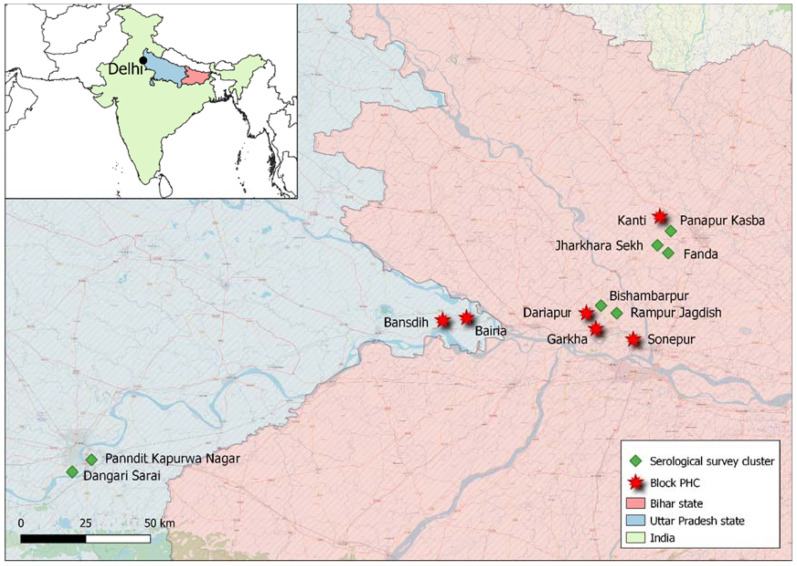
Visceral leishmaniasis (VL) is on the verge of elimination on the Indian subcontinent. Nonetheless, the currently low VL-incidence setting brings along new challenges, one of which is the validity of the diagnostic algorithm, based on a combination of suggestive clinical symptoms in combination with a positive rK39 Rapid Diagnostic Test (RDT). With this study, we aimed to assess the positive predictive value of the diagnostic algorithm in the current low-endemic setting in India by re-assessing newly diagnosed VL patients with a qPCR analysis on venous blood as the reference test. In addition, we evaluated the specificity of the rK39 RDT by testing non-VL cases with the rK39 RDT. Participants were recruited in Bihar and Uttar Pradesh, India. VL patients diagnosed based on the diagnostic algorithm were recruited through six primary health care centers (PHCs); non-VL cases were identified through a door-to-door survey in currently endemic, previously endemic, and non-endemic clusters, and tested with rK39 RDT, as well as-if positive-with qPCR on peripheral blood. We found that 95% (70/74; 95% CI 87-99%) of incident VL cases diagnosed at the PHC level using the current diagnostic algorithm were confirmed by qPCR. Among 15,422 non-VL cases, 39 were rK39 RDT positive, reflecting a specificity of the test of 99.7% (95% CI 99.7-99.8%). The current diagnostic algorithm combining suggestive clinical features with a positive rK39 RDT still seems valid in the current low-endemic setting in India.
内脏利什曼病(VL)在印度次大陆已处于消除的边缘。尽管如此,当前较低的VL发病率带来了新的挑战,其中之一是基于提示性临床症状与rK39快速诊断试验(RDT)阳性相结合的诊断算法的有效性。在本研究中,我们旨在通过对新诊断的VL患者进行静脉血qPCR分析作为参考试验,重新评估当前印度低流行环境下诊断算法的阳性预测值。此外,我们通过用rK39 RDT检测非VL病例来评估rK39 RDT的特异性。研究对象在印度比哈尔邦和北方邦招募。基于诊断算法诊断的VL患者通过六个初级卫生保健中心(PHC)招募;非VL病例通过在当前流行、既往流行和非流行地区进行挨家挨户调查来确定,并用rK39 RDT进行检测,如果呈阳性,则对外周血进行qPCR检测。我们发现,使用当前诊断算法在初级卫生保健中心层面诊断的新发VL病例中,95%(70/74;95%可信区间87-99%)经qPCR确认。在15422例非VL病例中,39例rK39 RDT呈阳性,该检测的特异性为99.7%(95%可信区间99.7-99.8%)。目前将提示性临床特征与rK39 RDT阳性相结合的诊断算法在当前印度低流行环境下似乎仍然有效。