
针对内脏利什曼病免疫力的发展与维持。
The development and maintenance of immunity against visceral leishmaniasis.
作者信息
Tiwari Rahul, Kumar Awnish, Singh Vishal Kumar, Chauhan Shashi Bhushan, Sundar Shyam, Nylén Susanne, Engwerda Christian, Kumar Rajiv
机构信息
Centre of Experimental Medicine and Surgery, Institute of Medical Sciences, Banaras Hindu University, Varanasi, India.
Department of Medicine, Institute of Medical Sciences, Banaras Hindu University, Varanasi, India.
出版信息
Front Immunol. 2024 Dec 9;15:1486407. doi: 10.3389/fimmu.2024.1486407. eCollection 2024.
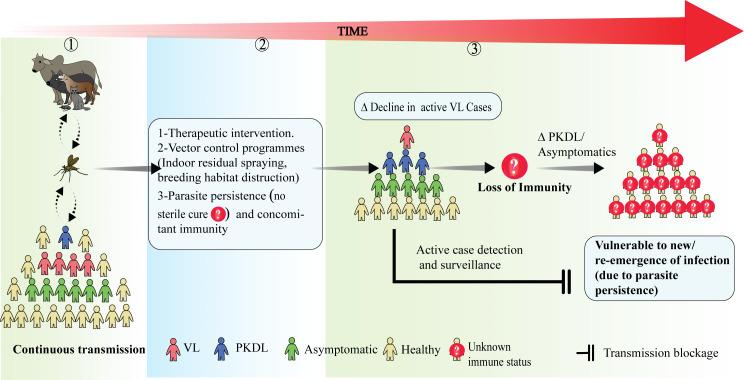
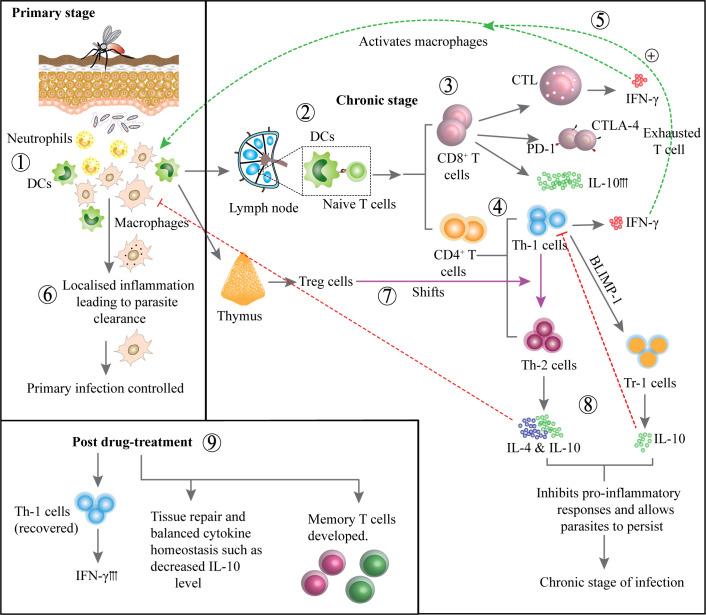
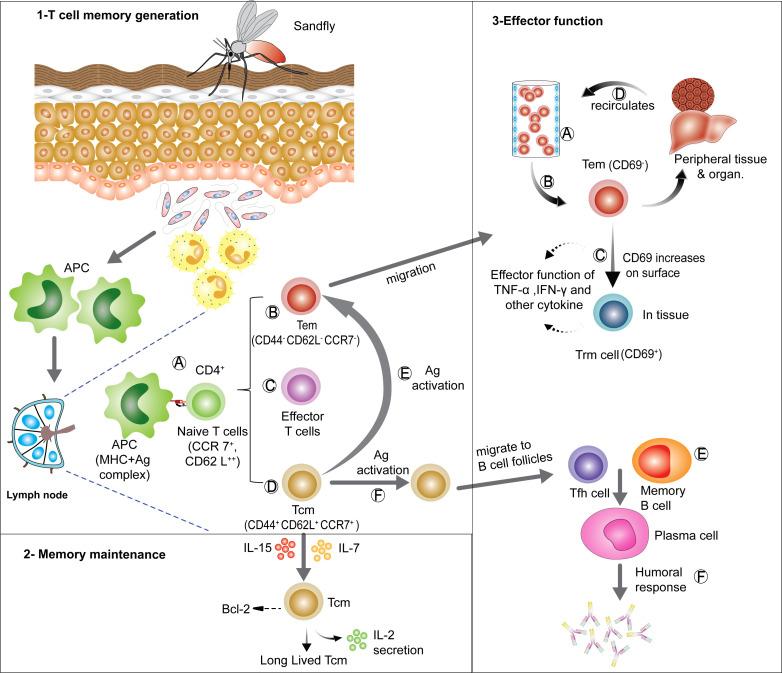
Understanding the development and maintenance of immunological memory is important for efforts to eliminate parasitic diseases like leishmaniasis. Leishmaniasis encompasses a range of pathologies, resulting from infection with protozoan parasites belonging to the subgenera and of the genus A striking feature of these infections is that natural or drug-mediated cure of infection generally confers life-long protection against disease. The generation of protective T cell responses are necessary to control infections. CD4 T helper (Th) cells orchestrate immune responses in leishmaniasis and IFNγ Tbet CD4 T (Th1) cells are required for the activation of phagocytes to kill captured or resident parasites, while other Th cell subset, including FoxP3 natural regulatory T cells and Th2 cells can promote disease progression by suppressing the activities of Th1 cells. Upon resolution of a primary infection, different subsets of CD4 T cells, including tissue-resident memory T cells, effector memory T cells, central memory T cells, and short-lived effector T cells, help to confer resistance against reinfection. To maintain long-term protective specific CD4 T cells responses, it is believed that persistent parasites or re-exposure to parasites at regular intervals is required (concomitant immunity). Despite the advances in our understanding about the immune responses during leishmaniasis, the generation of long-lasting protective immunity via vaccination has yet to be achieved. In this review, we summarize our current understanding about the formation and maintenance of immunological memory and control of leishmaniasis at the individual and population level. We will focus on Indian visceral leishmaniasis and discuss T cell responses that contribute to susceptibility to leishmaniasis, parasite persistence in populations and the environment, as well as describing advances in the development of leishmaniasis vaccines aimed at inducing protective CD4 T cell responses.
了解免疫记忆的形成和维持对于消除利什曼病等寄生虫病的努力至关重要。利什曼病包括一系列病理状况,由属于利什曼原虫属亚属和的原生动物寄生虫感染引起。这些感染的一个显著特征是,自然治愈或药物介导的感染治愈通常能赋予对疾病的终身保护。产生保护性T细胞反应对于控制利什曼原虫感染是必要的。CD4辅助性T(Th)细胞在利什曼病中协调免疫反应,IFNγ+Tbet+CD4+T(Th1)细胞是激活吞噬细胞以杀死捕获的或驻留的寄生虫所必需的,而其他Th细胞亚群,包括FoxP3自然调节性T细胞和Th2细胞,可以通过抑制Th1细胞的活性来促进疾病进展。在原发性利什曼原虫感染消退后,不同亚群的CD4+T细胞,包括组织驻留记忆T细胞、效应记忆T细胞、中枢记忆T细胞和短期效应T细胞,有助于赋予抵抗再次感染的能力。为了维持长期的保护性特异性CD4+T细胞反应,据信需要持续存在寄生虫或定期再次接触寄生虫(伴随免疫)。尽管我们对利什曼病期间免疫反应的理解取得了进展,但通过疫苗接种产生持久的保护性免疫尚未实现。在这篇综述中,我们总结了我们目前对免疫记忆的形成和维持以及在个体和群体水平上控制利什曼病的理解。我们将重点关注印度内脏利什曼病,并讨论导致易患利什曼病的T细胞反应、寄生虫在人群和环境中的持续存在,以及描述旨在诱导保护性CD4+T细胞反应的利什曼病疫苗开发的进展。
 Zotero 插件