Naritsuka Masahiro, Benedičič Izidor, Rhodes Luke C, Marques Carolina A, Trainer Christopher, Li Zhiwei, Komarek Alexander C, Wahl Peter
Scottish Universities Physics Alliance, School of Physics and Astronomy, University of St Andrews, North Haugh, St Andrews, KY16 9SS, United Kingdom.
Max Planck Institute for Chemical Physics of Solids, Dresden 01187, Germany.
Proc Natl Acad Sci U S A. 2023 Sep 5;120(36):e2308972120. doi: 10.1073/pnas.2308972120. Epub 2023 Aug 28.
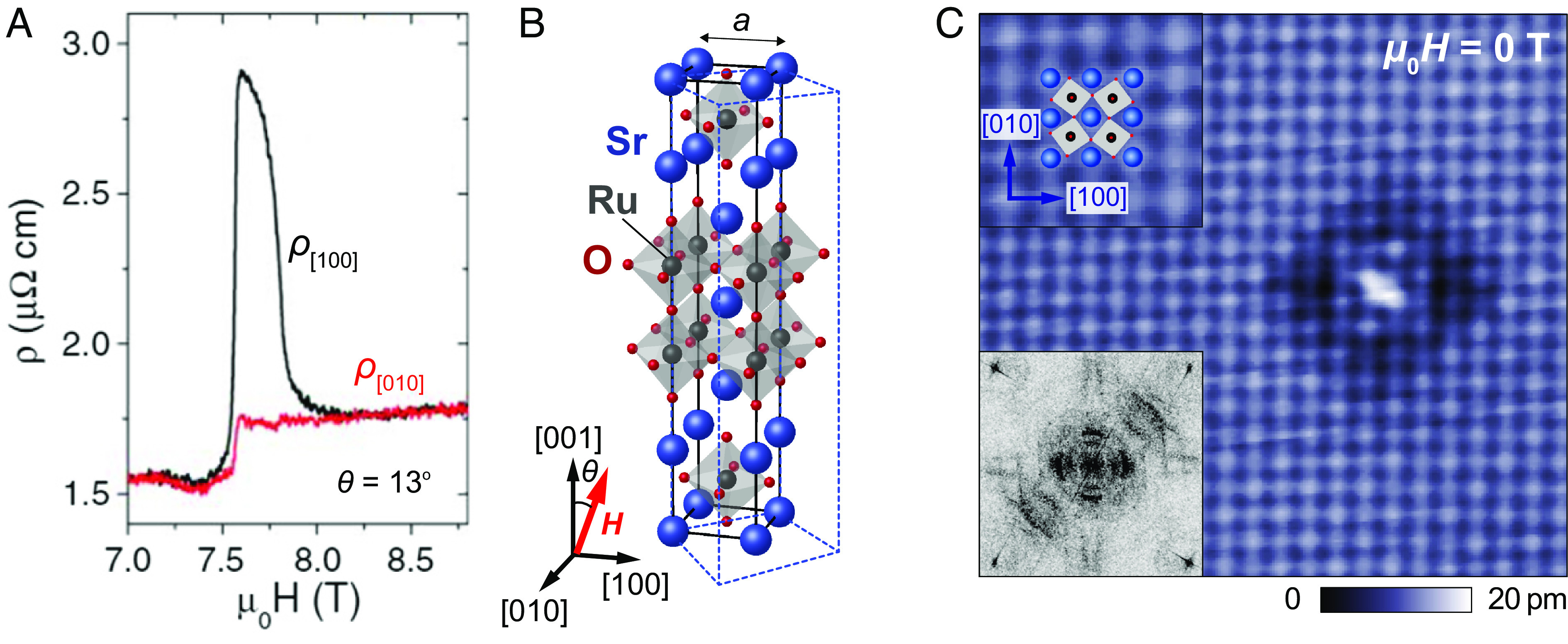
Electronic nematicity has been found in a wide range of strongly correlated electron materials, resulting in the electronic states having-4.5pc]Please note that the spelling of the following author name(s) in the manuscript differs from the spelling provided in the article metadata: Izidor Benedičič. The spelling provided in the manuscript has been retained; please confirm. a symmetry that is lower than that of the crystal that hosts them. One of the most astonishing examples is [Formula: see text], in which a small in-plane component of a magnetic field induces significant resistivity anisotropy. The direction of this anisotropy follows the direction of the in-plane field. The microscopic origin of this field-induced nematicity has been a long-standing puzzle, with recent experiments suggesting a field-induced spin density wave driving the anisotropy. Here, we report spectroscopic imaging of a field-controlled anisotropy of the electronic structure at the surface of [Formula: see text]. We track the electronic structure as a function of the direction of the field, revealing a continuous change with the angle. This continuous evolution suggests a mechanism based on spin-orbit coupling resulting in compass-like control of the electronic bands. The anisotropy of the electronic structure persists to temperatures about an order of magnitude higher compared to the bulk, demonstrating novel routes to stabilize such phases over a wider temperature range.
在众多强关联电子材料中都发现了电子向列性,这使得电子态具有一种对称性,该对称性低于承载它们的晶体的对称性。最令人惊讶的例子之一是[化学式:见原文],其中磁场的一个小面内分量会引起显著的电阻率各向异性。这种各向异性的方向与面内场的方向一致。这种场致向列性的微观起源一直是个长期存在的谜题,近期实验表明是场致自旋密度波驱动了这种各向异性。在此,我们报道了[化学式:见原文]表面电子结构的场控各向异性的光谱成像。我们追踪电子结构随场方向的变化,揭示出其随角度的连续变化。这种连续演化表明存在一种基于自旋 - 轨道耦合的机制,导致对电子能带进行类似指南针的控制。与体材料相比,电子结构的各向异性在温度高出约一个数量级时仍持续存在,这展示了在更宽温度范围内稳定此类相的新途径。
请注意,稿件中以下作者姓名的拼写与文章元数据中提供的拼写不同:伊齐多尔·贝内迪契奇(Izidor Benedičič)。稿件中提供的拼写予以保留;请确认。