Department of Infectious Diseases, Hospital Ramón y Cajal, IRYCIS, Madrid, Spain; CIBERINFEC, Instituto de Salud Carlos III, Madrid, Spain.
Department of Infectious Diseases, Hospital Ramón y Cajal, IRYCIS, Madrid, Spain; CIBERINFEC, Instituto de Salud Carlos III, Madrid, Spain.
EBioMedicine. 2023 Sep;95:104773. doi: 10.1016/j.ebiom.2023.104773. Epub 2023 Aug 26.
While a low CD4/CD8 ratio during HIV treatment correlates with immunosenescence, its value in identifying patients at an increased risk for clinical events remains unclear.
We analyzed data from the CoRIS cohort to determine whether CD4 count, CD8 count, and CD4/CD8 ratio at year two of antiretroviral therapy (ART) could predict the risk of serious non-AIDS events (SNAEs) during the next five years. These included major adverse cardiovascular events, non-AIDS-defining malignancies, and non-accidental deaths. We used pooled logistic regression with inverse probability weighting to estimate the survival curves and cumulative risk of clinical events.
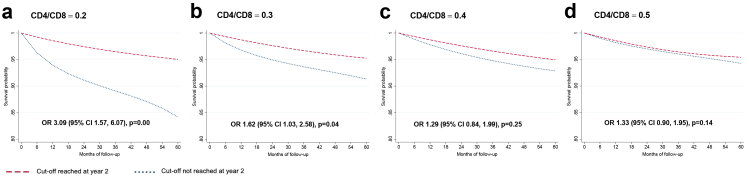
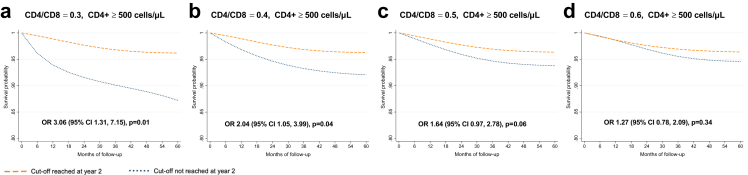
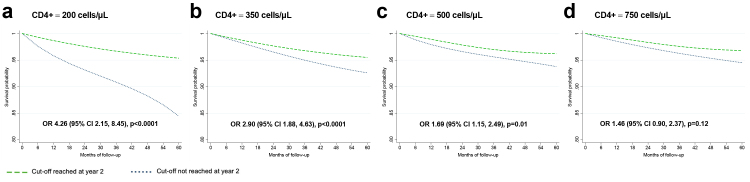
The study included 4625 participants, 83% male, of whom 200 (4.3%) experienced an SNAE during the follow-up period. A CD4/CD8 ratio <0.3 predicted an increased risk of SNAEs during the next five years (OR 1.63, 95% CI 1.03-2.58). The effect was stronger at a CD4/CD8 ratio cut-off of <0.2 (OR 3.09, 95% CI 1.57-6.07). Additionally, low CD4 count at cut-offs of <500 cells/μL predicted an increased risk of clinical events. Among participants with a CD4 count ≥500 cells/μL, a CD8 count ≥1500 cells/μL or a CD4/CD8 ratio <0.4 predicted increased SNAE risk.
Our results support the use of the CD4/CD8 ratio and CD8 count as predictors of clinical progression. Patients with CD4/CD8 ratio <0.3 or CD8 count ≥1500/μL, regardless of their CD4 count, may benefit from closer monitoring and targeted preventive interventions.
This work was supported by CIBER (CB 2021), Instituto de Salud Carlos III, Ministerio de Ciencia e Innovación and Unión Europea-NextGenerationEU; by the Spanish AIDS Research Network (RIS) RD16/0025/0001 project as part of the Plan Nacional R + D + I, and cofinanced by Instituto de Salud Carlos III (ISCIII)- Subdirección General de Evaluación y el Fondo Europeo de Desarrollo Regional (FEDER), ISCIII projects PI18/00154, PI21/00141, and ERDF, "A way to make Europe", ICI20/00058.
虽然 HIV 治疗期间的低 CD4/CD8 比值与免疫衰老相关,但它在识别发生临床事件风险增加的患者方面的价值仍不清楚。
我们分析了 CoRIS 队列的数据,以确定在抗逆转录病毒治疗(ART)的第二年,CD4 计数、CD8 计数和 CD4/CD8 比值是否可以预测未来五年内严重非艾滋病事件(SNAE)的风险。这些事件包括主要不良心血管事件、非艾滋病定义的恶性肿瘤和非意外死亡。我们使用具有逆概率加权的汇总逻辑回归来估计生存曲线和临床事件的累积风险。
该研究纳入了 4625 名参与者,其中 83%为男性,在随访期间有 200 名(4.3%)发生了 SNAE。CD4/CD8 比值<0.3 预测未来五年 SNAE 的风险增加(OR 1.63,95%CI 1.03-2.58)。CD4/CD8 比值<0.2 时的效果更强(OR 3.09,95%CI 1.57-6.07)。此外,CD4 计数<500 个/μL 的低值预示着临床事件风险增加。在 CD4 计数≥500 个/μL 的参与者中,CD8 计数≥1500 个/μL 或 CD4/CD8 比值<0.4 预示着 SNAE 风险增加。
我们的结果支持将 CD4/CD8 比值和 CD8 计数用作临床进展的预测因子。无论 CD4 计数如何,CD4/CD8 比值<0.3 或 CD8 计数≥1500/μL 的患者可能受益于更密切的监测和有针对性的预防干预。
这项工作得到了 CIBER(CB 2021)、西班牙卡洛斯三世健康研究所、西班牙科学部和欧盟的支持;作为国家 R+D+I 计划的一部分,由西班牙艾滋病研究网络(RIS)RD16/0025/0001 项目资助,并由西班牙卡洛斯三世健康研究所(ISCIII)-评估副总干事和欧洲区域发展基金(FEDER)共同资助,ISCIII 项目 PI18/00154、PI21/00141 和 ERDF,“走向欧洲的方式”,ICI20/00058。