Department of Pain Management, Cleveland Clinic, Cleveland, Ohio, USA
Neurosurgical Services, Anesthesia Pain Care Consultants, Boca Raton, Florida, USA.
Reg Anesth Pain Med. 2024 May 7;49(5):346-354. doi: 10.1136/rapm-2023-104751.
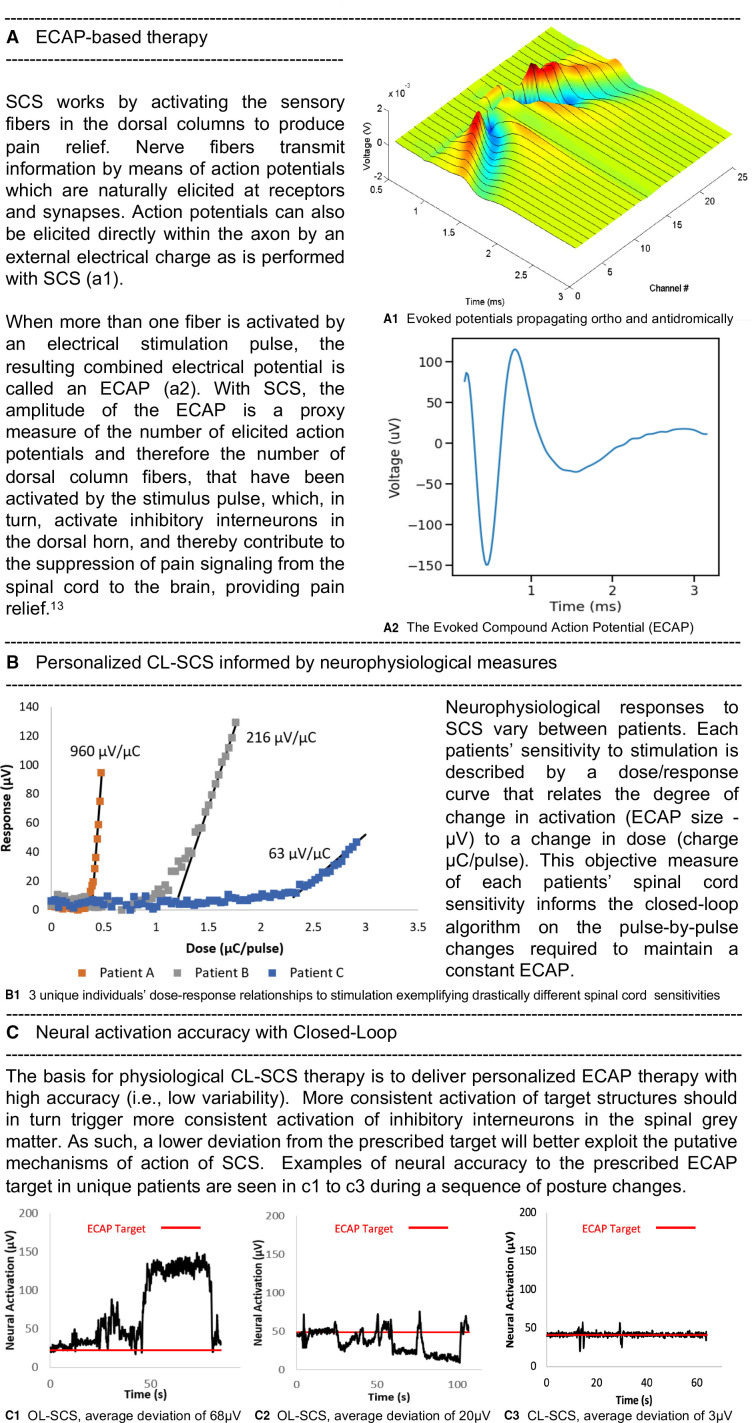
The evidence for spinal cord stimulation (SCS) has been criticized for the absence of blinded, parallel randomized controlled trials (RCTs) and limited evaluations of the long-term effects of SCS in RCTs. The aim of this study was to determine whether evoked compound action potential (ECAP)-controlled, closed-loop SCS (CL-SCS) is associated with better outcomes when compared with fixed-output, open-loop SCS (OL-SCS) 36 months following implant.
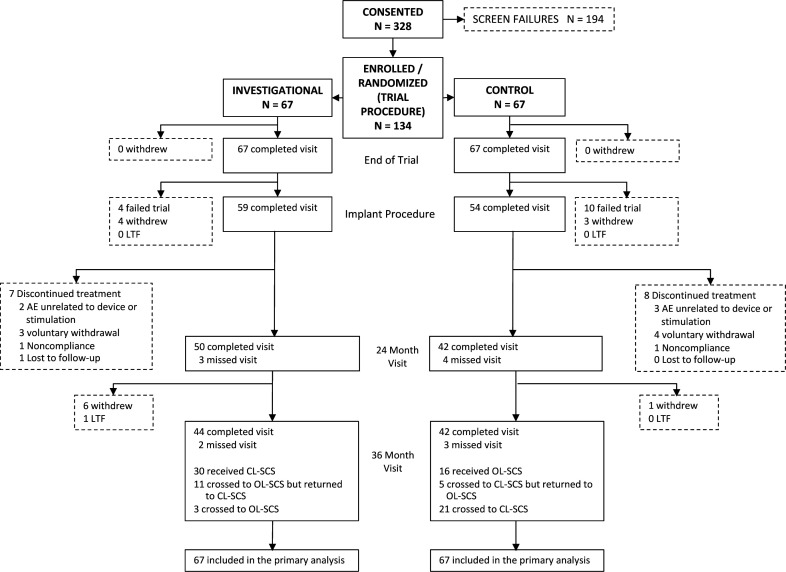
The EVOKE study was a multicenter, participant-blinded, investigator-blinded, and outcome assessor-blinded, randomized, controlled, parallel-arm clinical trial that compared ECAP-controlled CL-SCS with fixed-output OL-SCS. Participants with chronic, intractable back and leg pain refractory to conservative therapy were enrolled between January 2017 and February 2018, with follow-up through 36 months. The primary outcome was a reduction of at least 50% in overall back and leg pain. Holistic treatment response, a composite outcome including pain intensity, physical and emotional functioning, sleep, and health-related quality of life, and objective neural activation was also assessed.
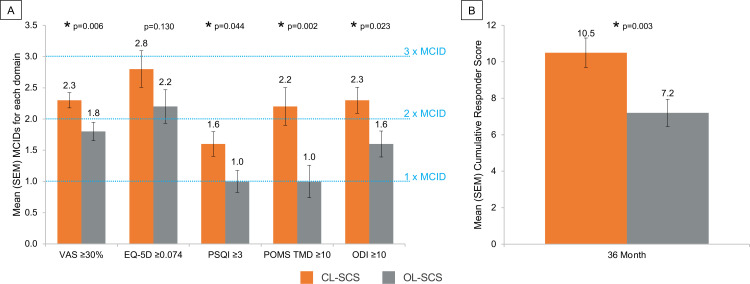
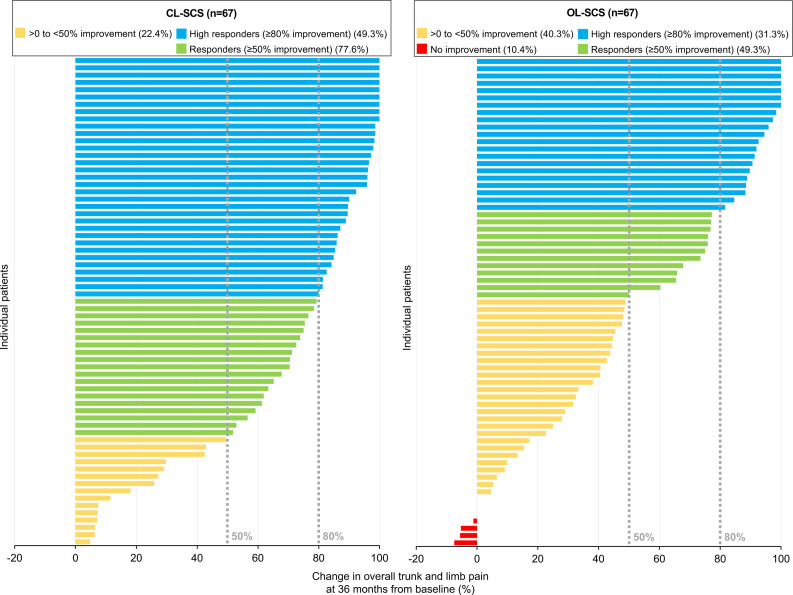
At 36 months, more CL-SCS than OL-SCS participants reported ≥50% reduction (CL-SCS=77.6%, OL-SCS=49.3%; difference: 28.4%, 95% CI 12.8% to 43.9%, p<0.001) and ≥80% reduction (CL-SCS=49.3%, OL-SCS=31.3%; difference: 17.9, 95% CI 1.6% to 34.2%, p=0.032) in overall back and leg pain intensity. Clinically meaningful improvements from baseline were observed at 36 months in both CL-SCS and OL-SCS groups in all other patient-reported outcomes with greater levels of improvement with CL-SCS. A greater proportion of patients with CL-SCS were holistic treatment responders at 36-month follow-up (44.8% vs 28.4%), with a greater cumulative responder score for CL-SCS patients. Greater neural activation and accuracy were observed with CL-SCS. There were no differences between CL-SCS and OL-SCS groups in adverse events. No explants due to loss of efficacy were observed in the CL-SCS group.
This long-term evaluation with objective measurement of SCS therapy demonstrated that ECAP-controlled CL-SCS resulted in sustained, durable pain relief and superior holistic treatment response through 36 months. Greater neural activation and increased accuracy of therapy delivery were observed with ECAP-controlled CL-SCS than OL-SCS.
NCT02924129.
脊髓刺激(SCS)的证据因缺乏盲法、平行随机对照试验(RCT)以及对 RCT 中 SCS 长期效果的有限评估而受到批评。本研究旨在确定与固定输出的开放式 SCS(OL-SCS)相比,在植入后 36 个月时,诱发电位复合动作电位(ECAP)控制的闭环 SCS(CL-SCS)是否与更好的结果相关。
EVOKE 研究是一项多中心、参与者盲法、研究者盲法和结局评估者盲法、随机、对照、平行臂临床试验,比较了 ECAP 控制的 CL-SCS 与固定输出的 OL-SCS。2017 年 1 月至 2018 年 2 月期间,纳入接受保守治疗无效的慢性、难治性背痛和腿痛的参与者,随访至 36 个月。主要结局是总体背痛和腿痛减轻至少 50%。还评估了综合治疗反应,这是一个包括疼痛强度、身体和情绪功能、睡眠和健康相关生活质量以及客观神经激活的复合结局。
在 36 个月时,CL-SCS 组比 OL-SCS 组报告的≥50%缓解率更高(CL-SCS=77.6%,OL-SCS=49.3%;差异:28.4%,95%CI 12.8%至 43.9%,p<0.001)和≥80%缓解率(CL-SCS=49.3%,OL-SCS=31.3%;差异:17.9,95%CI 1.6%至 34.2%,p=0.032)。在 36 个月时,CL-SCS 和 OL-SCS 组在所有其他患者报告的结局中均观察到与基线相比有临床意义的改善,CL-SCS 组的改善程度更大。在 36 个月的随访中,CL-SCS 组中有更多的患者是综合治疗应答者(44.8%比 28.4%),CL-SCS 患者的累积应答者评分更高。与 OL-SCS 组相比,CL-SCS 组观察到更大的神经激活和准确性。CL-SCS 组和 OL-SCS 组之间在不良事件方面没有差异。在 CL-SCS 组中未观察到因疗效丧失而导致的设备取出。
这项对 SCS 治疗的客观测量的长期评估表明,与固定输出的开放式 SCS(OL-SCS)相比,ECAP 控制的 CL-SCS 可在 36 个月内持续、持久地缓解疼痛,并获得更好的整体治疗反应。与 OL-SCS 相比,ECAP 控制的 CL-SCS 观察到更大的神经激活和更高的治疗准确性。
NCT02924129。