Department of Biochemistry and Interdisciplinary Centre of Excellence, Albert Szent-Györgyi Medical School, University of Szeged, 6720, Szeged, Hungary.
Department of Biochemistry, Bach Mai Hospital, Hanoi, 100000, Vietnam.
Sci Rep. 2023 Aug 28;13(1):14046. doi: 10.1038/s41598-023-41037-0.
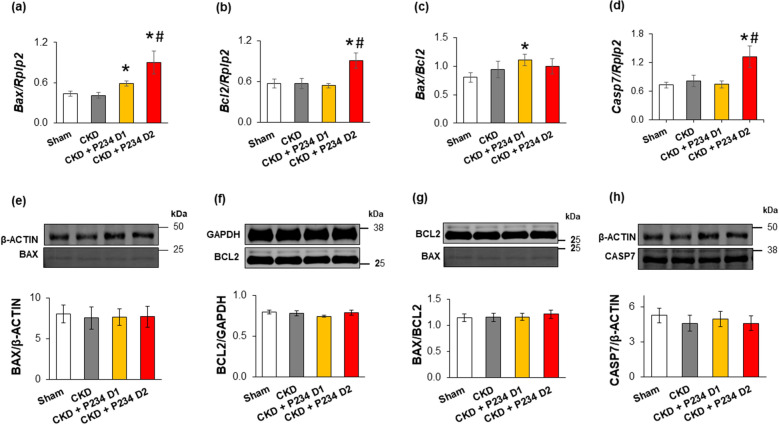
Uremic cardiomyopathy is characterized by diastolic dysfunction, left ventricular hypertrophy (LVH), and fibrosis. Dysregulation of the kisspeptin receptor (KISS1R)-mediated pathways are associated with the development of fibrosis in cancerous diseases. Here, we investigated the effects of the KISS1R antagonist peptide-234 (P234) on the development of uremic cardiomyopathy. Male Wistar rats (300-350 g) were randomized into four groups: (i) Sham, (ii) chronic kidney disease (CKD) induced by 5/6 nephrectomy, (iii) CKD treated with a lower dose of P234 (ip. 13 µg/day), (iv) CKD treated with a higher dose of P234 (ip. 26 µg/day). Treatments were administered daily from week 3 for 10 days. At week 13, the P234 administration did not influence the creatinine clearance and urinary protein excretion. However, the higher dose of P234 led to reduced anterior and posterior wall thicknesses, more severe interstitial fibrosis, and overexpression of genes associated with left ventricular remodeling (Ctgf, Tgfb, Col3a1, Mmp9), stretch (Nppa), and apoptosis (Bax, Bcl2, Casp7) compared to the CKD group. In contrast, no significant differences were found in the expressions of apoptosis-associated proteins between the groups. Our results suggest that the higher dose of P234 hastens the development and pathophysiology of uremic cardiomyopathy by activating the fibrotic TGF-β-mediated pathways.
尿毒症性心肌病的特征是舒张功能障碍、左心室肥厚(LVH)和纤维化。 kisspeptin 受体(KISS1R)介导的途径失调与癌症疾病中纤维化的发展有关。在这里,我们研究了 KISS1R 拮抗剂肽-234(P234)对尿毒症性心肌病发展的影响。雄性 Wistar 大鼠(300-350g)随机分为四组:(i)假手术组,(ii)5/6 肾切除术诱导的慢性肾脏病(CKD)组,(iii)用较低剂量 P234(腹腔注射,每天 13µg)治疗的 CKD 组,(iv)用较高剂量 P234(腹腔注射,每天 26µg)治疗的 CKD 组。治疗从第 3 周开始每天进行,持续 10 天。在第 13 周,P234 给药不影响肌酐清除率和尿蛋白排泄。然而,与 CKD 组相比,较高剂量的 P234 导致前壁和后壁厚度减小,间质纤维化更严重,与左心室重构(Ctgf、Tgfb、Col3a1、Mmp9)、伸展(Nppa)和凋亡(Bax、Bcl2、Casp7)相关的基因表达增加。相比之下,各组之间凋亡相关蛋白的表达没有明显差异。我们的结果表明,较高剂量的 P234 通过激活纤维化 TGF-β 介导的途径加速了尿毒症性心肌病的发展和病理生理学。