Zhu Xiaofeng, Cheng Kangning, Ding Yue, Liu Huanqing, Xie Shuqi, Cao Yuwei, Yue Weiwei
Shandong Province Key Laboratory of Medical Physics and Image Processing Technology, School of Physics and Electronics, Shandong Normal University, Jinan, 250358, People's Republic of China.
Discov Nano. 2023 Aug 29;18(1):106. doi: 10.1186/s11671-023-03886-6.
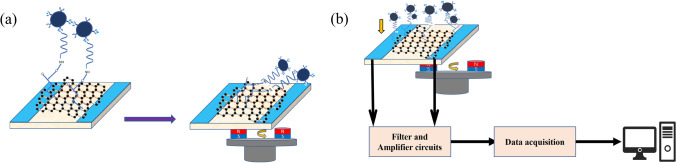
Herein, we have constructed a magnetic graphene field-effect transistor biosensor (MGFETs) for highly sensitive detection of cardiac troponin I (CTNI). Graphene films transferred to ITO conductive glass as conductive channels. CTNI aptamer was immobilized onto the graphene film via 1-pyrene-butanoic acid succinimidyl ester (PBASE) to capture CTNI. Magnetic nanobeads (MBs) modified with CTNI antibody were added to the reaction chamber to form an aptamer/CTNI/antibody/magnetic nanobeads sandwich-type complex. We found that the magnetic force exerted on the complex leads to an impedance change of the graphene film. The reason for this result is that the magnetic field exerts an influence on the MBs, causing CTNI aptamer strand to bend, resulting in a change in the distance between the double conductive layers of the graphene film surface and the test solution. With periodic sampling integration, different concentrations of CTNI can be detected with high sensitivity. Due to the stringent recognition capability and high affinity between the CTNI aptamer and CTNI, MGFETs have the potential to detect various types of proteins. Furthermore, MGFETs also have the potential to be utilized for the detection of DNA or specific cells in the future.
在此,我们构建了一种用于高灵敏度检测心肌肌钙蛋白I(CTNI)的磁性石墨烯场效应晶体管生物传感器(MGFETs)。将石墨烯薄膜转移到ITO导电玻璃上作为导电通道。通过1-芘丁酸琥珀酰亚胺酯(PBASE)将CTNI适配体固定在石墨烯薄膜上以捕获CTNI。将用CTNI抗体修饰的磁性纳米珠(MBs)添加到反应室中,形成适配体/CTNI/抗体/磁性纳米珠夹心型复合物。我们发现施加在复合物上的磁力会导致石墨烯薄膜的阻抗发生变化。该结果的原因是磁场对MBs产生影响,导致CTNI适配体链弯曲,从而使石墨烯薄膜表面与测试溶液的双导电层之间的距离发生变化。通过周期性采样积分,可以高灵敏度地检测不同浓度的CTNI。由于CTNI适配体与CTNI之间具有严格的识别能力和高亲和力,MGFETs有潜力检测各种类型的蛋白质。此外,MGFETs未来还有可能用于检测DNA或特定细胞。