Department of Nuclear Medicine, University Hospital Zurich, Rämistrasse 100, CH-8091, Zurich, Switzerland.
University of Zurich, Zurich, Switzerland.
Eur Radiol. 2024 Mar;34(3):1716-1723. doi: 10.1007/s00330-023-10056-w. Epub 2023 Aug 30.
To introduce an automated computational algorithm that estimates the global noise level across the whole imaging volume of PET datasets.
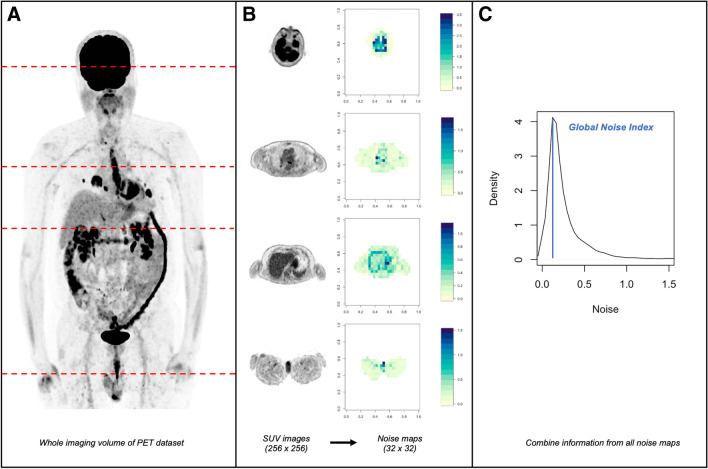
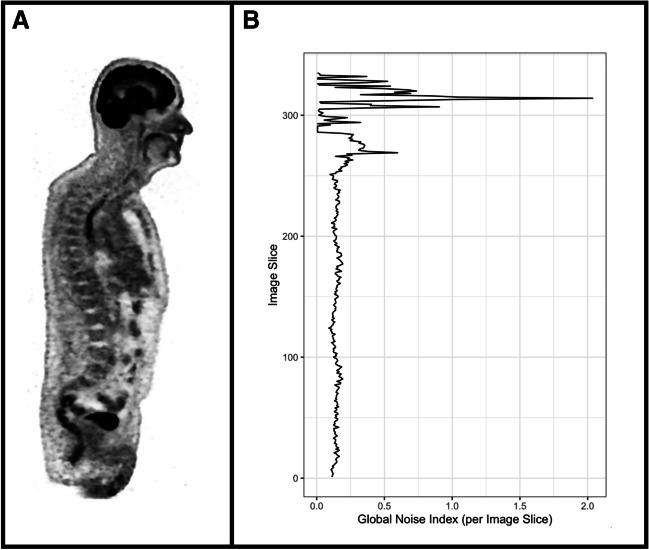
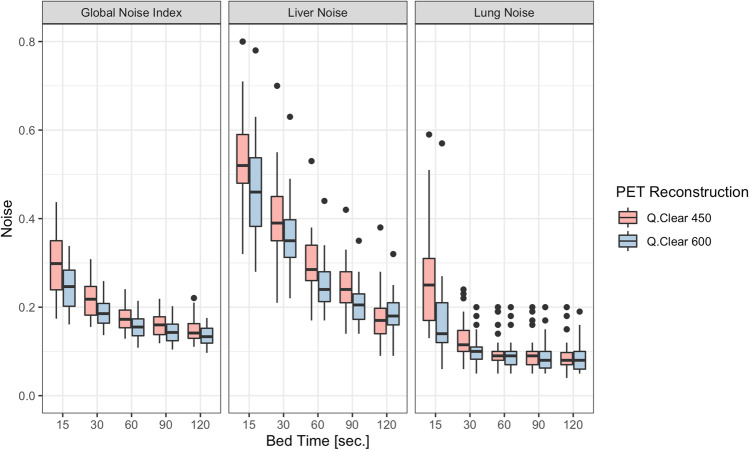
[F]FDG PET images of 38 patients were reconstructed with simulated decreasing acquisition times (15-120 s) resulting in increasing noise levels, and with block sequential regularized expectation maximization with beta values of 450 and 600 (Q.Clear 450 and 600). One reader performed manual volume-of-interest (VOI) based noise measurements in liver and lung parenchyma and two readers graded subjective image quality as sufficient or insufficient. An automated computational noise measurement algorithm was developed and deployed on the whole imaging volume of each reconstruction, delivering a single value representing the global image noise (Global Noise Index, GNI). Manual noise measurement values and subjective image quality gradings were compared with the GNI.
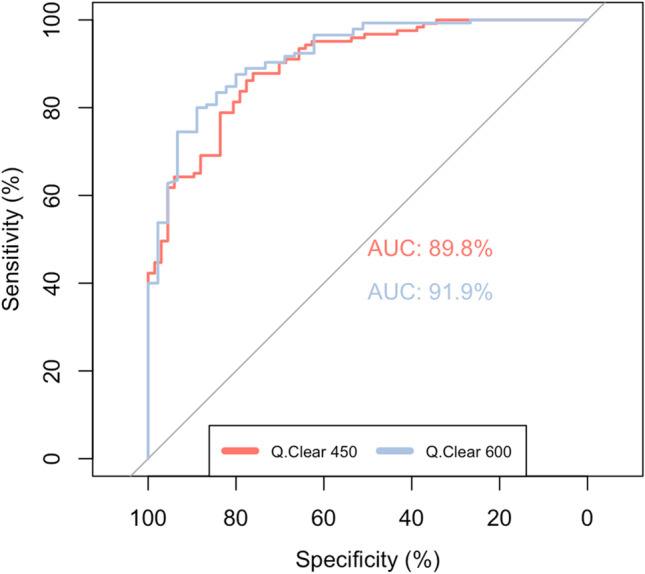
Irrespective of the absolute noise values, there was no significant difference between the GNI and manual liver measurements in terms of the distribution of noise values (p = 0.84 for Q.Clear 450, and p = 0.51 for Q.Clear 600). The GNI showed a fair to moderately strong correlation with manual noise measurements in liver parenchyma (r = 0.6 in Q.Clear 450, r = 0.54 in Q.Clear 600, all p < 0.001), and a fair correlation with manual noise measurements in lung parenchyma (r = 0.52 in Q.Clear 450, r = 0.33 in Q.Clear 600, all p < 0.001). Classification performance of the GNI for subjective image quality was AUC 0.898 for Q.Clear 450 and 0.919 for Q.Clear 600.
An algorithm provides an accurate and meaningful estimation of the global noise level encountered in clinical PET imaging datasets.
An automated computational approach that measures the global noise level of PET imaging datasets may facilitate quality standardization and benchmarking of clinical PET imaging within and across institutions.
• Noise is an important quantitative marker that strongly impacts image quality of PET images. • An automated computational noise measurement algorithm provides an accurate and meaningful estimation of the global noise level encountered in clinical PET imaging datasets. • An automated computational approach that measures the global noise level of PET imaging datasets may facilitate quality standardization and benchmarking as well as protocol harmonization.
介绍一种自动计算算法,用于估计 PET 数据集整个成像体积的全局噪声水平。
对 38 例患者的 [F]FDG PET 图像进行重建,模拟采集时间逐渐减少(15-120 s),噪声水平逐渐增加,采用 450 和 600(Q.Clear 450 和 600)的β值进行块顺序正则化期望最大化。一名读者在肝和肺实质中进行基于手动感兴趣区(VOI)的噪声测量,两名读者对主观图像质量进行足够或不足的分级。开发了一种自动计算噪声测量算法,并应用于每个重建的整个成像体积,提供一个表示全局图像噪声的单一值(全局噪声指数,GNI)。手动噪声测量值和主观图像质量分级与 GNI 进行比较。
无论绝对噪声值如何,在 Q.Clear 450 时,GNI 与肝测量值的噪声值分布之间没有显著差异(p = 0.84),在 Q.Clear 600 时,GNI 与肝测量值的噪声值分布之间也没有显著差异(p = 0.51)。GNI 与肝实质的手动噪声测量值具有中等至强的相关性(在 Q.Clear 450 中 r = 0.6,在 Q.Clear 600 中 r = 0.54,均 p < 0.001),与肺实质的手动噪声测量值具有中等相关性(在 Q.Clear 450 中 r = 0.52,在 Q.Clear 600 中 r = 0.33,均 p < 0.001)。对于主观图像质量,GNI 的分类性能在 Q.Clear 450 时 AUC 为 0.898,在 Q.Clear 600 时 AUC 为 0.919。
该算法可准确、有意义地估计临床 PET 成像数据集中遇到的全局噪声水平。
一种自动计算方法,可以测量 PET 成像数据集的全局噪声水平,可能有助于在机构内和机构间实现 PET 成像的质量标准化和基准测试。
噪声是影响 PET 图像质量的重要定量标志物。
一种自动计算算法可准确、有意义地估计临床 PET 成像数据集中遇到的全局噪声水平。
一种自动计算方法,可以测量 PET 成像数据集的全局噪声水平,可能有助于在机构内和机构间实现 PET 成像的质量标准化和基准测试。