International Vaccine Institute, Seoul, South Korea.
Graduate School of Public Health, Seoul National University, Seoul, South Korea.
BMC Infect Dis. 2023 Aug 29;23(1):562. doi: 10.1186/s12879-023-08452-0.
Water, sanitation, and hygiene (WASH) play a pivotal role in controlling typhoid fever, as it is primarily transmitted through oral-fecal pathways. Given our constrained resources, staying current with the most recent research is crucial. This ensures we remain informed about practical insights regarding effective typhoid fever control strategies across various WASH components. We conducted a systematic review and meta-analysis of case-control studies to estimate the associations of water, sanitation, and hygiene exposures with typhoid fever.
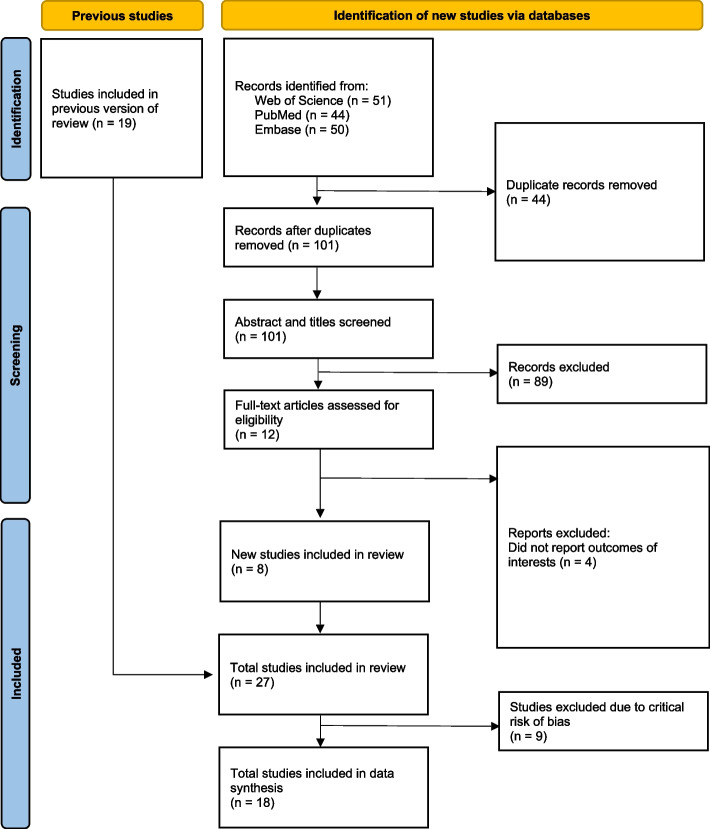
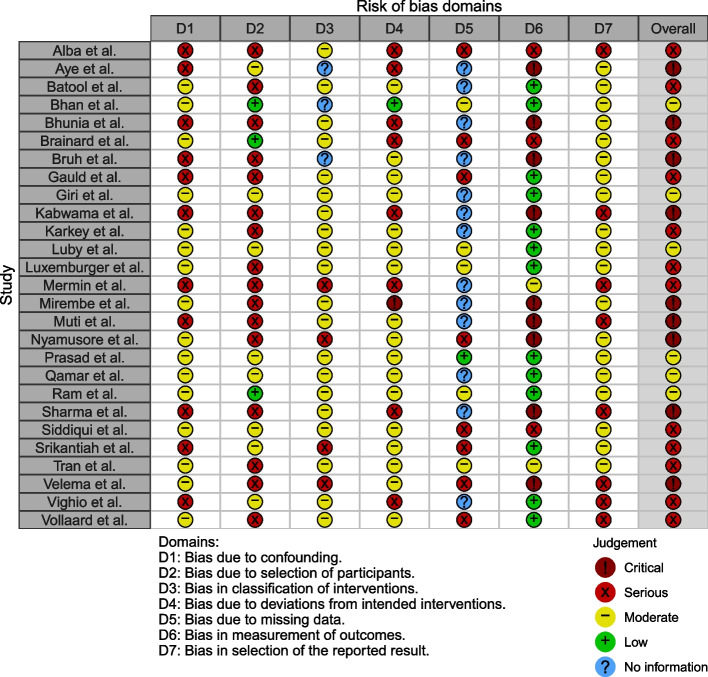
We updated the previous review conducted by Brockett et al. We included new findings published between June 2018 and October 2022 in Web of Science, Embase, and PubMed. We used the Risk of Bias in Non-Randomized Studies of Interventions (ROBINS-I) tool for risk of bias (ROB) assessment. We classified WASH exposures according to the classification provided by the WHO/UNICEF Joint Monitoring Programme for Water Supply, Sanitation, and Hygiene (JMP) update in 2015. We conducted the meta-analyses by only including studies that did not have a critical ROB in both Bayesian and frequentist random-effects models.
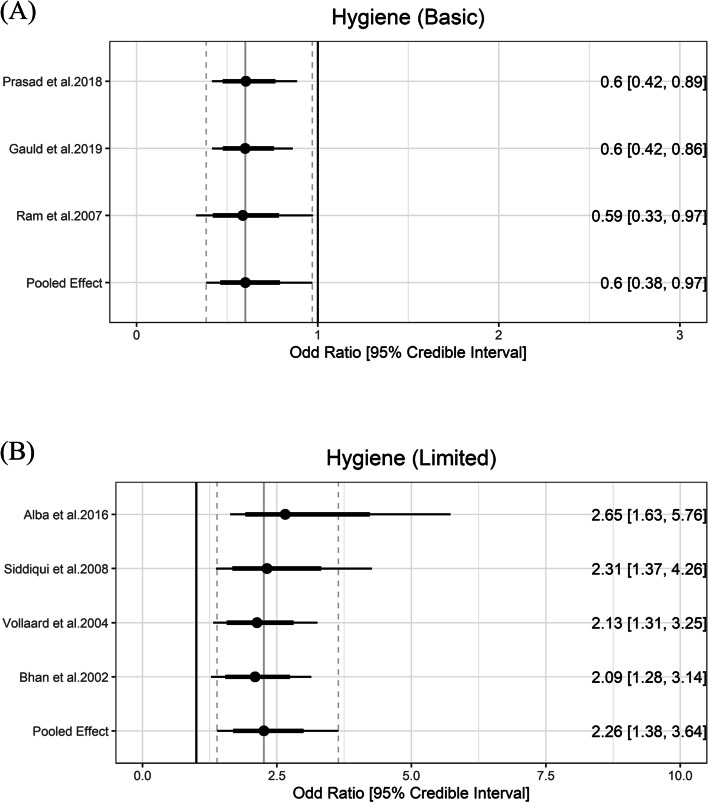
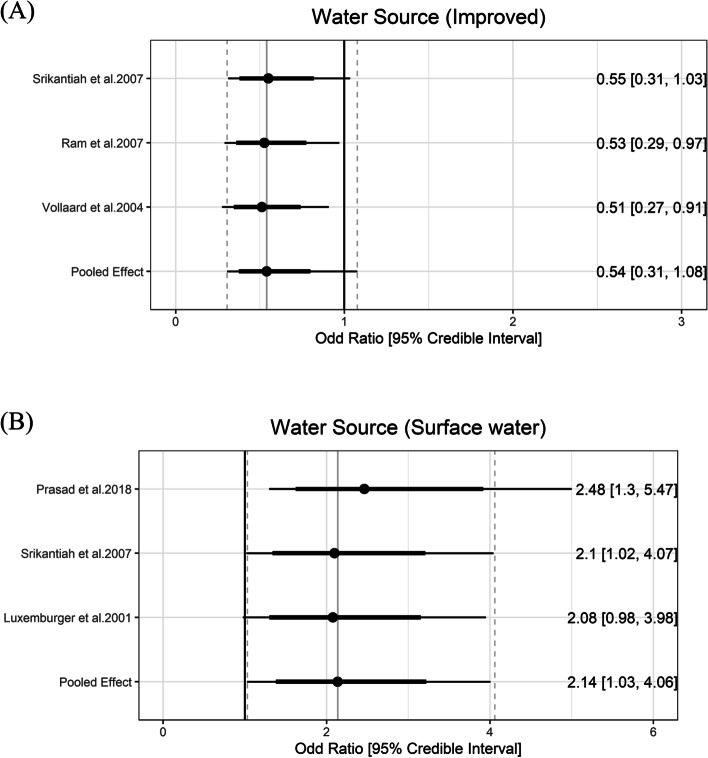
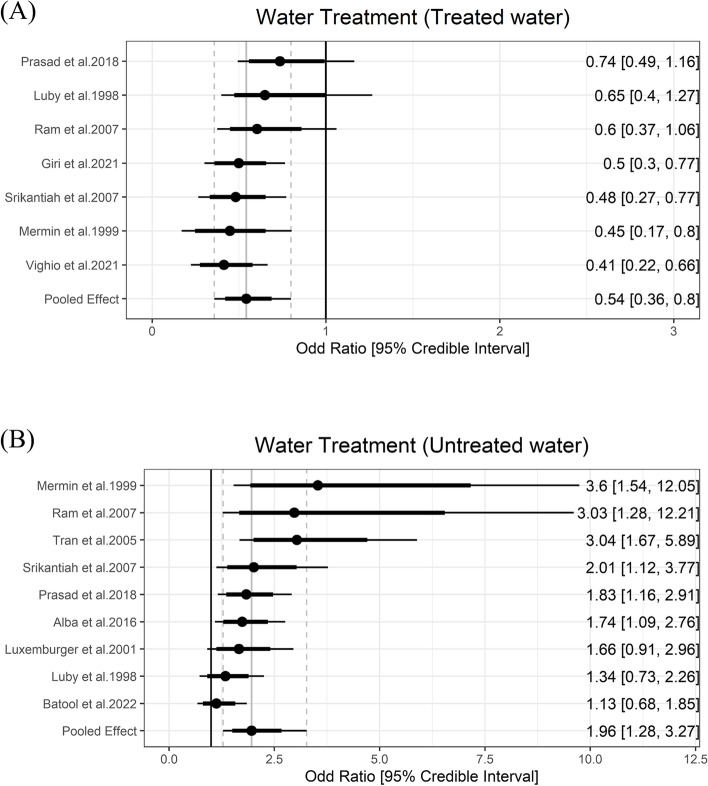
We identified 8 new studies and analyzed 27 studies in total. Our analyses showed that while the general insights on the protective (or harmful) impact of improved (or unimproved) WASH remain the same, the pooled estimates of OR differed. Pooled estimates of limited hygiene (OR = 2.26, 95% CrI: 1.38 to 3.64), untreated water (OR = 1.96, 95% CrI: 1.28 to 3.27) and surface water (OR = 2.14, 95% CrI: 1.03 to 4.06) showed 3% increase, 18% decrease, and 16% increase, respectively, from the existing estimates. On the other hand, improved WASH reduced the odds of typhoid fever with pooled estimates for improved water source (OR = 0.54, 95% CrI: 0.31 to 1.08), basic hygiene (OR = 0.6, 95% CrI: 0.38 to 0.97) and treated water (OR = 0.54, 95% CrI: 0.36 to 0.8) showing 26% decrease, 15% increase, and 8% decrease, respectively, from the existing estimates.
The updated pooled estimates of ORs for the association of WASH with typhoid fever showed clear changes from the existing estimates. Our study affirms that relatively low-cost WASH strategies such as basic hygiene or water treatment can be an effective tool to provide protection against typhoid fever in addition to other resource-intensive ways to improve WASH.
PROSPERO 2021 CRD42021271881.
水、环境卫生和个人卫生(WASH)在控制伤寒方面起着关键作用,因为它主要通过口腔-粪便途径传播。鉴于我们资源有限,及时了解最新研究至关重要。这可以确保我们了解到各种 WASH 环节中有效控制伤寒的实用见解。我们对病例对照研究进行了系统评价和荟萃分析,以估计水、环境卫生和个人卫生暴露与伤寒之间的关联。
我们更新了 Brockett 等人之前进行的综述。我们纳入了 2018 年 6 月至 2022 年 10 月间在 Web of Science、Embase 和 PubMed 上发表的新发现。我们使用非随机干预研究风险偏倚评估工具(ROBINS-I)评估风险偏倚(ROB)。我们根据世界卫生组织/联合国儿童基金会联合供水、环境卫生和个人卫生监测计划(JMP)2015 年更新版提供的分类,对 WASH 暴露进行分类。我们仅对贝叶斯和频率论随机效应模型中 ROB 均不具有关键性的研究进行荟萃分析。
我们确定了 8 项新研究,总共分析了 27 项研究。我们的分析表明,尽管改善(或未改善)WASH 的一般见解仍然相同,但 OR 的汇总估计值有所不同。有限卫生(OR=2.26,95%CrI:1.38 至 3.64)、未处理水(OR=1.96,95%CrI:1.28 至 3.27)和地表水(OR=2.14,95%CrI:1.03 至 4.06)的汇总估计值分别显示出 3%、18%和 16%的增加,而改善的 WASH 则降低了伤寒的发病几率,其汇总估计值为改善水源(OR=0.54,95%CrI:0.31 至 1.08)、基本卫生(OR=0.6,95%CrI:0.38 至 0.97)和处理水(OR=0.54,95%CrI:0.36 至 0.8),分别显示出 26%、15%和 8%的减少。
更新后的 WASH 与伤寒之间关联的 OR 汇总估计值与现有估计值相比有明显变化。我们的研究证实,相对低成本的 WASH 策略,如基本卫生或水处理,除了其他资源密集型改善 WASH 的方法外,还可以成为预防伤寒的有效工具。
PROSPERO 2021 CRD42021271881。