Sexton Zachary A, Hudson Andrew R, Herrmann Jessica E, Shiwarski Dan J, Pham Jonathan, Szafron Jason M, Wu Sean M, Skylar-Scott Mark, Feinberg Adam W, Marsden Alison
Department of Bioengineering, Stanford University, Stanford, CA, USA.
Department of Biomedical Engineering Carnegie Mellon University, Pittsburgh, PA, USA.
ArXiv. 2023 Aug 15:arXiv:2308.07586v1.
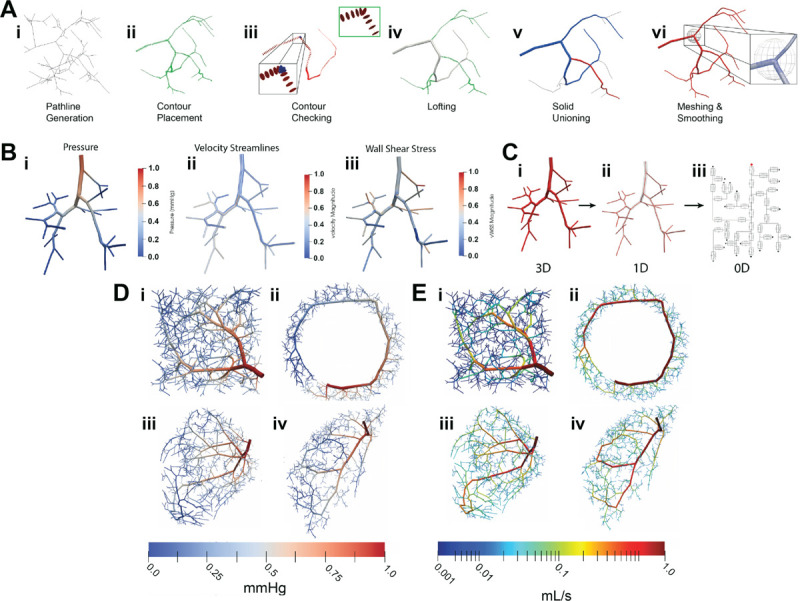
Our ability to produce human-scale bio-manufactured organs is critically limited by the need for vascularization and perfusion. For tissues of variable size and shape, including arbitrarily complex geometries, designing and printing vasculature capable of adequate perfusion has posed a major hurdle. Here, we introduce a model-driven design pipeline combining accelerated optimization methods for fast synthetic vascular tree generation and computational hemodynamics models. We demonstrate rapid generation, simulation, and 3D printing of synthetic vasculature in complex geometries, from small tissue constructs to organ scale networks. We introduce key algorithmic advances that all together accelerate synthetic vascular generation by more than 230 -fold compared to standard methods and enable their use in arbitrarily complex shapes through localized implicit functions. Furthermore, we provide techniques for joining vascular trees into watertight networks suitable for hemodynamic CFD and 3D fabrication. We demonstrate that organ-scale vascular network models can be generated in silico within minutes and can be used to perfuse engineered and anatomic models including a bioreactor, annulus, bi-ventricular heart, and gyrus. We further show that this flexible pipeline can be applied to two common modes of bioprinting with free-form reversible embedding of suspended hydrogels and writing into soft matter. Our synthetic vascular tree generation pipeline enables rapid, scalable vascular model generation and fluid analysis for bio-manufactured tissues necessary for future scale up and production.
我们制造人体尺寸生物制造器官的能力受到血管化和灌注需求的严重限制。对于大小和形状各异的组织,包括任意复杂的几何形状,设计和打印能够进行充分灌注的血管系统构成了一个主要障碍。在此,我们引入了一种模型驱动的设计流程,该流程结合了用于快速生成合成血管树的加速优化方法和计算血流动力学模型。我们展示了在从小型组织构建体到器官尺度网络的复杂几何形状中,合成血管系统的快速生成、模拟和3D打印。我们介绍了关键的算法进展,这些进展共同使合成血管生成速度比标准方法快230多倍,并通过局部隐函数使其能够应用于任意复杂形状。此外,我们提供了将血管树连接成适用于血流动力学CFD和3D制造的水密网络的技术。我们证明,器官尺度的血管网络模型可以在几分钟内在计算机上生成,并可用于灌注工程模型和解剖模型,包括生物反应器、瓣环、双心室心脏和脑回。我们进一步表明,这种灵活的流程可以应用于两种常见的生物打印模式,即悬浮水凝胶的自由形式可逆嵌入和写入软物质。我们的合成血管树生成流程能够为未来扩大规模和生产所需的生物制造组织快速、可扩展地生成血管模型并进行流体分析。