Martin Eliza C, Le Targa Lorlane, Tsakou-Ngouafo Louis, Fan Tzu-Pei, Lin Che-Yi, Xiao Jianxiong, Su Yi Hsien, Petrescu Andrei-Jose, Pontarotti Pierre, Schatz David G
Department of Immunobiology, Yale School of Medicine, 300 Cedar Street, Box 208011, New Haven, CT, 06520-8011, United States.
Aix-Marseille Université, IRD, APHM, MEPHI, IHU Méditerranée Infection, Marseille France.
bioRxiv. 2023 Aug 20:2023.08.20.553239. doi: 10.1101/2023.08.20.553239.
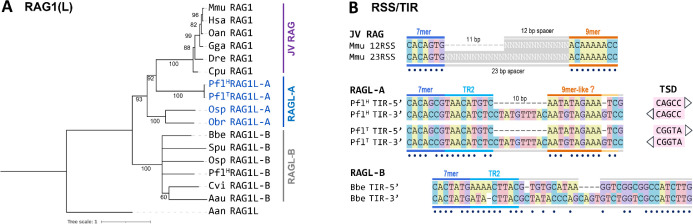
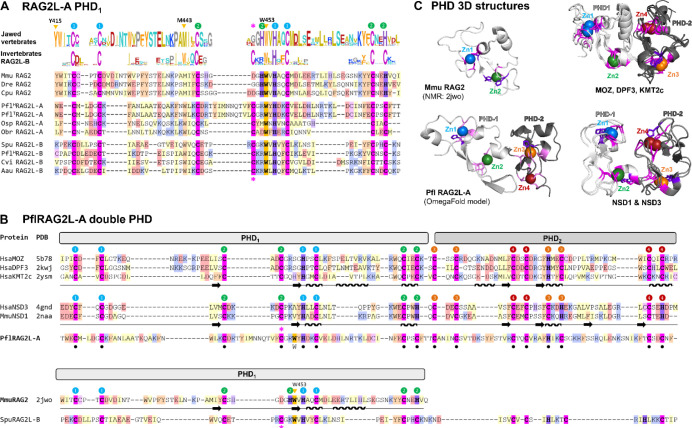
A series of "molecular domestication" events are thought to have converted an invertebrate RAG-like (RAGL) transposase into the RAG1-RAG2 (RAG) recombinase, a critical enzyme for adaptive immunity in jawed vertebrates. The timing and order of these events is not well understood, in part because of a dearth of information regarding the invertebrate transposon family. In contrast to the abundant and divergent transposon family, most closely resembles and is represented by a single orphan () gene in the genome of the hemichordate (). Here, we provide evidence for the existence of complete transposons in the genomes of and several echinoderms. The predicted RAG1L-A and RAG2L-A proteins encoded by these transposons intermingle sequence features of jawed vertebrate RAG and RAGL-B transposases, leading to a prediction of DNA binding, catalytic, and transposition activities that are a hybrid of RAG and RAGL-B. Similarly, the terminal inverted repeats (TIRs) of the transposons combine features of both transposon TIRs and RAG recombination signal sequences. Unlike all previously described RAG2L proteins, PflRAG2L-A and echinoderm RAG2L-A contain an acidic hinge region, which we demonstrate is capable of efficiently inhibiting RAG-mediated transposition. Our findings provide evidence for a critical intermediate in RAG evolution and argue that certain adaptations thought to be specific to jawed vertebrates (e.g., the RAG2 acidic hinge) actually arose in invertebrates, thereby focusing attention on other adaptations as the pivotal steps in the completion of RAG domestication in jawed vertebrates.
一系列“分子驯化”事件被认为已将一种无脊椎动物类RAG(RAGL)转座酶转化为RAG1-RAG2(RAG)重组酶,这是有颌脊椎动物适应性免疫中的一种关键酶。这些事件的时间和顺序尚未得到很好的理解,部分原因是关于无脊椎动物转座子家族的信息匮乏。与丰富多样的转座子家族不同, 与 最为相似,并且在半索动物 的基因组中由单个孤儿 ( )基因代表。在这里,我们提供了证据证明 和几种棘皮动物的基因组中存在完整的 转座子。这些转座子编码的预测RAG1L-A和RAG2L-A蛋白混合了有颌脊椎动物RAG和RAGL-B转座酶的序列特征,从而预测出具有RAG和RAGL-B杂交特征的DNA结合、催化和转座活性。同样, 转座子的末端反向重复序列(TIRs)结合了 转座子TIRs和RAG重组信号序列的特征。与所有先前描述的RAG2L蛋白不同,PflRAG2L-A和棘皮动物RAG2L-A含有一个酸性铰链区,我们证明该区域能够有效抑制RAG介导的转座。我们的发现为RAG进化中的一个关键中间体提供了证据,并表明某些被认为是有颌脊椎动物特有的适应性变化(例如RAG2酸性铰链)实际上起源于无脊椎动物,从而将注意力集中在其他适应性变化上,将其视为有颌脊椎动物中RAG驯化完成的关键步骤。