Department of Animal Sciences, Genetics Institute, University of Florida, Gainesville, Florida, USA.
Department of Animal Science, University of Connecticut, Storrs, Connecticut, USA.
Reproduction. 2023 Sep 28;166(5):311-322. doi: 10.1530/REP-23-0074. Print 2023 Nov 1.
Inadequate maternal nutrition during gestation can have immediate and lifelong effects on offspring. This study shows that maternal restricted - and over- nutrition during gestation do not affect semen characteristics in F1 male offspring but alters offspring sperm sncRNA profiles and DNA methylome in sheep.
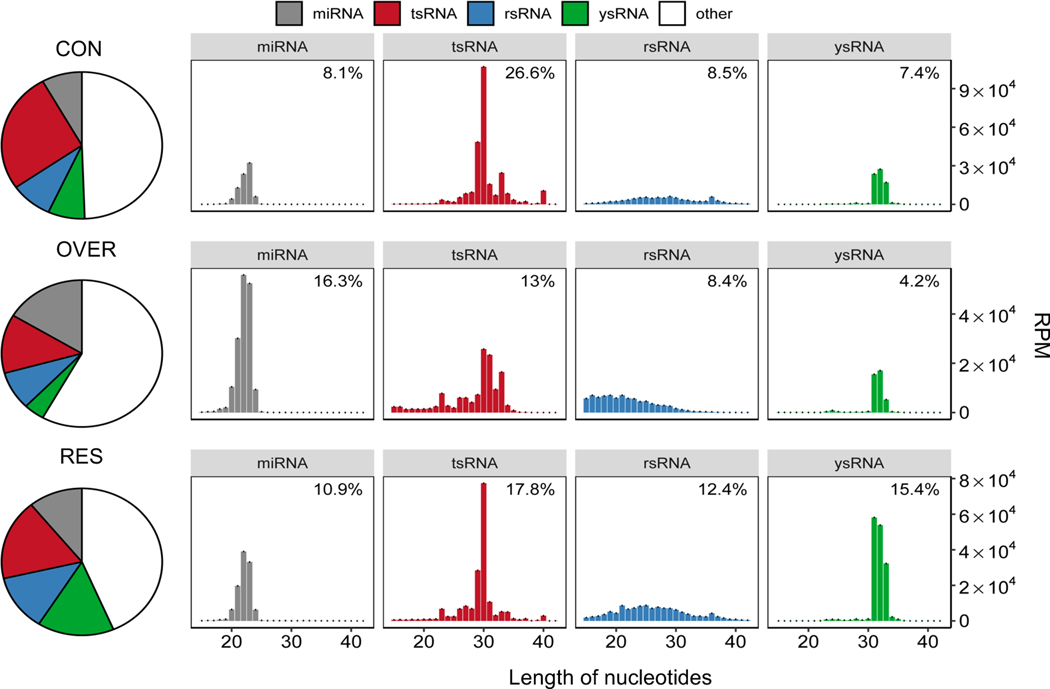
There is a growing body of evidence that inadequate maternal nutrition during gestation can have immediate and lifelong effects on offspring. However, little is known about the effects of maternal nutrition during gestation on male offspring reproduction. Here, using a sheep model of maternal restricted - and over - nutrition (60 or 140% of the National Research Council requirements) during gestation, we found that maternal restricted - and over - nutrition do not affect semen characteristics (i.e. volume, sperm concentration, pH, sperm motility, sperm morphology) or scrotal circumference in male F1 offspring. However, using small RNA sequencing analysis, we demonstrated that both restricted - and over - nutrition during gestation induced marked changes in composition and expression of sperm small noncoding RNAs (sncRNAs) subpopulations including in male F1 offspring. Whole-genome bisulfite sequencing analysis further identified specific genomic loci where poor maternal nutrition resulted in alterations in DNA methylation. These findings indicate that maternal restricted - and over - nutrition during gestation induce epigenetic modifications in sperm of F1 offspring sperm in sheep, which may contribute to environmentally influenced phenotypes in ruminants.
孕期母体营养不足会对后代产生即时和终身的影响。本研究表明,孕期母体限制和过度营养不会影响 F1 雄性后代的精液特征,但会改变绵羊后代精子 sncRNA 谱和 DNA 甲基化组。
越来越多的证据表明,孕期母体营养不足会对后代产生即时和终身的影响。然而,对于孕期母体营养对雄性后代生殖的影响知之甚少。在这里,我们使用绵羊母体限制和过度营养(60%或 140%的国家研究委员会需求)的模型,发现孕期母体限制和过度营养不会影响雄性 F1 后代的精液特征(即体积、精子浓度、pH 值、精子活力、精子形态)或阴囊周长。然而,我们通过小 RNA 测序分析表明,孕期限制和过度营养都会导致精子小非编码 RNA(sncRNA)亚群的组成和表达发生明显变化,包括雄性 F1 后代。全基因组亚硫酸氢盐测序分析进一步确定了母体营养不良导致 DNA 甲基化改变的特定基因组位点。这些发现表明,孕期母体限制和过度营养会导致绵羊 F1 后代精子的表观遗传修饰,这可能导致反刍动物中环境影响的表型。