Chambliss Allison B, Aljehani Mayada, Tran Brian, Chen Xingyao, Elton Elizabeth, Garri Carolina, Ung Nolan, Matasci Naim, Gross Mitchell E
Department of Pathology, Keck School of Medicine, University of Southern California, Los Angeles, CA, USA.
Lawrence J. Ellison Institute for Transformative Medicine, Los Angeles, CA, USA.
Pract Lab Med. 2023 Jul 3;36:e00323. doi: 10.1016/j.plabm.2023.e00323. eCollection 2023 Aug.
We sought to identify immune biomarkers associated with severe Coronavirus disease 2019 (COVID-19) in patients admitted to a large urban hospital during the early phase of the SARS-CoV-2 pandemic.
The study population consisted of SARS-CoV-2 positive subjects admitted for COVID-19 (n = 58) or controls (n = 14) at the Los Angeles County University of Southern California Medical Center between April 2020 through December 2020. Immunologic markers including chemokine/cytokines (IL-6, IL-8, IL-10, IP-10, MCP-1, TNF-α) and serologic markers against SARS-CoV-2 antigens (including spike subunits S1 and S2, receptor binding domain, and nucleocapsid) were assessed in serum collected on the day of admission using bead-based multiplex immunoassay panels.
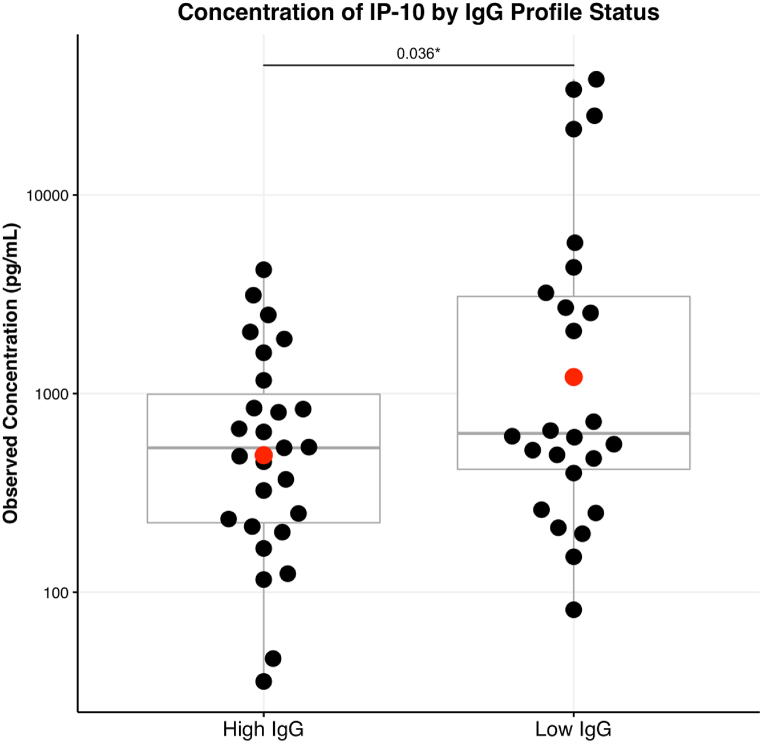
We observed that body mass index (BMI) and SARS-CoV-2 antibodies were significantly elevated in patients with the highest COVID-19 disease severity. IP-10 was significantly elevated in COVID-19 patients and was associated with increased SARS-CoV-2 antibodies. Interactions among all available variables on COVID-19 disease severity were explored using a linear support vector machine model which supported the importance of BMI and SARS-CoV-2 antibodies.
Our results confirm the known adverse association of BMI on COVID-19 severity and suggest that IP-10 and SARS-CoV-2 antibodies could be useful to identify patients most likely to experience the most severe forms of the disease.
我们试图在严重急性呼吸综合征冠状病毒2型(SARS-CoV-2)大流行早期,于一家大型城市医院住院的2019冠状病毒病(COVID-19)患者中,识别与重症COVID-19相关的免疫生物标志物。
研究人群包括2020年4月至2020年12月期间在南加州大学洛杉矶县医学中心因COVID-19入院的SARS-CoV-2阳性受试者(n = 58)或对照组(n = 14)。使用基于微珠的多重免疫分析板,对入院当天采集的血清中的免疫标志物进行评估,这些标志物包括趋化因子/细胞因子(白细胞介素6、白细胞介素8、白细胞介素10、干扰素诱导蛋白10、单核细胞趋化蛋白1、肿瘤坏死因子-α)以及针对SARS-CoV-2抗原的血清学标志物(包括刺突亚基S1和S2、受体结合域以及核衣壳)。
我们观察到,COVID-19疾病严重程度最高的患者,其体重指数(BMI)和SARS-CoV-2抗体显著升高。COVID-19患者的干扰素诱导蛋白10显著升高,且与SARS-CoV-2抗体增加相关。使用线性支持向量机模型探索了所有可用变量与COVID-19疾病严重程度之间的相互作用,该模型支持BMI和SARS-CoV-2抗体的重要性。
我们的结果证实了BMI与COVID-19严重程度之间已知的不良关联,并表明干扰素诱导蛋白10和SARS-CoV-2抗体可能有助于识别最有可能经历最严重疾病形式的患者。