Population Research Center, The University of Texas at Austin, Austin, Texas, United States of America.
Department of Epidemiology and Biostatistics, University of California, San Francisco, San Francisco, California, United States of America.
PLoS One. 2023 Aug 31;18(8):e0290726. doi: 10.1371/journal.pone.0290726. eCollection 2023.
Young people's ability to use their preferred contraceptive method is an indicator of reproductive autonomy and healthcare access. State policies can hinder or facilitate access to a preferred contraceptive method.
This study compared use of preferred contraceptive method in Texas and California, states with contrasting health policy contexts that impact health insurance coverage and access to subsidized family planning services.
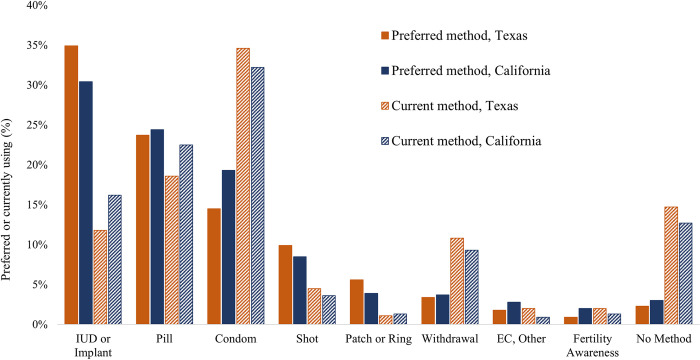
We used baseline survey data from an ongoing cluster randomized controlled trial of sexually active students, assigned female at birth, ages 18-25, at 29 community colleges in Texas and California (N = 1,974). We described contraceptive preferences and use, as well as reasons for nonuse of a preferred method. We conducted multivariable-adjusted mixed-effects logistic regression analyses for clustered data, and then calculated the predicted probability of using a preferred contraceptive method in Texas and California by insurance status.
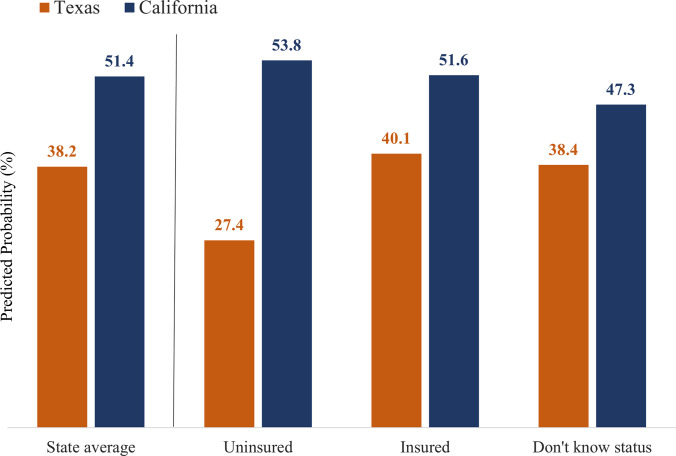
More Texas participants were uninsured than Californians (30% vs. 8%, p<0.001). Thirty-six percent of Texas participants were using their preferred contraceptive method compared to 51% of Californians. After multivariable adjustments, Texas participants had lower odds of using their preferred method (adjusted odds ratio = 0.62, 95% confidence interval = 0.48-0.81) compared to those in California. Texas participants in all insurance categories had a lower predicted probability of preferred method use compared to California participants. In Texas, we found a 12.1 percentage-point difference in the predicted probability of preferred method use between the uninsured (27.5%) and insured (39.6%) (p<0.001). Texans reported financial barriers to using their preferred method more often than Californians (36.7% vs. 19.2%, p<0.001) as did the uninsured compared to the insured (50.9% vs. 18.7%, p<0.001).
These findings present new evidence that state of residence plays an important role in young people's ability to realize their contraceptive preference. Young people in Texas, with lower insurance coverage and more limited access to safety net programs for contraceptive care than in California, have lower use of preferred contraception. It has become urgent in states with abortion bans to support young people's access to their preferred methods.
年轻人能够使用他们偏好的避孕方法是生殖自主权和获得医疗保健的一个指标。国家政策可能会阻碍或促进获得偏好的避孕方法。
本研究比较了德克萨斯州和加利福尼亚州年轻人使用偏好避孕方法的情况,这两个州的卫生政策背景截然不同,影响了医疗保险覆盖范围和获得补贴计划生育服务的机会。
我们使用了正在进行的一项针对有性活跃史、出生时为女性、年龄在 18-25 岁的社区大学生的群组随机对照试验的基线调查数据(N=1974)。我们描述了避孕偏好和使用情况,以及不使用偏好方法的原因。我们对聚类数据进行了多变量调整混合效应逻辑回归分析,然后计算了德克萨斯州和加利福尼亚州按保险状况使用偏好避孕方法的预测概率。
与加利福尼亚州相比,更多的德克萨斯州参与者没有保险(30%比 8%,p<0.001)。36%的德克萨斯州参与者正在使用他们偏好的避孕方法,而 51%的加利福尼亚州参与者正在使用。在多变量调整后,与加利福尼亚州参与者相比,德克萨斯州参与者使用偏好方法的可能性较低(调整后的优势比=0.62,95%置信区间=0.48-0.81)。所有保险类别的德克萨斯州参与者使用偏好方法的预测概率均低于加利福尼亚州参与者。在德克萨斯州,我们发现,与加利福尼亚州相比,无保险(27.5%)和有保险(39.6%)之间使用偏好方法的预测概率存在 12.1 个百分点的差异(p<0.001)。与加利福尼亚州相比,德克萨斯州的参与者更频繁地报告使用偏好方法存在经济障碍(36.7%比 19.2%,p<0.001),无保险者比有保险者更频繁地报告存在经济障碍(50.9%比 18.7%,p<0.001)。
这些发现提供了新的证据,表明居住州在年轻人实现避孕偏好的能力方面起着重要作用。与加利福尼亚州相比,保险覆盖范围较低且获得避孕护理的安全网计划更有限的德克萨斯州年轻人,使用偏好避孕方法的比例较低。在禁止堕胎的州,支持年轻人获得他们偏好的方法已经变得紧迫。