Steenland Maria W, Oviedo Dea, Bates Mary Ann, Zhou Annetta, Zera Chloe, Baicker Katherine, McConnell Margaret A
Population Studies and Training Center, Brown University, Providence, Rhode Island; the Department of Global Health and Population, Harvard T.H. Chan School of Public Health, the RAND Corporation, Division of Maternal Fetal Medicine, Department of Obstetrics and Gynecology, Beth Israel Deaconess Medical Center, and the Department of Obstetrics, Gynecology and Reproductive Biology, Harvard Medical School, Boston, and the Abdul Latif Jameel Poverty Action Lab (J-PAL), Massachusetts Institute of Technology, and the National Bureau of Economic Research (NBER), Cambridge, Massachusetts; the Cradle-to-Career Data System, State of California, Sacramento, California; and the University of Chicago, Chicago, Illinois.
Obstet Gynecol. 2025 Jan 1;145(1):3-12. doi: 10.1097/AOG.0000000000005786. Epub 2024 Nov 14.
To evaluate the effect of an intensive nurse home visiting program on postpartum contraceptive use and birth spacing among individuals with a first pregnancy who were eligible for Medicaid insurance in South Carolina.
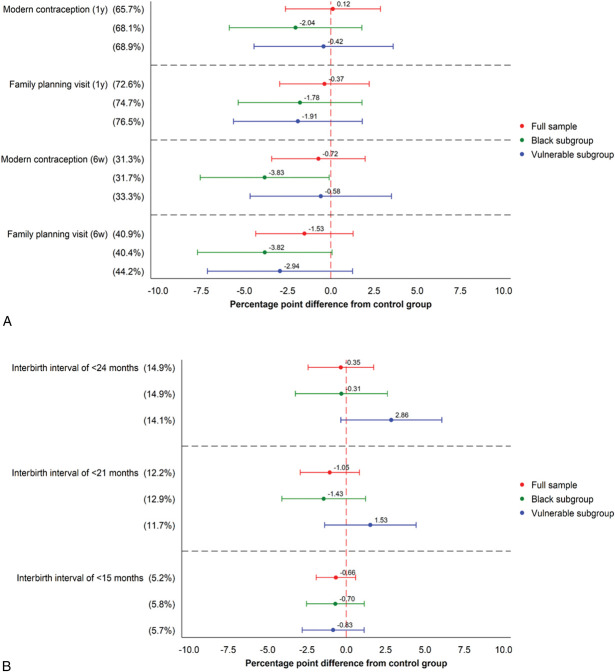
We conducted a nonblinded, randomized controlled trial of the Nurse-Family Partnership (NFP), an established intensive home visiting program that provides prenatal and postpartum home visits through 2 years after childbirth. The trial included patients who were eligible for Medicaid insurance with a first pregnancy at less than 28 weeks of gestation between April 1, 2016, and March 17, 2020, who were followed up through 2 years after childbirth. Participants were randomized 2:1 to NFP compared with standard of care treatment. The primary outcome was a birth interval of less than 21 months between the index pregnancy and a subsequent birth. The secondary outcomes were birth intervals of less than 15 and 24 months, receipt of a contraceptive implant or intrauterine device (IUD) immediately postpartum, any contraceptive use and receipt of a family planning visit (at both 6 weeks and 1 year postpartum), and IUD receipt at 1 year postpartum. We assessed outcomes using linked birth certificate records and Medicaid claims data.
A total of 4,932 trial participants (3,295 in the intervention group and 1,637 in the control group) were included in the study analysis. Within 21 months of the study index birth, 11.0% of individuals in the NFP group and 12.2% of the usual care group had a subsequent birth. The NFP did not have a statistically significant effect on birth intervals of less than 21 months (adjusted coefficient -1.1, 95% CI, -2.9 to 0.8). There were no statistically significant differences between the NFP and control groups for any of the study's eight secondary outcomes related to birth spacing and postpartum contraceptive use.
Home visits with a registered nurse did not affect postpartum contraceptive use or birth spacing.
ClinicalTrials.gov, NCT03360539.
评估强化护士家访计划对南卡罗来纳州符合医疗补助保险条件的首次怀孕者产后避孕措施使用情况及生育间隔的影响。
我们对护士-家庭伙伴关系(NFP)进行了一项非盲法随机对照试验,NFP是一项既定的强化家访计划,在产后两年内提供产前和产后家访服务。该试验纳入了在2016年4月1日至2020年3月17日期间首次怀孕且妊娠少于28周、符合医疗补助保险条件的患者,并在产后两年进行随访。参与者按2:1随机分配至NFP组与标准护理治疗组。主要结局指标是本次妊娠与随后一次分娩之间的生育间隔少于21个月。次要结局指标包括生育间隔少于15个月和24个月、产后立即接受避孕植入物或宫内节育器(IUD)、任何避孕措施的使用以及接受计划生育访视(产后6周和1年时),以及产后1年接受IUD。我们使用关联的出生证明记录和医疗补助理赔数据评估结局。
共有4932名试验参与者(干预组3295名,对照组1637名)纳入研究分析。在研究索引分娩后的21个月内,NFP组11.0%的个体以及常规护理组12.2%的个体有了后续分娩。NFP对生育间隔少于21个月没有统计学上的显著影响(调整系数-1.1,95%置信区间,-2.9至0.8)。在与生育间隔和产后避孕使用相关的八项研究次要结局指标中,NFP组与对照组之间均无统计学上的显著差异。
由注册护士进行的家访对产后避孕措施的使用或生育间隔没有影响。
ClinicalTrials.gov,NCT03360539。