Department of Internal Medicine, School of Clinical Medicine, Muhimbili University of Health and Allied Sciences, Dar Es Salaam, Tanzania.
Jakaya Kikwete Cardiac Institute, Dar Es Salaam, Tanzania.
BMC Womens Health. 2023 Aug 31;23(1):404. doi: 10.1186/s12905-023-02332-0.
Rheumatic heart disease (RHD) remains prevalent in the developing world and reproductive-age women are disproportionately affected. It is among the common est cardiac diseases during pregnancy and is associated with poor pregnancy outcomes. Despite its importance among reproductive-age women, there are no local studies that characterize the clinical characteristics, risk of poor pregnancy outcomes and contraception which represents one effective way to prevent unplanned pregnancies in this population.
This was a hospital-based descriptive cross-sectional study. Non-pregnant reproductive-age women with echocardiographically diagnosed RHD were consecutively recruited from in- and out-patients units of the Jakaya Kikwete Cardiac Institute (JKCI). A clinical research form was used to gather socio-demographic, clinical characteristics, contraception status and echocardiographic information. The maternal/pregnancy risk class was determined using the modified World Health Organization (WHO) classification of maternal risk.
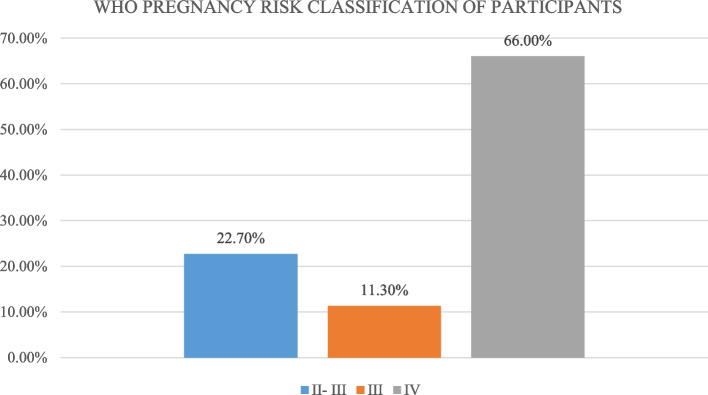
Two hundred thirty-eight women of reproductive age with RHD were recruited. The median age (range) was 36 years (15-49). Two-thirds were dyspneic on moderate exertion and 17.2% had New York Heart Association class IV heart failure. A quarter had atrial fibrillation/flutter. On echocardiography, mitral regurgitation was the most common valvular lesion (68.1%), followed by mitral stenosis (66.8%), and 12.2% of participants had reduced left ventricular ejection fraction. Two-thirds (66%) had a high pregnancy risk (class IV) based on the modified WHO classification system. The proportion of participants using contraception was 7.1% and common methods were: bilateral tubal ligation 5 of 17 (29.4%) and hormonal implant (4 of 17). The most common reason for the choice of a method was safety, 10 out of 17 (58.8%).
The majority of women of reproductive age with RHD in our hospital cohort are at the highest pregnancy risk based on the modified WHO classification and a very small proportion of them are on contraception. These results call for action among clinicians to offer counselling to these patients, educating them on their risk and offering appropriate contraception advice while waiting for definitive interventions.
风湿性心脏病(RHD)在发展中国家仍然普遍存在,育龄妇女受影响的比例不成比例。它是妊娠期间常见的心脏疾病之一,与不良妊娠结局相关。尽管它在育龄妇女中很重要,但没有当地的研究来描述其临床特征、不良妊娠结局的风险以及避孕方法,而避孕是预防该人群意外怀孕的一种有效方法。
这是一项基于医院的描述性横断面研究。从 Jakaya Kikwete 心脏研究所(JKCI)的门诊和住院患者中连续招募了经超声心动图诊断为 RHD 的非妊娠育龄妇女。使用临床研究表格收集社会人口统计学、临床特征、避孕状况和超声心动图信息。使用改良的世界卫生组织(WHO)孕产妇风险分类来确定孕产妇/妊娠风险类别。
共招募了 238 名育龄妇女 RHD 患者。中位数年龄(范围)为 36 岁(15-49 岁)。三分之二的患者在中等强度运动时出现呼吸困难,17.2%的患者患有纽约心脏协会(NYHA)心功能 IV 级心力衰竭。四分之一的患者有心房颤动/扑动。超声心动图显示,最常见的瓣膜病变是二尖瓣反流(68.1%),其次是二尖瓣狭窄(66.8%),12.2%的患者左心室射血分数降低。根据改良的 WHO 分类系统,三分之二(66%)的患者具有较高的妊娠风险(IV 类)。使用避孕方法的患者比例为 7.1%,常见的方法是:双侧输卵管结扎术 5 例(29.4%)和激素植入物 4 例(29.4%)。选择一种方法的最常见原因是安全性,17 例中有 10 例(58.8%)。
在我们医院队列中,大多数患有 RHD 的育龄妇女根据改良的 WHO 分类处于最高妊娠风险,只有很少一部分人在使用避孕方法。这些结果呼吁临床医生为这些患者提供咨询,向他们传授风险知识,并在等待明确干预措施的同时提供适当的避孕建议。