Department of Anesthesiology, Pharmacology & Therapeutics, University of British Columbia, Vancouver, BC, Canada.
Department of Anesthesiology, Royal Columbian Hospital, Vancouver, BC, Canada.
BMC Health Serv Res. 2023 Aug 31;23(1):932. doi: 10.1186/s12913-023-09977-5.
Sepsis, characterized by organ dysfunction due to presumed or proven infection, has a case-fatality over 20% in severe cases in low-and-middle income countries. Early diagnosis and treatment have proven benefits, prompting our implementation of Smart Triage at Jinja Regional Referral Hospital in Uganda, a program that expedites treatment through a data-driven triage platform. We conducted a cost-effectiveness analysis of Smart Triage to explore its impact on patients and inform multicenter scale up.
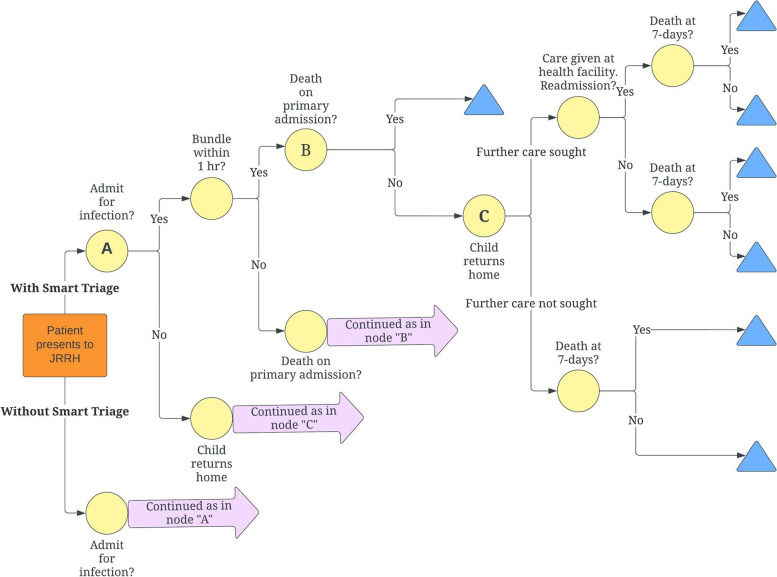
The parent clinical trial for Smart Triage was pre-post in design, using the proportion of children receiving sepsis treatment within one hour as the primary outcome, a measure linked to mortality benefit in existing literature. We used a decision-analytic model with Monte Carlo simulation to calculate the cost per year-of-life-lost (YLL) averted of Smart Triage from societal, government, and patient perspectives. Healthcare utilization and lost work for seven days post-discharge were translated into costs and productivity losses via secondary linkage data.
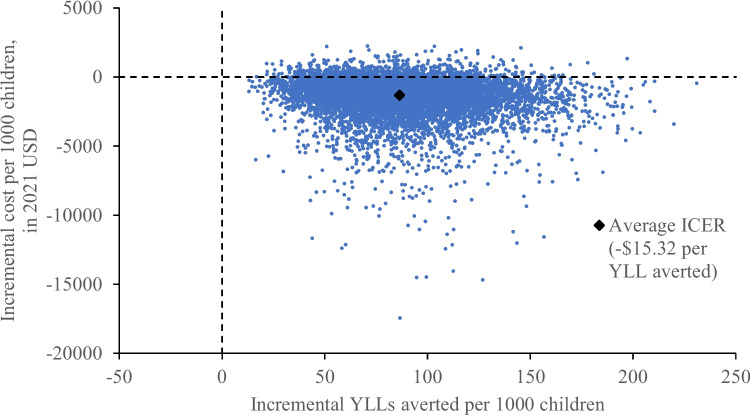
In 2021 United States dollars, Smart Triage requires an annuitized program cost of only $0.05 per child, but results in $15.32 saved per YLL averted. At a willingness-to-pay threshold of only $3 per YLL averted, well below published cost-effectiveness threshold estimates for Uganda, Smart Triage approaches 100% probability of cost-effectiveness over the baseline manual triage system. This cost-effectiveness was observed from societal, government, and patient perspectives. The cost-effectiveness observed was driven by a reduction in admission that, while explainable by an improved triage mechanism, may also be partially attributable to changes in healthcare utilization influenced by the coronavirus pandemic. However, Smart Triage remains cost-effective in sensitivity analyses introducing a penalty factor of up to 50% in the reduction in admission.
Smart Triage's ability to both save costs and avert YLLs indicates that patients benefit both economically and clinically, while its high probability of cost-effectiveness strongly supports multicenter scale up. Areas for further research include the incorporation of years lived with disability when sepsis disability weights in low-resource settings become available and analyzing budget impact during multicenter scale up.
NCT04304235 (registered on 11/03/2020, clinicaltrials.gov).
败血症的特征是由于疑似或确诊感染导致的器官功能障碍,在中低收入国家的重症病例中,病死率超过 20%。早期诊断和治疗已被证明有益,这促使我们在乌干达的金贾地区转诊医院实施了 Smart Triage,这是一个通过数据驱动分诊平台加快治疗的项目。我们对 Smart Triage 进行了成本效益分析,以探讨其对患者的影响,并为多中心推广提供信息。
Smart Triage 的母临床试验采用前后设计,以儿童在一小时内接受败血症治疗的比例作为主要结局,这一措施与现有文献中的死亡率获益相关。我们使用决策分析模型和蒙特卡罗模拟来计算从社会、政府和患者角度来看 Smart Triage 避免的每年生命损失(YLL)的成本。通过二次链接数据,将出院后七天内的医疗保健利用和失去工作时间转化为成本和生产力损失。
以 2021 年美元计算,Smart Triage 每个孩子的年度项目成本仅为 0.05 美元,但可节省 15.32 美元/YLL。在仅为 3 美元/YLL 的支付意愿阈值下,远低于乌干达公布的成本效益阈值估计,Smart Triage 在基线手动分诊系统下,接近 100%的成本效益概率。从社会、政府和患者的角度来看,都具有成本效益。成本效益的实现是由于入院人数的减少,虽然这可以用改良的分诊机制来解释,但也可能部分归因于冠状病毒大流行影响下医疗保健利用的变化。然而,在引入高达 50%的入院减少惩罚因素的敏感性分析中,Smart Triage 仍然具有成本效益。
Smart Triage 既能节省成本,又能避免 YLL,表明患者在经济和临床方面都受益,而其高成本效益概率强烈支持多中心推广。进一步研究的领域包括在获得低资源环境下败血症残疾权重的残疾生命年(YLD)时纳入 YLD,并在多中心推广时分析预算影响。
NCT04304235(于 2020 年 11 月 3 日注册,clinicaltrials.gov)。