Huxford Charly, Hwang Bella, Dunsmuir Dustin, Pillay Yashodani, Tusingwire Fredson, Otim Florence Oyella, Akello Beatrice, Ishebukara Aine Ivan Aye, Novakowski Stefanie K, Toliva Bernard Opar, Kenya-Mugisha Nathan, Tagoola Abner, Wiens Matthew O, Kissoon Niranjan, Ansermino J Mark
Department of Anesthesiology, Pharmacology & Therapeutics, University of British Columbia, Vancouver, British Columbia.
Institute for Global Health, BC Children's Hospital and BC Women's Hospital + Health Centre, Vancouver, British Columbia.
PLoS One. 2025 Aug 11;20(8):e0322969. doi: 10.1371/journal.pone.0322969. eCollection 2025.
Automated messaging through text (SMS) and instant messaging services (IMS) offers low-cost solutions for patient follow-up in resource-constrained contexts. This study aims to evaluate a quality improvement (QI) initiative to improve caregiver response rates to an automated messaging system for post-discharge follow-up of children in rural Uganda.
From June 2022 to June 2024, caregivers of children triaged through the Smart Triage platform at Gulu Regional Referral Hospital were invited to participate in an automated follow-up program. Messages were sent seven days after discharge via SMS and IMS (WhatsApp), prompting caregivers to report if their child had "improved" or "not improved". Non-responders and "not improved" cases were followed up with a phone call from a study nurse. From April 2023 to November 2023, a QI initiative refined the messaging system to improve response rates and a post-QI period then continued the intervention with no changes until June 2024. Response rates were analyzed over three periods: historical (pre-QI, June 2022 - March 2023), QI intervention, and post-QI. Additionally, data on message delivery rates, improvement strategies, and health outcomes were analyzed.
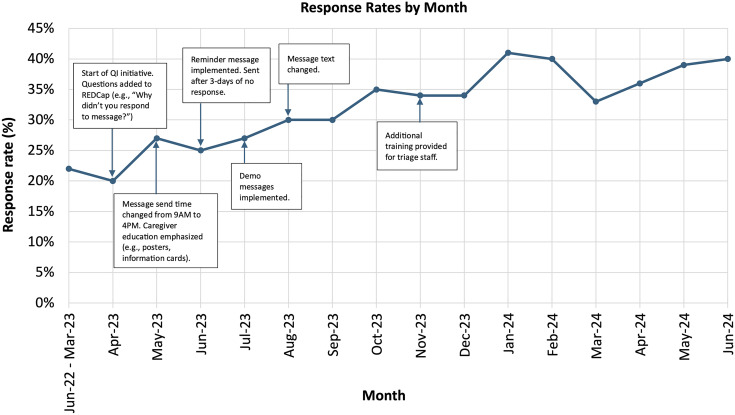
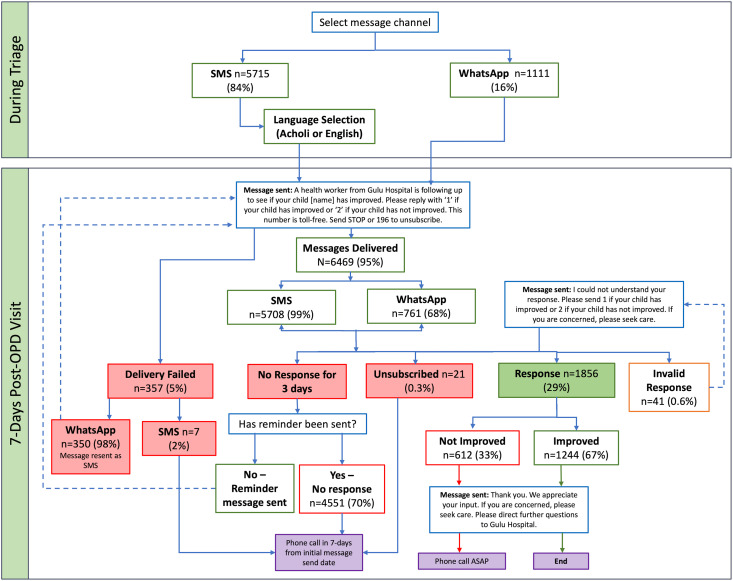
Of 6826 participants, 6469 (95%) messages were successfully delivered. Response rates improved from 20% in April 2023 to 40% in June 2024 and remained stable between 33% and 41% during the post-QI period. Compared to the historical period, post-QI response rates were significantly higher (95% CI: 12.5% to 18.2%, p < 0.001). This improvement reflected a statistically significant positive trend during the QI period. Overall, 1856 caregivers responded: 1244 (67%) reported improvement and 612 (33%) reported no improvement. Follow-up phone calls for those "not improved" revealed 58 (9%) sought care, 12 (2%) were readmitted, and no deaths occurred. For non-responders, 206 (5%) sought care, 33 (0.7%) were readmitted, and 3 (0.07%) deaths occurred.
Automated two-way text messages for post-discharge pediatric follow-up yielded high delivery and moderate response rates. Iterative QI efforts increased response rates, highlighting the importance of tailored communication strategies. Automated messages can facilitate timely intervention for high-risk children and enable efficient collection of health outcomes, offering a viable alternative to in-person follow-up in resource-poor settings.
通过短信(SMS)和即时通讯服务(IMS)进行自动消息传递,为资源有限环境下的患者随访提供了低成本解决方案。本研究旨在评估一项质量改进(QI)举措,以提高乌干达农村地区儿童出院后随访自动消息系统中照护者的回复率。
2022年6月至2024年6月,邀请通过古卢地区转诊医院智能分诊平台进行分诊的儿童的照护者参与自动随访项目。出院七天后通过短信和即时通讯服务(WhatsApp)发送消息,提示照护者报告其孩子是“情况好转”还是“未好转”。对未回复者和“未好转”的病例,研究护士会打电话进行随访。2023年4月至2023年11月,一项质量改进举措对消息系统进行了优化,以提高回复率,之后的质量改进后阶段继续进行干预且无变化,直至2024年6月。对三个阶段的回复率进行了分析:历史阶段(质量改进前,2022年6月至2023年3月)、质量改进干预阶段和质量改进后阶段。此外,还分析了消息送达率、改进策略和健康结果的数据。
在6826名参与者中,成功送达了6469条(95%)消息。回复率从2023年4月的20%提高到2024年6月的40%,在质量改进后阶段保持在33%至41%之间稳定。与历史阶段相比,质量改进后的回复率显著更高(95%置信区间:12.5%至18.2%,p < 0.001)。这一改进在质量改进阶段呈现出统计学上显著的积极趋势。总体而言,1856名照护者做出了回复:1244名(67%)报告情况好转,612名(33%)报告未好转。对那些“未好转”者的随访电话显示,58名(9%)寻求了治疗,12名(2%)再次入院,且无死亡情况发生。对于未回复者,206名(5%)寻求了治疗,33名(0.7%)再次入院,3名(0.07%)死亡。
出院后儿科随访的自动双向短信送达率高且回复率适中。反复的质量改进努力提高了回复率,凸显了量身定制沟通策略的重要性。自动消息可以促进对高危儿童的及时干预,并能有效收集健康结果,为资源匮乏地区的面对面随访提供了可行的替代方案。