Grivas Alexandros, Grigoriou Maria, Papagoras Charalampos, Mitroulis Ioannis, Verginis Panayotis, Katsimbri Pelagia, Boumpas Dimitrios T
Biomedical Research Foundation of the Academy of Athens, Greece.
Joint Rheumatology Program, National and Kapodistrian University of Athens, School of Medicine-Clinical Immunology-Rheumatology Unit, 4th Department of Medicine, Athens, Greece.
Mediterr J Rheumatol. 2023 Jun 30;34(2):271-274. doi: 10.31138/mjr.34.2.271. eCollection 2023 Jun.
Despite the development of treatments targeting T cell co-stimulation and cytokines TNF, IL-12/23, and IL-17, less than half of patients within clinical trials achieve high levels of clinical response. This fact, as well as the absence of prognostic biomarkers represents major unmet clinical needs that necessitate further investigation of the disease pathophysiology. Myeloid cells are critical components of PsA inflammatory mechanisms, being a highly prevalent immune population in biopsies of PsA target tissues, such as the skin and the synovium. Through their antigen-presenting capacity and their pro-angiogenic and pro-inflammatory properties myeloid cells could contribute to persistent inflammation in PsA leading to treatment-resistant disease. To this end, we have recently shown the expansion of monocytes in the blood of PsA patients compared to healthy subjects. Importantly, we have also identified an immature myeloid cell population in patients with highly active, refractory disease, indicating the presence of an "emergency myelopoiesis" process in PsA.
In this research protocol, we aim to decipher the pro-inflammatory "myeloid signature" in patients with active PsA and explore the role of immature myeloid cells in disease pathophysiology and their potential as prognostic biomarkers.
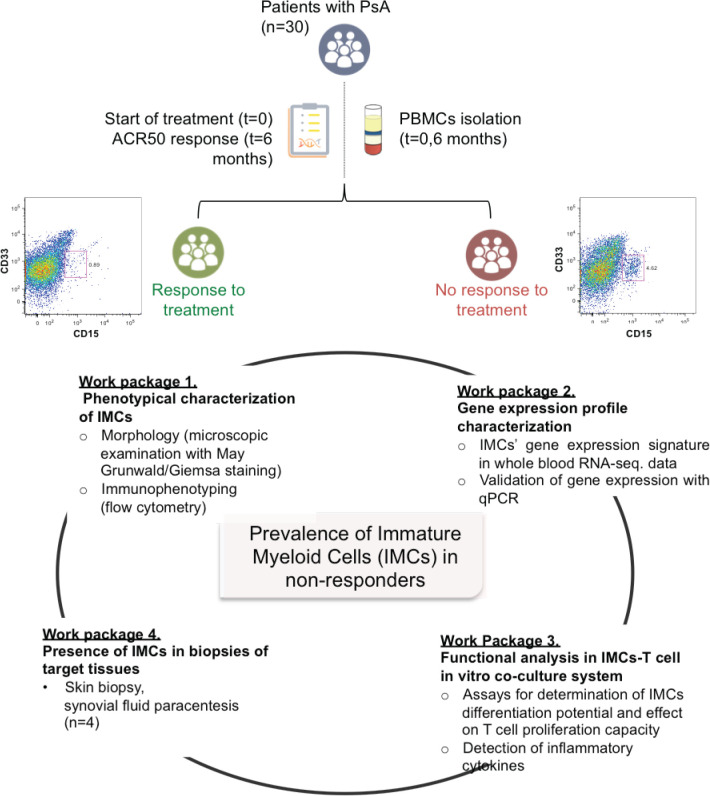
To address this, we will isolate and analyse monocytes and immature myeloid cells from PsA patients -before and after a 6-month treatment course- focusing on differences between responders and non-responders. In this context, we will perform a thorough phenotypic and functional analysis of these cells, identify their expression signature in an already established whole blood RNA-seq dataset and investigate their presence in target tissues, such as the skin and synovial fluid.
This study will elucidate the role of myeloid cells in disease propagation by further defining the involvement of immature myeloid cells in PsA.
尽管针对T细胞共刺激以及细胞因子肿瘤坏死因子(TNF)、白细胞介素-12/23和白细胞介素-17的治疗方法有所发展,但在临床试验中,不到一半的患者能达到高水平的临床反应。这一情况,以及缺乏预后生物标志物,代表了尚未满足的重大临床需求,这就需要对该疾病的病理生理学进行进一步研究。髓样细胞是银屑病关节炎(PsA)炎症机制的关键组成部分,是PsA靶组织(如皮肤和滑膜)活检中高度普遍的免疫细胞群体。通过其抗原呈递能力以及促血管生成和促炎特性,髓样细胞可能导致PsA中的持续性炎症,进而导致难治性疾病。为此,我们最近发现,与健康受试者相比,PsA患者血液中的单核细胞有所增多。重要的是,我们还在高度活跃、难治性疾病患者中鉴定出了一种未成熟髓样细胞群体,这表明PsA中存在“应急髓系造血”过程。
在本研究方案中,我们旨在解读活动性PsA患者的促炎“髓样特征”,并探讨未成熟髓样细胞在疾病病理生理学中的作用及其作为预后生物标志物的潜力。
为解决这一问题,我们将在6个月治疗疗程前后,从PsA患者中分离并分析单核细胞和未成熟髓样细胞,重点关注反应者和无反应者之间的差异。在此背景下,我们将对这些细胞进行全面的表型和功能分析,在已建立的全血RNA测序数据集中确定它们的表达特征,并研究它们在皮肤和滑液等靶组织中的存在情况。
本研究将通过进一步明确未成熟髓样细胞在PsA中的作用,阐明髓样细胞在疾病传播中的作用。