Petrova Valeria, Yonkova Penka, Simeonova Galina, Vachkova Ekaterina
Department of Pharmacology, Animal Physiology and Physiological Chemistry, Faculty of Veterinary Medicine, Trakia University, Stara Zagora, Bulgaria.
Department of Veterinary Anatomy, Histology and Embryology, Faculty of Veterinary Medicine, Trakia University, Stara Zagora, Bulgaria.
Int J Vet Sci Med. 2023 Aug 29;11(1):94-105. doi: 10.1080/23144599.2023.2248805. eCollection 2023.
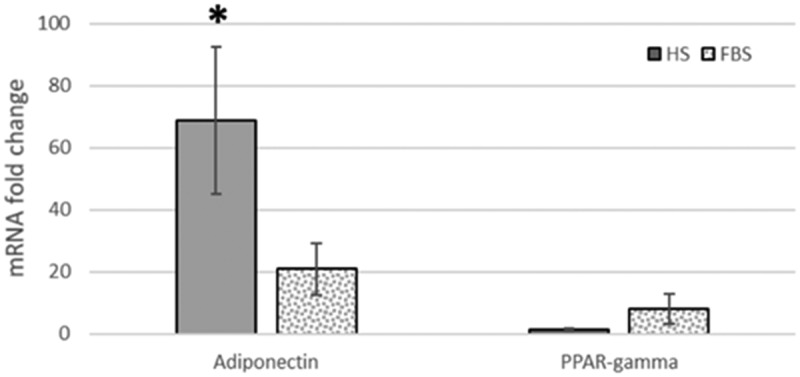
Subcutaneous fat tissue is an accessible and abundant source of multipotent stem cells for cell therapy in regenerative medicine. Successful trilineage differentiation is required to define the stemness features of the obtained mesenchymal cells, and adipogenesis is a part of it. Since indomethacin is bound to serum albumin, replacing foetal bovine serum (FBS) with horse serum (HS) in adipogenic induction protocols would suppress its cytotoxic effect and reveal a better adipogenic potential in equine MSCs. The equine subcutaneous adipose-derived stem cells (ASCs) were separately induced in adipogenesis by three different concentrations of 3-isobutyl-1-methylxanthine, IBMX (0.5 mM; 0.25 mM and 0.1 mM) and indomethacin (0.1 mM; 0.05 mM and 0.02 mM) for 48 h. In contrast to the IBMX, indomethacin in all concentrations caused dramatic cellular detachment. Further, the same induction concentrations were used in FBS and HS conditions for adipogenic induction. The MTT assay revealed that the culture media supplemented with HS raised cellular vitality by about 35% compared to those cultured in FBS. Based on those results, an adipogenic cocktail containing indomethacin (0.05 mM) and IBMX (0.5 mM), supplemented with HS and FBS, respectively, was applied for 18 days. The adiponectin gene expression was significantly up-regulated in HS-supplemented media since established changes in PPAR-gamma were insignificant. The tri-lineage differentiation was successful, and a cross-sectional area of adipocytes was performed. The albumin concentration was higher in HS than in FBS. In conclusion, our study revealed that HS is an appropriate supplement in induced adipogenesis since it probably suppresses the indomethacin-related cytotoxic effect and increases adipogenic ability in equine subcutaneous ASCs.
皮下脂肪组织是再生医学中细胞治疗多能干细胞的一个可获取且丰富的来源。成功的三系分化是定义所获得间充质细胞干性特征所必需的,而成脂分化是其中一部分。由于吲哚美辛与血清白蛋白结合,在成脂诱导方案中用马血清(HS)替代胎牛血清(FBS)会抑制其细胞毒性作用,并在马间充质干细胞中显示出更好的成脂潜力。将马皮下脂肪来源干细胞(ASC)分别用三种不同浓度的3-异丁基-1-甲基黄嘌呤(IBMX,0.5 mM、0.25 mM和0.1 mM)和吲哚美辛(0.1 mM、0.05 mM和0.02 mM)诱导成脂48小时。与IBMX相反,所有浓度的吲哚美辛都会导致细胞剧烈脱离。此外,在FBS和HS条件下使用相同的诱导浓度进行成脂诱导。MTT分析显示,与在FBS中培养的细胞相比,添加HS的培养基使细胞活力提高了约35%。基于这些结果,分别添加HS和FBS的含有吲哚美辛(0.05 mM)和IBMX(0.5 mM)的成脂鸡尾酒应用18天。由于PPAR-γ的既定变化不显著,在添加HS的培养基中脂联素基因表达显著上调。三系分化成功,并对脂肪细胞的横截面积进行了检测。HS中的白蛋白浓度高于FBS。总之,我们的研究表明,HS是诱导成脂过程中的合适补充剂,因为它可能抑制吲哚美辛相关的细胞毒性作用,并提高马皮下ASC的成脂能力。