Division of Hepato-Gastroenterology, Kaohsiung Chang Gung Memorial Hospital and Chang Gung University College of Medicine, Kaohsiung, Taiwan.
Graduate Institute of Clinical Medical Sciences, Chang Gung University College of Medicine, Taoyuan, Taiwan.
PLoS One. 2020 Apr 14;15(4):e0231102. doi: 10.1371/journal.pone.0231102. eCollection 2020.
Our preliminary data showed a slight decrease of estimated glomerular filtration rate (eGFR) after direct-acting antivirals (DAAs) treatment in chronic hepatitis C (CHC). However, long-term outcome of renal evolution after DAAs has not been well documented.
To assess the renal function under DAAs treatment in CHC patients of an Asian population at 6 months and 1 year after complete treatment.
A cohort of 1536 CHC patients who received therapies with DAAs were analyzed. Serial eGFR levels at 24 weeks after treatment (SVR24) and 48 weeks after treatment (SVR48) were evaluated. We compared eGFR at baseline, SVR12, SVR24 and SVR48, and defined renal function deterioration as decrease of eGFR >25% from baseline to SVR24 and SVR48.
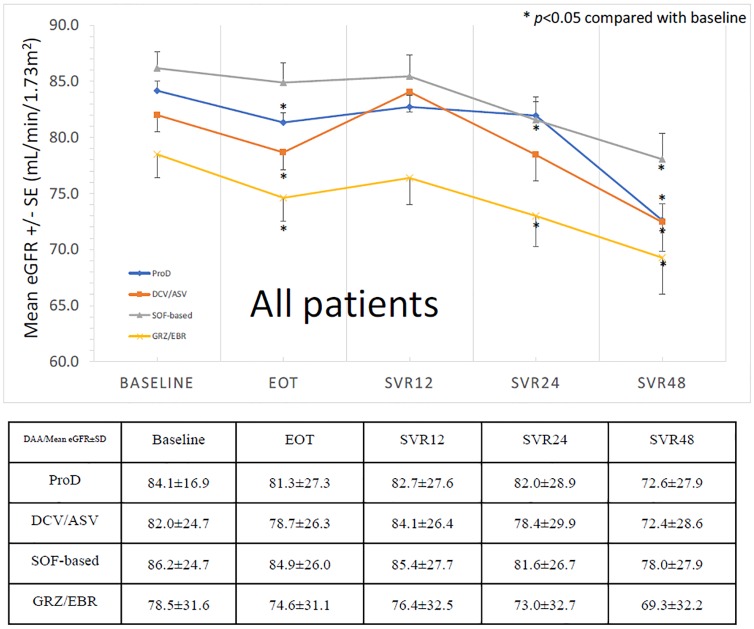
Overall, there was decline of eGFR from SVR12 to SVR48 in all patients (84.30 ± 27.00 -> 73.20 ± 28.67 mL/min/1.73m2, p<0.001). This trend of decline was similar in all groups. Multivariate analysis for deterioration in renal function from baseline to SVR24 showed liver transplantation, hypertension and baseline eGFR < 60 mL/min/1.73m2 were independent risk factors. Multivariate analysis for persistent deterioration in renal function from baseline to SVR48 showed liver transplantation, baseline eGFR < 60 mL/min/1.73m2 and DCV/ASV use were independent predictive factors.
There is a trend of decline in eGFR at 1-year after DAAs treatment regardless of baseline renal function or DAAs. Liver transplantation and baseline eGFR < 60 mL/min/1.73m2 were independent predictive factors of persistent deterioration in renal function from baseline to SVR48. Close monitoring renal function in these patients was suggested.
我们的初步数据显示,慢性丙型肝炎(CHC)患者在接受直接作用抗病毒药物(DAA)治疗后,估算肾小球滤过率(eGFR)略有下降。然而,DAA 治疗后肾脏演变的长期结果尚未得到很好的记录。
在完成治疗后 6 个月和 1 年时,评估亚洲 CHC 患者在 DAA 治疗下的肾功能。
分析了 1536 例接受 DAA 治疗的 CHC 患者的队列。评估治疗后 24 周(SVR24)和 48 周(SVR48)时的连续 eGFR 水平。我们比较了基线、SVR12、SVR24 和 SVR48 时的 eGFR,并将 eGFR 从基线下降 >25%定义为 SVR24 和 SVR48 时的肾功能恶化。
总体而言,所有患者的 eGFR 从 SVR12 下降到 SVR48(84.30 ± 27.00 至 73.20 ± 28.67 mL/min/1.73m2,p<0.001)。这种下降趋势在所有组中均相似。从基线到 SVR24 肾功能恶化的多变量分析显示,肝移植、高血压和基线 eGFR<60 mL/min/1.73m2 是独立的危险因素。从基线到 SVR48 肾功能持续恶化的多变量分析显示,肝移植、基线 eGFR<60 mL/min/1.73m2 和 DCV/ASV 使用是独立的预测因素。
无论基线肾功能或 DAA 如何,DAA 治疗后 1 年 eGFR 呈下降趋势。肝移植和基线 eGFR<60 mL/min/1.73m2 是从基线到 SVR48 肾功能持续恶化的独立预测因素。建议对这些患者进行密切监测肾功能。