Department of Neurology, Johns Hopkins University School of Medicine, Baltimore, MD, USA.
Brain Science Institute, Johns Hopkins University School of Medicine, Baltimore, MD, USA.
FEBS Lett. 2023 Oct;597(20):2546-2566. doi: 10.1002/1873-3468.14729. Epub 2023 Sep 12.
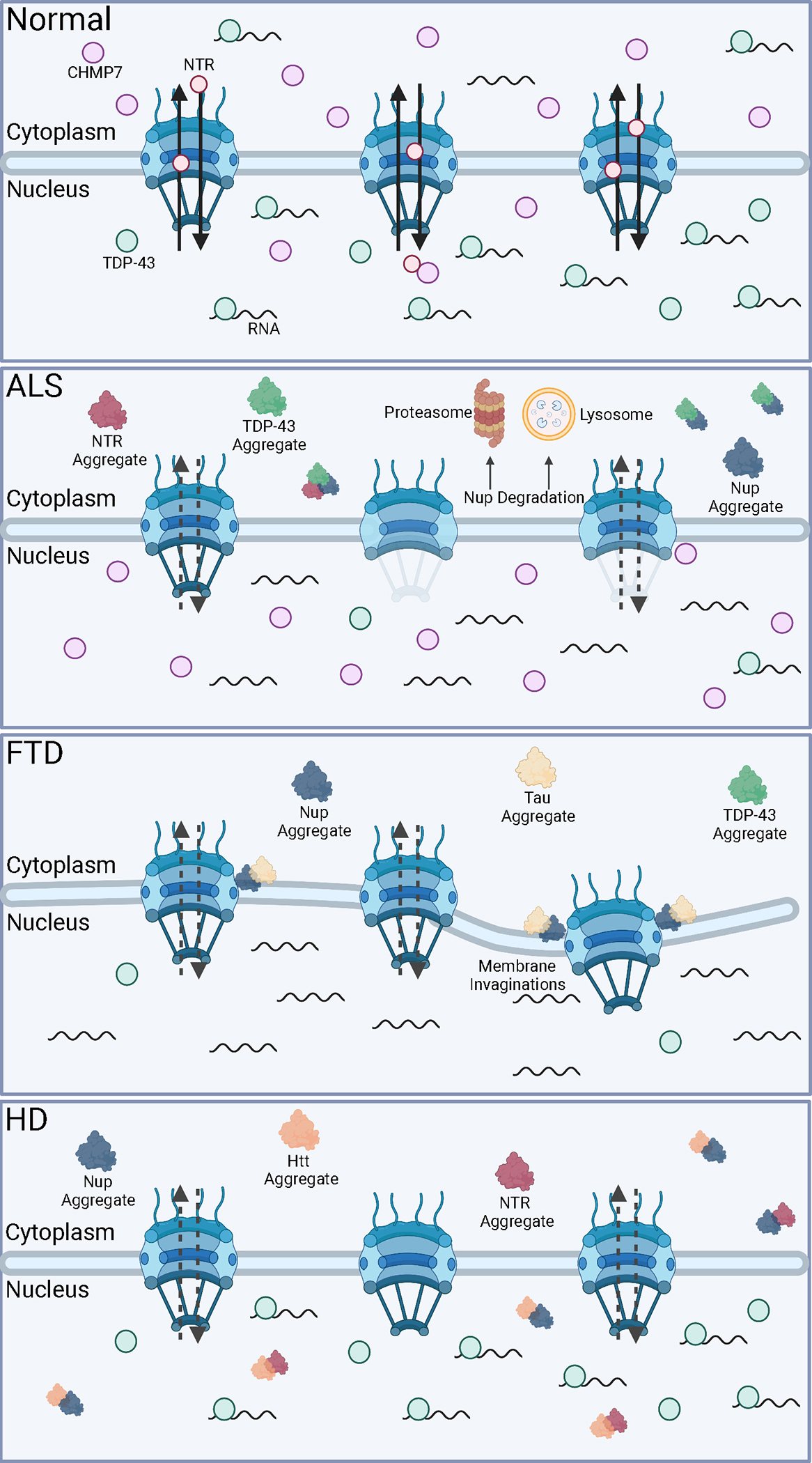
Nuclear pore complexes (NPCs) play a critical role in maintaining the equilibrium between the nucleus and cytoplasm, enabling bidirectional transport across the nuclear envelope, and are essential for proper nuclear organization and gene regulation. Perturbations in the regulatory mechanisms governing NPCs and nuclear envelope homeostasis have been implicated in the pathogenesis of several neurodegenerative diseases. The ESCRT-III pathway emerges as a critical player in the surveillance and preservation of well-assembled, functional NPCs, as well as nuclear envelope sealing. Recent studies have provided insights into the involvement of nuclear ESCRT-III in the selective reduction of specific nucleoporins associated with neurodegenerative pathologies. Thus, maintaining quality control of the nuclear envelope and NPCs represents a pivotal element in the pathological cascade leading to neurodegenerative diseases. This review describes the constituents of the nuclear-cytoplasmic transport machinery, encompassing the nuclear envelope, NPC, and ESCRT proteins, and how their structural and functional alterations contribute to the development of neurodegenerative diseases.
核孔复合体(NPC)在维持核质平衡中起着关键作用,使核被膜的双向运输成为可能,并且对核组织和基因调节至关重要。调节 NPC 和核膜动态平衡的机制的扰动与几种神经退行性疾病的发病机制有关。ESCRT-III 途径作为监视和维护组装良好、功能正常的 NPC 以及核膜封闭的关键参与者出现。最近的研究提供了有关核 ESCRT-III 参与与神经退行性病理相关的特定核孔蛋白选择性减少的见解。因此,维持核膜和 NPC 的质量控制是导致神经退行性疾病的病理级联反应的关键因素。这篇综述描述了核质运输机制的组成部分,包括核被膜、NPC 和 ESCRT 蛋白,以及它们的结构和功能改变如何导致神经退行性疾病的发展。