Department of Oral Anatomy and Dental Research Institute, School of Dentistry, Seoul National University, 101 Daehak-ro, Jongno-gu, Seoul, 03080, Republic of Korea.
Center for Future Dentistry, School of Dentistry, Seoul National University, Seoul, 03080, Republic of Korea.
BMC Oral Health. 2023 Sep 1;23(1):619. doi: 10.1186/s12903-023-03319-x.
Hydrogen peroxide (HP) and citric acid (CA), key contributors to toothpaste acidity, can lead to dental loss. This study aimed to compare the amount of abrasion or loss of dentin based on pH, buffering, and concentration of HP and CA in commercial and experimental toothpastes after toothbrushing or immersion.
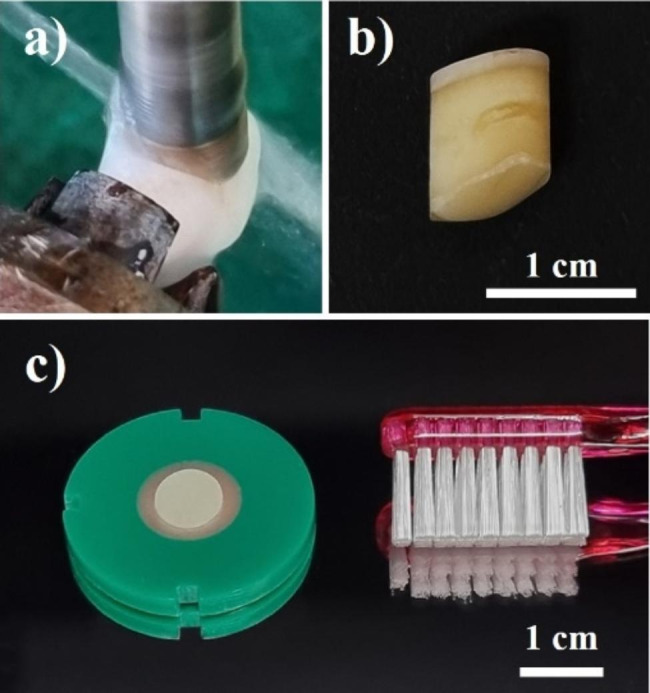
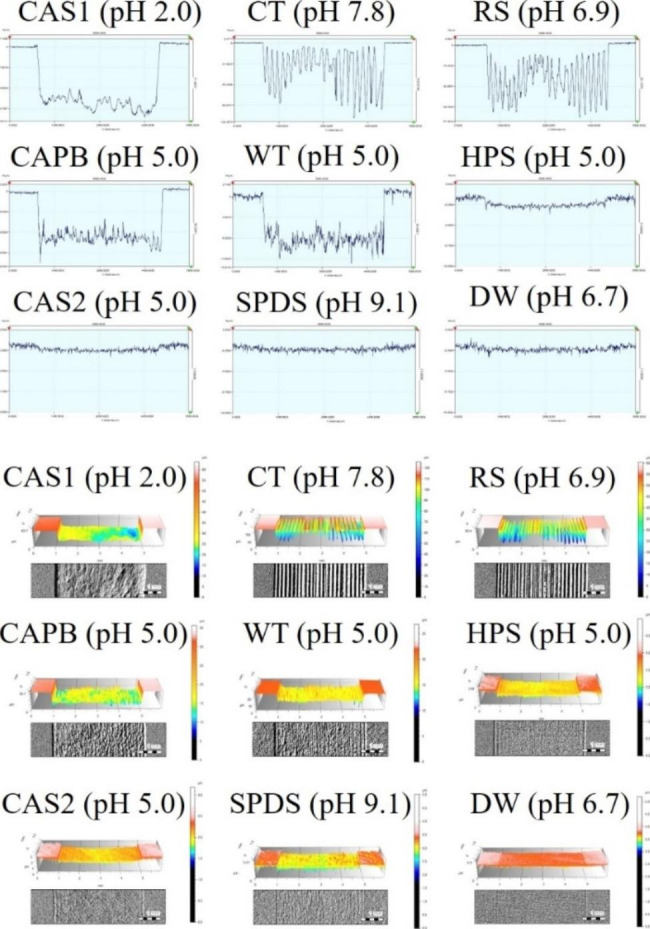
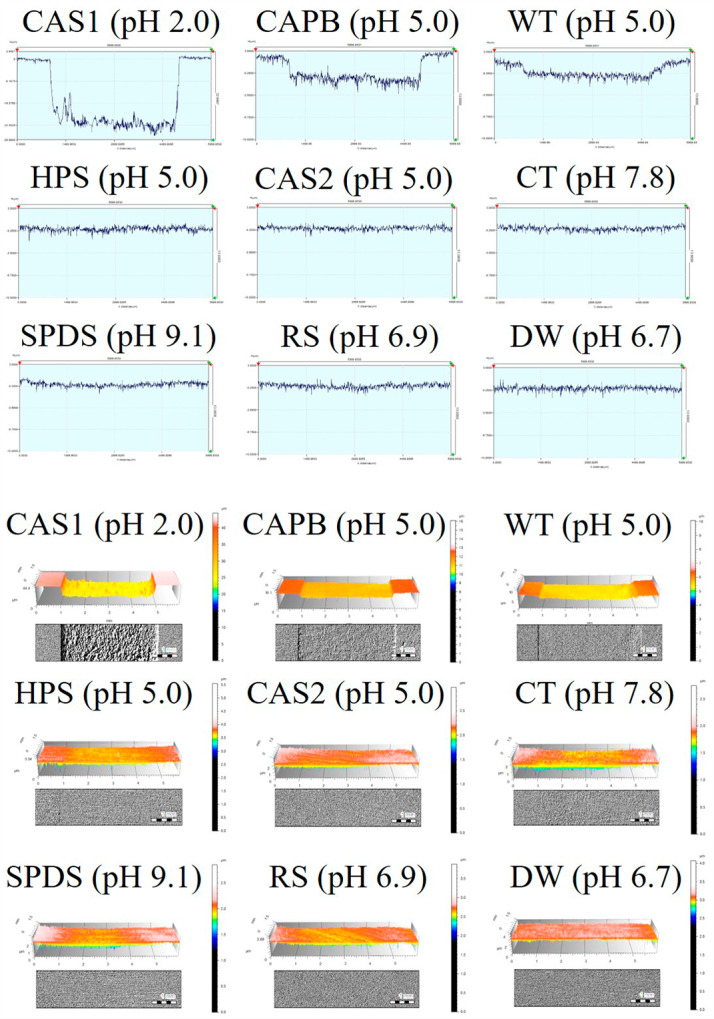
Bovine dentin specimens were randomly assigned to nine solutions. The prepared solutions included two commercial toothpastes (whitening toothpaste [WT] with HP and CA; conventional toothpaste [CT] without HP and CA), reference slurry (RS), two CA solutions (1.92%, CAS1; 0.001%, CAS2), basic solution (7.16% sodium phosphate dibasic [SPDS]), CA phosphate buffer solution (3.58% SPDS and 0.96% CA [CAPB]), HP solution (4%, HPS), and distilled water (DW). Dentin specimens were performed in two treatments: one with only abrasion (10,000 brushings) and one with only immersion (1 h). After treatments, the amount of dentin loss and surface images were measured and observed using noncontact profilometry. Data were analyzed using an one-way analysis of variance and the Tukey test as a post hoc analysis (p < 0.05).
WT with pH 5.0 had lower dentin abrasion than CT and RS after brushing but had higher dentin loss than both after immersion. The dentin surfaces of CAS1, CAPB, and WT were damaged after immersion, whereas HPS, CAS2, CT, SPDS, RS, and DW remained intact after soaking. CAS2 and HPS, which had a pH of 5.0 like WT, did not significantly differ from those of DW after brushing.
WT containing HP and CA did not cause significant dentin abrasion but may cause additional dentin loss even without brushing. After brushing or immersion, the CA concentration may affect the dentin surface more than the HP concentration included in WT. The amount of abrasion or loss of dentin after brushing or soaking can vary based on the composition, concentration, and buffer in the solution, even if the pH of the solution is similar to pH 5.0.
过氧化氢(HP)和柠檬酸(CA)是牙膏酸度的主要贡献者,会导致牙齿损失。本研究旨在比较基于 pH 值、缓冲能力和 HP 和 CA 浓度的商业和实验牙膏在刷牙或浸泡后对牙本质的磨损或损失量。
将牛牙本质标本随机分配到九种溶液中。制备的溶液包括两种商业牙膏(含 HP 和 CA 的美白牙膏[WT];不含 HP 和 CA 的常规牙膏[CT])、参考浆料(RS)、两种 CA 溶液(1.92%,CAS1;0.001%,CAS2)、碱性溶液(7.16% 磷酸氢二钠[SPDS])、CA 磷酸盐缓冲溶液(3.58% SPDS 和 0.96% CA[CAPB])、HP 溶液(4%,HPS)和蒸馏水(DW)。牙本质标本进行了两种处理:仅磨损(10000 次刷牙)和仅浸泡(1 小时)。处理后,使用非接触式轮廓仪测量和观察牙本质损失量和表面图像。使用单向方差分析和 Tukey 检验作为事后分析(p<0.05)对数据进行分析。
pH 值为 5.0 的 WT 在刷牙后对牙本质的磨损程度低于 CT 和 RS,但浸泡后牙本质的损失量高于两者。浸泡后 CAS1、CAPB 和 WT 的牙本质表面受损,而 HPS、CAS2、CT、SPDS、RS 和 DW 浸泡后仍保持完整。pH 值与 WT 相同的 CAS2 和 HPS 在刷牙后与 DW 无显著差异。
含 HP 和 CA 的 WT 不会导致明显的牙本质磨损,但即使不刷牙也可能导致额外的牙本质损失。刷牙或浸泡后,CA 浓度对牙本质表面的影响可能大于 WT 中包含的 HP 浓度。即使溶液的 pH 值与 5.0 相似,刷牙或浸泡后牙本质的磨损或损失量也可能因溶液的成分、浓度和缓冲能力而异。