Nursing Graduate Program, Universidade Federal do Pará, Rua Augusto Correia, 01 - Setor Saúde, Guamá - Belém, Pará, 66075-110, Brazil.
Escola de Enfermagem de Ribeirão Preto. Graduate Program in Fundamental Nursing, Universidade de São Paulo, Av.Bandeirantes, Ribeirão Preto, 3900, 14040-902, SP, Brazil.
BMC Womens Health. 2023 Sep 1;23(1):463. doi: 10.1186/s12905-023-02616-5.
Approximately 37.7 million people worldwide are infected with human immunodeficiency virus (HIV). Although HIV detection among women, they still representing 53% of population living with the virus. Spatial analysis techniques are powerful tools for combating HIV allowing the association of the phenomenon with socioeconomic and political factors. Therefore, the main goal of this study was to spatially analyze HIV prevalence among Brazilian women from 2007 to 2020.
ecological study was conducted using secondary databases of the Notifiable Diseases Information System (SINAN) for HIV and Acquired Immunodeficiency Syndrom (AIDS) in Brazilian women 15 years old and over. Age-adjusted HIV/AIDS incidence rates were analyzed using spatial distribution, autocorrelation, and spatiotemporal risk analysis techniques.
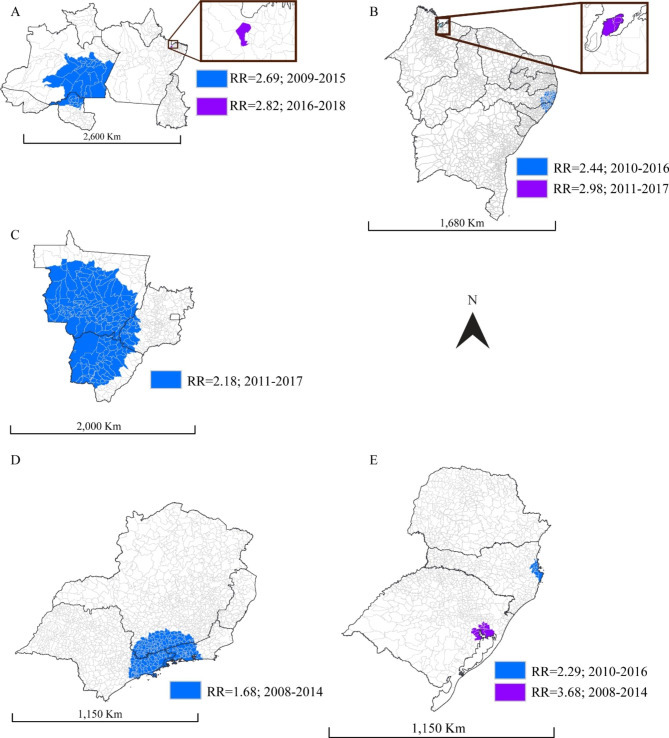
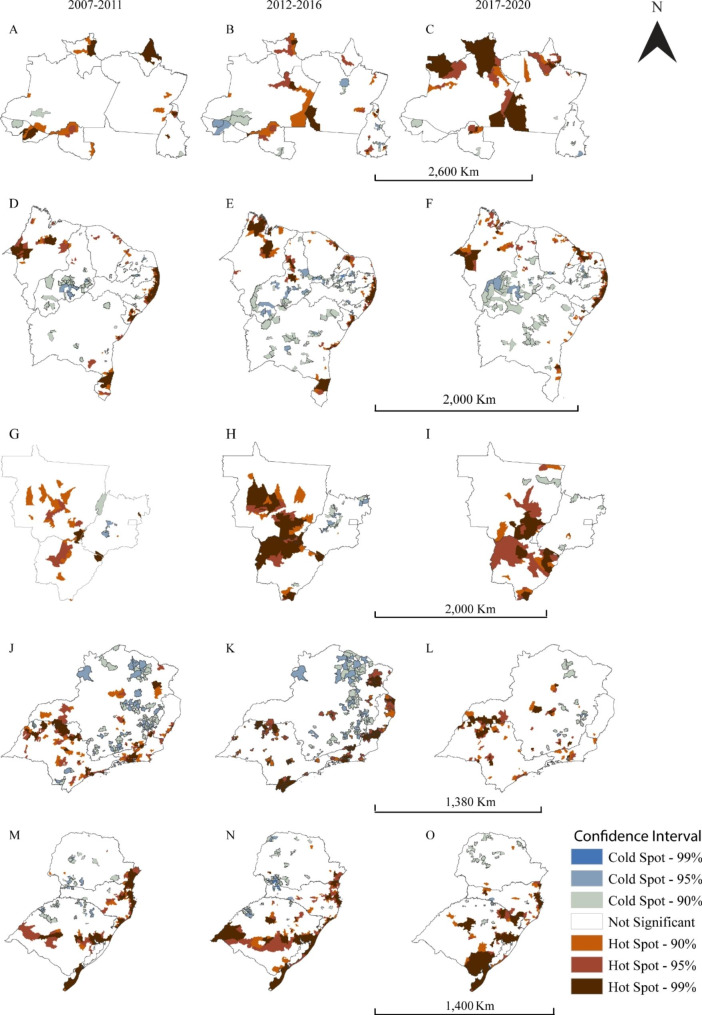
During the study period, 119,890 cases of HIV/AIDS were reported among Brazilian women. The southeastern region had a higher age-adjusted HIV/AIDS incidence than other Brazilian regions. Hotspot HIV/AIDS incidence rates decreased in all Brazil. Piauí, Paraná, and Minas Gerais were the only states with an increased number of cold spots. Previous spatiotemporal risk zones were observed in the states of São Paulo, Rio Grande do Sul, and Rio de Janeiro. Belém was a risk zone with a later spatiotemporal risk.
The efficiency of public policies fighting HIV has not been uniform among municipalities, although HIV/AIDS cases have decreased among Brazilian women. The social determinants of health in each municipality should be considered when local health authorities implement policies. Women empowerment should be promoted, and access to preventive, diagnostic, and treatment healthcare places should be expanded and guaranteed.
全球约有 3770 万人感染人类免疫缺陷病毒(HIV)。尽管女性的 HIV 检测率有所提高,但她们仍占病毒携带者总数的 53%。空间分析技术是对抗 HIV 的有力工具,可以将该现象与社会经济和政治因素联系起来。因此,本研究的主要目的是分析 2007 年至 2020 年巴西女性 HIV 的流行情况。
本研究采用巴西 15 岁及以上女性的传染病报告系统(SINAN)中 HIV 和获得性免疫缺陷综合征(AIDS)的二级数据库进行生态研究。采用空间分布、自相关和时空风险分析技术分析年龄调整后的 HIV/AIDS 发病率。
在研究期间,巴西女性共报告了 119890 例 HIV/AIDS 病例。东南部地区的年龄调整 HIV/AIDS 发病率高于巴西其他地区。巴西所有地区的热点 HIV/AIDS 发病率均有所下降。皮奥伊、巴拉那和米纳斯吉拉斯州是冷点数量增加的唯三州。在圣保罗、南里奥格兰德州和里约热内卢观察到先前的时空风险区。贝伦是一个具有后期时空风险的危险区。
尽管巴西女性的 HIV/AIDS 病例有所减少,但各地公共卫生政策防治 HIV 的效率并不均衡。在地方卫生当局实施政策时,应考虑每个城市的卫生保健的社会决定因素。应促进妇女赋权,并扩大和保障获得预防、诊断和治疗保健的机会。