Department of Radiology, National Clinical Research Center for Geriatric Disorders, Xiangya Hospital, Central South University, No.87 Xiangya Rd., Kai Fu District, Changsha, 410008, Hunan, China.
MR Research, GE Healthcare, Beijing, 100176, China.
Cancer Imaging. 2023 Sep 1;23(1):80. doi: 10.1186/s40644-023-00602-6.
The three-dimensional chemical exchange saturation transfer (3D CEST) technique is a novel and promising magnetic resonance sequence; however, its application in nasopharyngeal carcinoma (NPC) lacks sufficient evaluation. This study aimed to assess the feasibility of the 3D CEST technique in predicting the short-term treatment outcomes for chemoradiotherapy (CRT) in NPC patients.
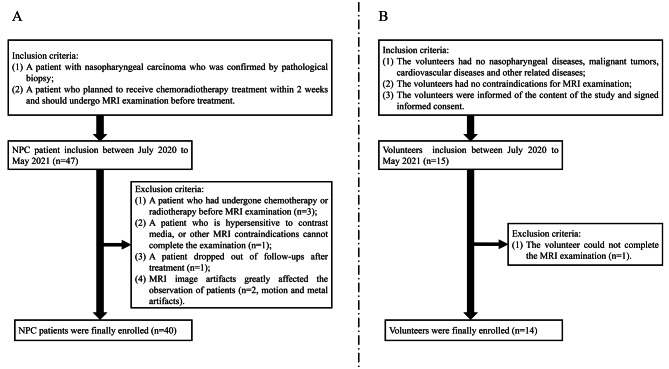
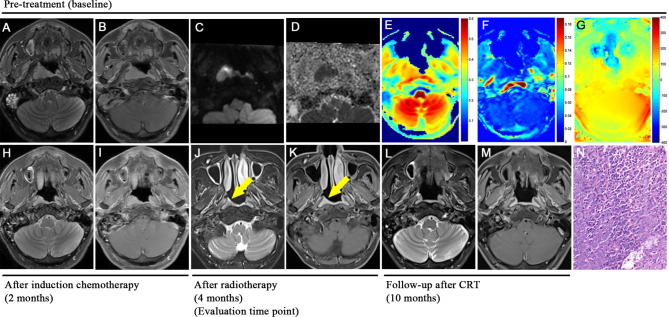
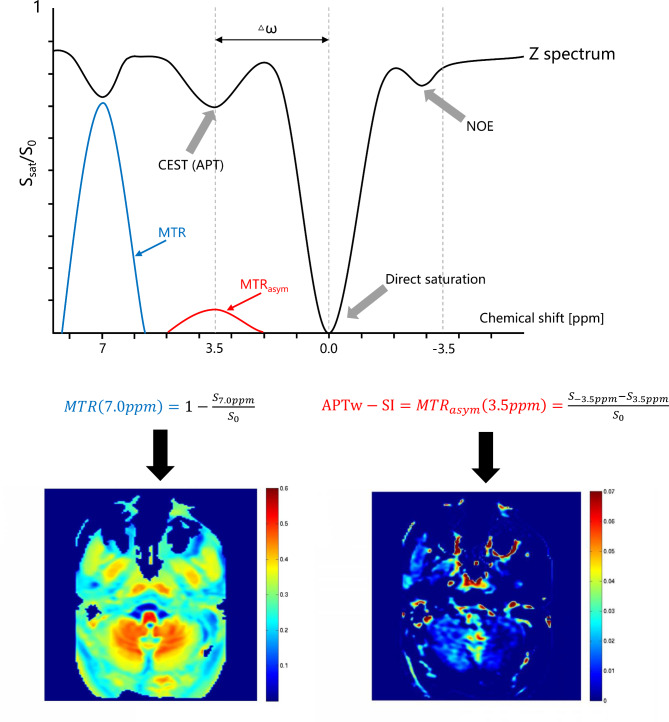
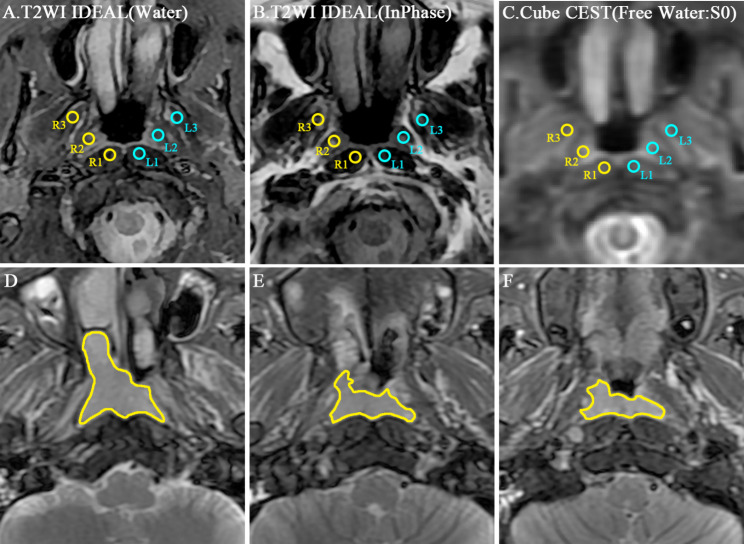
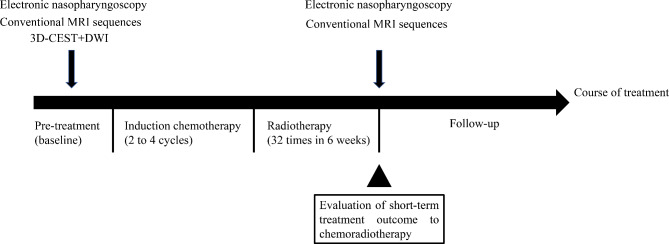
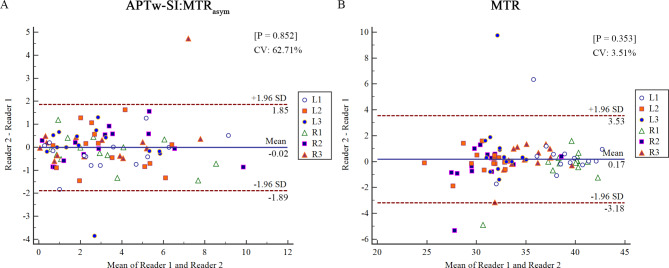
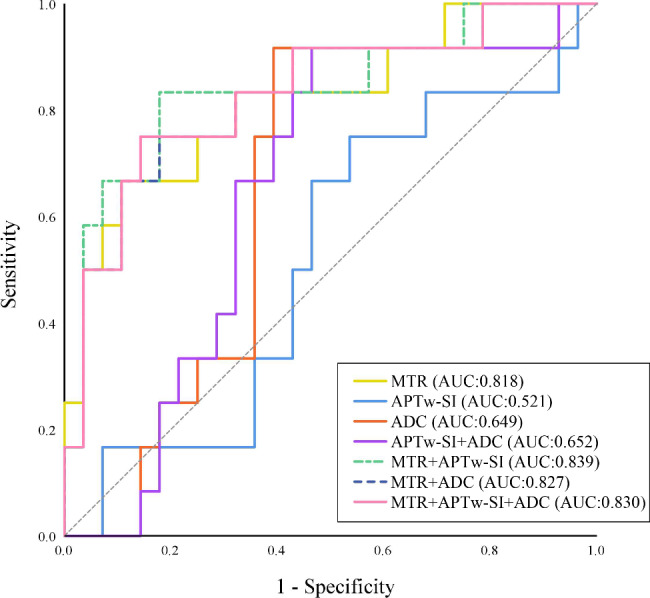
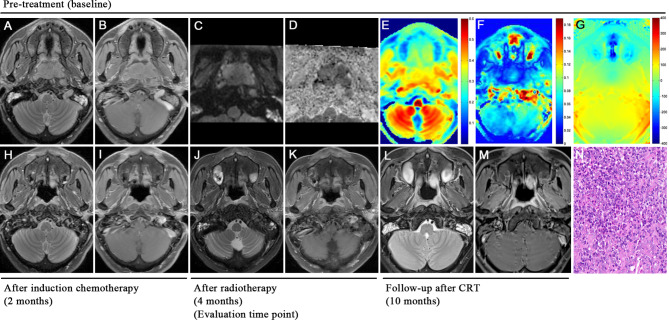
Forty NPC patients and fourteen healthy volunteers were enrolled and underwent the pre-treatment 3D CEST magnetic resonance imaging and diffusion-weighted imaging (DWI). The reliability of 3D CEST was assessed in healthy volunteers by calculating the intra- and inter-observer correlation coefficient (ICC) for amide proton transfer weighted-signal intensity (APTw-SI) and magnetization transfer ratio (MTR) values. NPC patients were divided into residual and non-residual groups based on short-term treatment outcomes after CRT. Whole-tumor regions of interest (ROIs) were manually drawn to measure APTw-SI, MTR and apparent diffusion coefficient (ADC) values. Multivariate analysis and the receiver operating characteristic curve (ROC) were used to evaluate the prediction performance of clinical characteristics, APTw-SI, MTR, ADC values, and combined models in predicting short-term treatment outcomes in NPC patients.
For the healthy volunteer group, all APTw-SI and MTR values exhibited good to excellent intra- and inter-observer agreements (0.736-0.910, 0.895-0.981, all P > 0.05). For NPC patients, MTR values showed a significant difference between the non-residual and residual groups (31.24 ± 5.21% vs. 34.74 ± 1.54%, P = 0.003) while no significant differences were observed for APTw-SI and ADC values (P > 0.05). Moreover, the diagnostic power of MTR value was superior to APTw-SI (AUC: 0.818 vs. 0.521, P = 0.017) and comparable to ADC values (AUC: 0.818 vs. 0.649, P > 0.05) in predicting short-term treatment outcomes for NPC patients. The prediction performance did not improve even when combining MTR values with APTw-SI and/or ADC values (P > 0.05).
The pre-treatment MTR value acquired through 3D CEST demonstrated superior predictive performance for short-term treatment outcomes compared to APTw-SI and ADC values in NPC patients after CRT.
三维化学交换饱和转移(3D CEST)技术是一种新颖且有前途的磁共振序列;然而,其在鼻咽癌(NPC)中的应用缺乏充分的评估。本研究旨在评估 3D CEST 技术在预测 NPC 患者放化疗(CRT)短期治疗结果中的可行性。
纳入 40 名 NPC 患者和 14 名健康志愿者,进行治疗前 3D CEST 磁共振成像和弥散加权成像(DWI)检查。通过计算酰胺质子转移加权信号强度(APTw-SI)和磁化转移率(MTR)值的观察者内和观察者间相关系数(ICC)评估 3D CEST 的可靠性。根据 CRT 后短期治疗结果,将 NPC 患者分为残留组和非残留组。手动勾画全肿瘤感兴趣区(ROI),测量 APTw-SI、MTR 和表观弥散系数(ADC)值。采用多变量分析和受试者工作特征曲线(ROC)评估临床特征、APTw-SI、MTR、ADC 值以及联合模型在预测 NPC 患者短期治疗结果中的预测性能。
在健康志愿者组中,所有 APTw-SI 和 MTR 值的观察者内和观察者间一致性均较好至极好(0.736-0.910,0.895-0.981,均 P>0.05)。在 NPC 患者中,MTR 值在非残留组和残留组之间存在显著差异(31.24±5.21% vs. 34.74±1.54%,P=0.003),而 APTw-SI 和 ADC 值无显著差异(P>0.05)。此外,MTR 值在预测 NPC 患者短期治疗结果方面的诊断效能优于 APTw-SI(AUC:0.818 与 0.521,P=0.017),与 ADC 值相当(AUC:0.818 与 0.649,P>0.05)。即使将 MTR 值与 APTw-SI 和/或 ADC 值相结合,其预测性能也没有改善(P>0.05)。
与 CRT 后 NPC 患者的 APTw-SI 和 ADC 值相比,3D CEST 获得的预处理 MTR 值在预测短期治疗结果方面具有更好的预测性能。