CRO Aviano, National Cancer Institute, IRCCS, Aviano, Italy.
KI4LIFE, Fraunhofer Austria Research, Klagenfurt, Austria.
Am J Clin Pathol. 2023 Dec 1;160(6):620-632. doi: 10.1093/ajcp/aqad099.
This article addresses the need for effective screening methods to identify negative urine samples before urine culture, reducing the workload, cost, and release time of results in the microbiology laboratory. We try to overcome the limitations of current solutions, which are either too simple, limiting effectiveness (1 or 2 parameters), or too complex, limiting interpretation, trust, and real-world implementation ("black box" machine learning models).
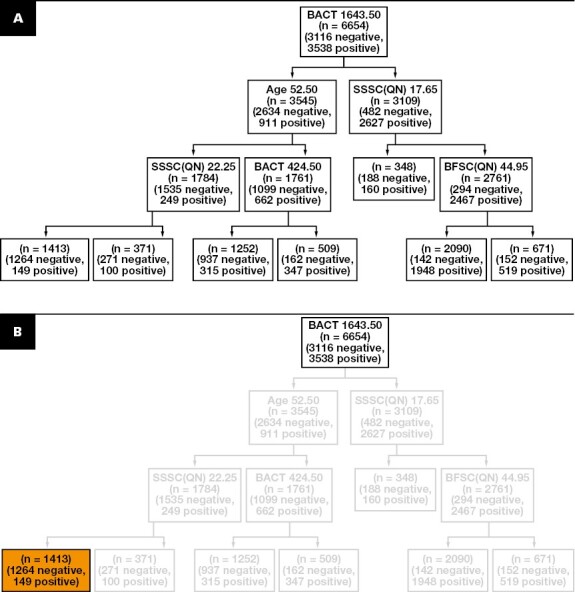
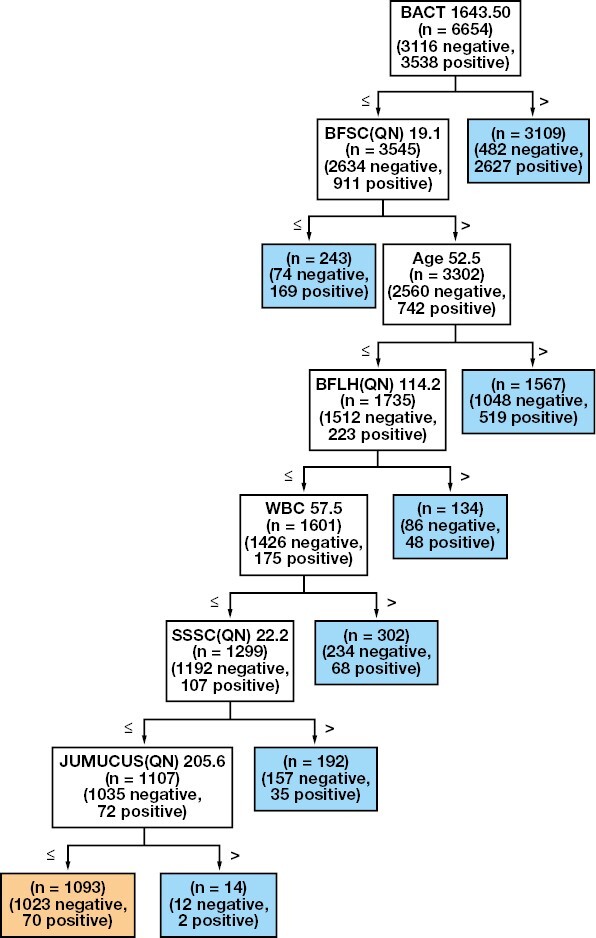
The study analyzed 15,312 samples from 10,534 patients with clinical features and the Sysmex Uf-1000i automated analyzer data. Decision tree (DT) models with or without lookahead strategy were used, as they offer a transparent set of logical rules that can be easily understood by medical professionals and implemented into automated analyzers.
The best model achieved a sensitivity of 94.5% and classified negative samples based on age, bacteria, mucus, and 2 scattering parameters. The model reduced the workload by an additional 16% compared to the current procedure in the laboratory, with an estimated financial impact of €40,000/y considering 15,000 samples/y. Identified logical rules have a scientific rationale matched to existing knowledge in the literature.
Overall, this study provides an effective and interpretable screening method for urine culture in microbiology laboratories, using data from the Sysmex UF-1000i automated analyzer. Unlike other machine learning models, our model is interpretable, generating trust and enabling real-world implementation.
本文旨在寻找有效的筛选方法,以便在进行尿液培养之前识别出阴性尿液样本,从而减少微生物实验室的工作量、成本和结果发布时间。我们试图克服当前解决方案的局限性,这些方案要么过于简单,限制了有效性(仅使用 1 或 2 个参数),要么过于复杂,限制了解释、信任和实际应用(“黑盒”机器学习模型)。
本研究分析了来自 10534 例具有临床特征的患者的 15312 个样本和希森美康 UF-1000i 自动分析仪数据。使用了具有或不具有前瞻策略的决策树(DT)模型,因为它们提供了一组易于医疗专业人员理解并可应用于自动分析仪的透明逻辑规则。
最佳模型的灵敏度达到 94.5%,可根据年龄、细菌、黏液和 2 个散射参数对阴性样本进行分类。与实验室当前的程序相比,该模型将工作量减少了 16%,考虑到每年 15000 个样本,预计每年可节省 40000 欧元。确定的逻辑规则具有科学依据,与文献中的现有知识相匹配。
总的来说,本研究为微生物实验室的尿液培养提供了一种有效且可解释的筛选方法,该方法使用了希森美康 UF-1000i 自动分析仪的数据。与其他机器学习模型不同,我们的模型具有可解释性,可建立信任并实现实际应用。