Kamali Ali N, Bautista José M, Eisenhut Michael, Hamedifar Haleh
CinnaGen Medical Biotechnology Research Center, Alborz University of Medical Sciences, Simin Dasht Industrial Area, Karaj, Iran.
CinnaGen Research and Production Co., Alborz 3165933155, Iran.
Ther Adv Vaccines Immunother. 2023 Aug 30;11:25151355231192043. doi: 10.1177/25151355231192043. eCollection 2023.
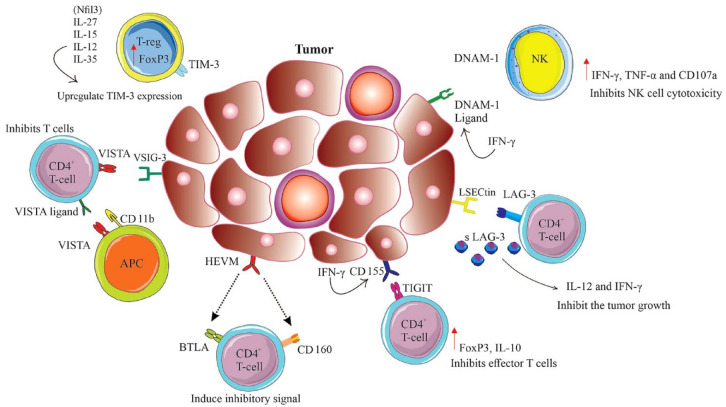
Checkpoint markers and immune checkpoint inhibitors have been increasingly identified and developed as potential immunotherapeutic targets in various human cancers. Despite valuable efforts to discover novel immune checkpoints and their ligands, the precise roles of their therapeutic functions, as well as the broad identification of their counterpart receptors, remain to be addressed. In this context, it has been suggested that various putative checkpoint receptors can be induced upon activation. In the tumor microenvironment, T cells, as crucial immune response against malignant diseases as well as other immune central effector cells, such as natural killer cells, are regulated co-stimulatory or co-inhibitory signals from immune or tumor cells. Studies have shown that exposure of T cells to tumor antigens upregulates the expression of inhibitory checkpoint receptors, leading to T-cell dysfunction or exhaustion. Although targeting immune checkpoint regulators has shown relative clinical efficacy in some tumor types, most trials in the field of cancer immunotherapies have revealed unsatisfactory results due to or adaptive resistance in cancer patients. To overcome these obstacles, combinational therapies with newly discovered inhibitory molecules or combined blockage of several checkpoints provide a rationale for further research. Moreover, precise identification of their receptors counterparts at crucial checkpoints is likely to promise effective therapies. In this review, we examine the prospects for the application of newly emerging checkpoints, such as T-cell immunoglobulin and mucin domain 3, lymphocyte activation gene-3, T-cell immunoreceptor with Ig and ITIM domains (TIGIT), V-domain Ig suppressor of T-cell activation (VISTA), new B7 family proteins, and B- and T-cell lymphocyte attenuator, in association with immunotherapy of malignancies. In addition, their clinical and biological significance is discussed, including their expression in various human cancers, along with their roles in T-cell-mediated immune responses.
检查点标志物和免疫检查点抑制剂已越来越多地被确定并开发为各种人类癌症潜在的免疫治疗靶点。尽管在发现新型免疫检查点及其配体方面付出了宝贵努力,但其治疗功能的确切作用以及对应受体的广泛识别仍有待解决。在这种情况下,有人提出各种假定的检查点受体可在激活后被诱导。在肿瘤微环境中,T细胞作为针对恶性疾病的关键免疫反应以及其他免疫中心效应细胞,如自然杀伤细胞,受到来自免疫细胞或肿瘤细胞的共刺激或共抑制信号的调节。研究表明,T细胞暴露于肿瘤抗原会上调抑制性检查点受体的表达,导致T细胞功能障碍或耗竭。尽管靶向免疫检查点调节剂在某些肿瘤类型中已显示出相对的临床疗效,但癌症免疫治疗领域的大多数试验都因癌症患者的原发性或适应性耐药而显示出不尽人意的结果。为克服这些障碍,与新发现的抑制分子联合治疗或联合阻断多个检查点为进一步研究提供了理论依据。此外,精确识别关键检查点处的对应受体可能会带来有效的治疗方法。在这篇综述中,我们研究了新兴检查点,如T细胞免疫球蛋白和粘蛋白结构域3、淋巴细胞激活基因-3、具有Ig和ITIM结构域的T细胞免疫受体(TIGIT)、T细胞激活的V结构域Ig抑制因子(VISTA)、新的B7家族蛋白以及B和T淋巴细胞衰减器,在恶性肿瘤免疫治疗中的应用前景。此外,还讨论了它们的临床和生物学意义,包括它们在各种人类癌症中的表达以及它们在T细胞介导的免疫反应中的作用。