Kouhen Fadila, El Ghanmi Adil, Inghaoun Hanane, Miftah Hayat, Ghazi Bouchra, Badou Abdallah
Mohammed VI Faculty of Medicine, Mohammed VI University of Sciences and Health (UM6SS), Rabat, Morocco.
Laboratory of Neurooncology, Oncogenetic and Personalized Medicine, Faculty of Medicine, Mohammed VI University of Sciences and Health (UM6SS), Casablanca, Morocco.
Front Immunol. 2025 May 13;16:1573576. doi: 10.3389/fimmu.2025.1573576. eCollection 2025.
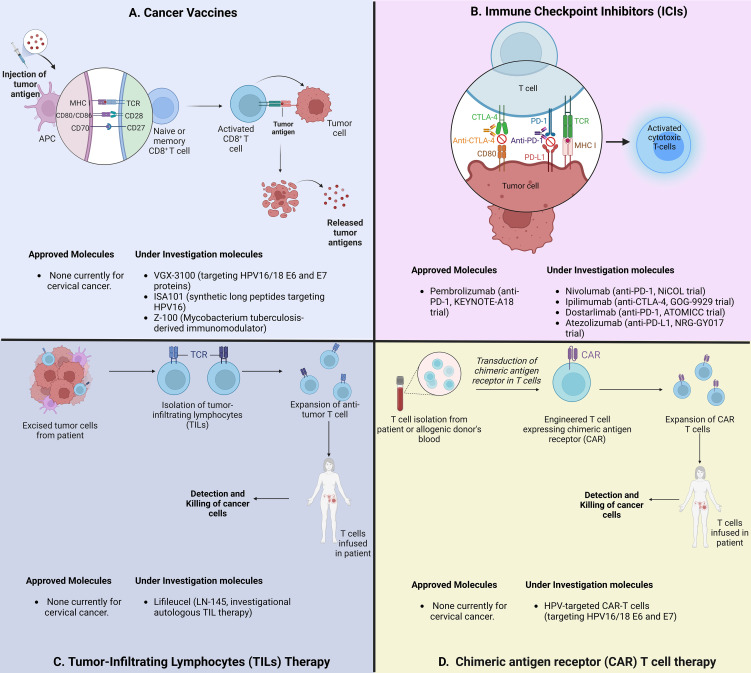
Locally advanced cervical cancer remains a significant therapeutic challenge, with high rates of recurrence and metastasis despite advances in chemoradiation. Immunotherapy, particularly immune checkpoint inhibitors targeting the PD-1/PD-L1 axis, has emerged as a promising strategy to enhance treatment efficacy. This review explores the integration of immunotherapy with standard chemoradiation, highlighting the potential of PD-1 inhibitors, such as pembrolizumab, in improving progression-free survival (PFS) among high-risk patients. Furthermore, the role of predictive biomarkers, including microsatellite instability (MSI) and tumor mutational burden (TMB), is examined to refine patient selection and personalize therapeutic approaches. Emerging strategies, including the use of nivolumab, ipilimumab, and maintenance immunotherapy, are also discussed. While preliminary clinical data are encouraging, further research is required to optimize treatment combinations, establish robust patient selection criteria, and enhance long-term outcomes in cervical cancer management.
局部晚期宫颈癌仍然是一个重大的治疗挑战,尽管放化疗取得了进展,但复发和转移率仍然很高。免疫疗法,特别是针对PD-1/PD-L1轴的免疫检查点抑制剂,已成为提高治疗效果的一种有前景的策略。本综述探讨了免疫疗法与标准放化疗的整合,强调了帕博利珠单抗等PD-1抑制剂在改善高危患者无进展生存期(PFS)方面的潜力。此外,还研究了预测性生物标志物的作用,包括微卫星不稳定性(MSI)和肿瘤突变负荷(TMB),以优化患者选择并实现治疗方法的个性化。还讨论了包括使用纳武利尤单抗、伊匹木单抗和维持免疫疗法在内的新兴策略。虽然初步临床数据令人鼓舞,但仍需要进一步研究以优化治疗组合、建立可靠的患者选择标准,并改善宫颈癌管理的长期疗效。