Alinia Tahereh, Khodakarim Soheila, Tehrani Fahimeh Ramezani, Sabour Siamak
Student Research Committee, School of Health and Safety, Shahid Beheshti University of Medical Sciences, Tehran, Iran.
Department of Epidemiology, School of Allied Medical Sciences, School of Public Health and Safety, Shahid Beheshti University of Medical Sciences, Tehran, Iran.
Int J Prev Med. 2021 Dec 30;12:180. doi: 10.4103/ijpvm.IJPVM_647_20. eCollection 2021.
The timing of the age at which menopause occurs varies among female populations. This variation is attributed to genetic and environmental factors. This study aims to investigate the determinants of early and late-onset menopause.
We used data from the National Health and Nutrition Examination Survey 2013-2014 for 762 naturally menopause women. Data on sociodemographic, lifestyle, examination, and laboratory characteristics were examined. We used random forest (RF), support vector machine (SVM), and logistic regression (LR) to identify important determinants of early and late-onset menopause. We compared the performance of models using sensitivity, specificity, Brier score, and area under the receiver operating characteristic (AUROC). The top determinants were assessed by using the best performing models, using the mean decease in Gini.
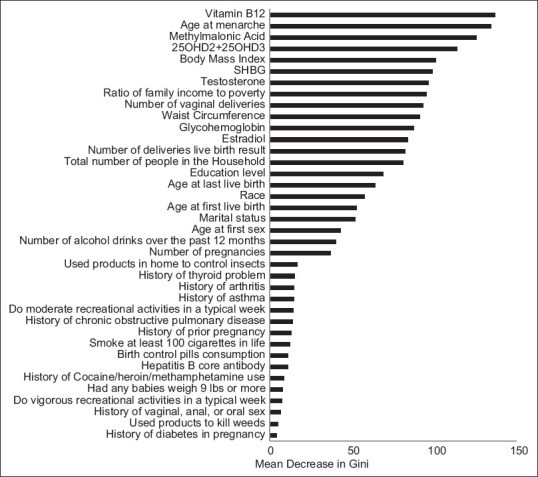
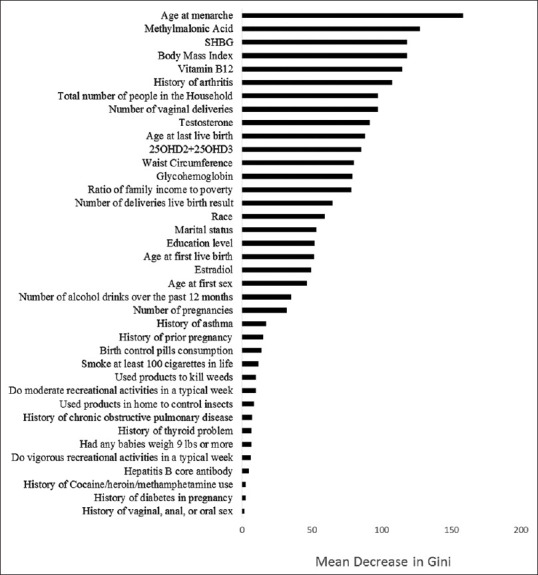
Random forest outperformed LR and SVM with overall AUROC 99% for identifying related factors of early and late-onset menopause (Brier score: 0.051 for early and 0.005 for late-onset menopause). Vitamin B12 and age at menarche were strongly related to early menopause. Also, methylmalonic acid (MMA), vitamin D, body mass index (BMI) were among the top highly ranked factors contributing to early menopause. Features such as age at menarche, MMA, sex hormone-binding globulin (SHBG), BMI, vitamin B12 were the most important covariate for late-onset menopause.
Menarche age and BMI are among the important contributors of early and late-onset menopause. More research on the association between vitamin D, vitamin B12, SHBG, and menopause timing is required which will produce invaluable information for better prediction of menopause timing.
女性群体中绝经发生的年龄时间各不相同。这种差异归因于遗传和环境因素。本研究旨在调查早发性和晚发性绝经的决定因素。
我们使用了2013 - 2014年全国健康与营养检查调查中762名自然绝经女性的数据。对社会人口统计学、生活方式、检查和实验室特征的数据进行了研究。我们使用随机森林(RF)、支持向量机(SVM)和逻辑回归(LR)来确定早发性和晚发性绝经的重要决定因素。我们使用敏感性、特异性、布里尔评分和受试者工作特征曲线下面积(AUROC)来比较模型的性能。通过使用基尼系数的平均下降,利用表现最佳的模型评估首要决定因素。
随机森林在识别早发性和晚发性绝经相关因素方面优于LR和SVM,总体AUROC为99%(布里尔评分:早发性绝经为0.051,晚发性绝经为0.005)。维生素B12和初潮年龄与早发性绝经密切相关。此外,甲基丙二酸(MMA)、维生素D、体重指数(BMI)是导致早发性绝经的排名靠前的因素。初潮年龄、MMA、性激素结合球蛋白(SHBG)、BMI、维生素B12等特征是晚发性绝经最重要的协变量。
初潮年龄和BMI是早发性和晚发性绝经的重要影响因素。需要对维生素D、维生素B12、SHBG与绝经时间之间的关联进行更多研究,这将为更好地预测绝经时间提供宝贵信息。