Ali A M Mohamed Thoufic, Narayana S Devi Soorya, Lulu S Sajitha, Nag Sagnik, Sundararajan Vino
Integrative Multiomics Lab, School of Bio Sciences and Technology, Vellore Institute of Technology, Vellore 632014, Tamil Nadu, India.
Heliyon. 2023 Aug 19;9(8):e19270. doi: 10.1016/j.heliyon.2023.e19270. eCollection 2023 Aug.
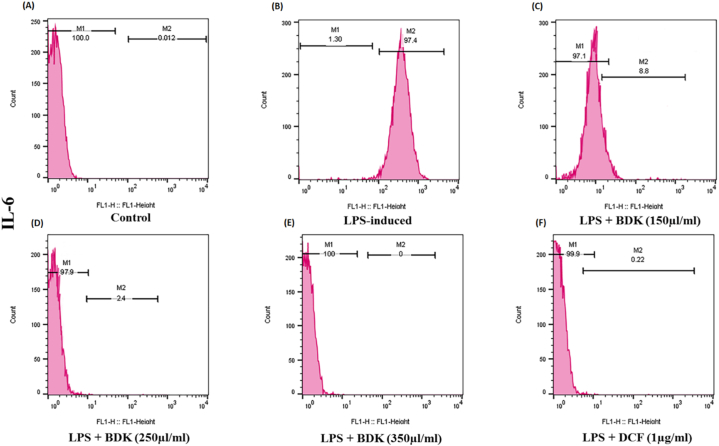
Macrophage-arbitrated inflammation is associated with the regulation of rheumatoid arthritis (RA). Low risk and better efficiency are steered herbal drugs more credible than conventional medicines in RA management. Bhadradarvadi (BDK) concoction has been traditionally used for rheumatism in Ayurveda. However, the mechanisms at the molecular level are still elusive. This study was designed to inspect the process of immunomodulation and anti-inflammatory properties of BDK in lipopolysaccharide (LPS)-stimulated RAW 264.7 macrophages for the first time. BDK concoction was prepared and evaluated with the stimulated murine macrophage-like RAW 264.7 cell lines. TNF-α, IL6, and PGE were quantified by ELISA. The normalization of the fold change in the expression of the target gene mRNA was done by comparing the values of the housekeeping gene using the 2 comparative cycle threshold. The expression of TNF-α, IL6, iNOS, and COX-2 in the RAW 264.7 macrophage cells was analyzed using flow cytometry. Our results showed that BDK (150-350 μl/ml) treatment significantly decreased the inflammatory cytokines (TNF-α, and IL-6) and inflammatory mediators (PGE) in LPS-stimulated RAW 264.7 macrophage cells. The pro-inflammatory cytokines (TNF-α, IL-1β, and IL-6) expression, inflammatory enzymes (iNOS and COX-2), and NF-κBp65 were significantly downregulated at transcriptome level in LPS-stimulated RAW 264.7 macrophage cells. The flow cytometry analysis revealed that BDK treatment diminished the TNF-α, IL-6, iNOS, and COX-2 expression at the proteome level, as well as obstruction of NF-κB-p65 nuclear translocation was observed by immunofluorescence analysis in LPS-stimulated RAW 264.7 macrophage cells. Collectively, BDK can intensely augment the anti-inflammatory activities via inhibiting the NF-κB signaling pathway trigger for treating autoimmune disorders including RA.
巨噬细胞介导的炎症与类风湿关节炎(RA)的调节有关。在RA管理中,低风险且效率更高的草药比传统药物更可靠。Bhadradarvadi(BDK)制剂在阿育吠陀传统医学中一直用于治疗风湿病。然而,其分子水平的机制仍不清楚。本研究首次旨在检测BDK在脂多糖(LPS)刺激的RAW 264.7巨噬细胞中的免疫调节过程和抗炎特性。制备BDK制剂并用其刺激小鼠巨噬细胞样RAW 264.7细胞系进行评估。通过酶联免疫吸附测定(ELISA)对肿瘤坏死因子-α(TNF-α)、白细胞介素-6(IL-6)和前列腺素E(PGE)进行定量。通过使用2个比较循环阈值比较管家基因的值,对靶基因mRNA表达的倍数变化进行标准化。使用流式细胞术分析RAW 264.7巨噬细胞中TNF-α、IL-6、诱导型一氧化氮合酶(iNOS)和环氧化酶-2(COX-2)的表达。我们的结果表明,BDK(150 - 350μl/ml)处理显著降低了LPS刺激的RAW 264.7巨噬细胞中的炎性细胞因子(TNF-α和IL-6)和炎性介质(PGE)。在LPS刺激的RAW 264.7巨噬细胞中,促炎细胞因子(TNF-α、白细胞介素-1β和IL-6)的表达、炎性酶(iNOS和COX-2)以及核因子κB p65(NF-κBp65)在转录组水平上显著下调。流式细胞术分析显示,BDK处理在蛋白质组水平上降低了TNF-α、IL-6、iNOS和COX-2的表达,并且通过免疫荧光分析在LPS刺激的RAW 264.7巨噬细胞中观察到NF-κB-p65核转位受阻。总体而言,BDK可通过抑制NF-κB信号通路触发来强烈增强抗炎活性,用于治疗包括RA在内的自身免疫性疾病。