Department of Laboratory Medicine, Chonnam National University Medical School and Chonnam National University Hospital, Gwangju, Korea.
Division of Trauma, Department of Surgery, Chonnam National University Medical School and Chonnam National University Hospital, Gwangju, Korea.
Ann Lab Med. 2024 Jan 1;44(1):74-81. doi: 10.3343/alm.2024.44.1.74. Epub 2023 Sep 4.
Rotational thromboelastometry (ROTEM; TEM International GmbH, Munich, Germany) is a global coagulation test that guides evidence-based platelet transfusion in trauma patients. We evaluated ROTEM parameters for predicting mid-term (five days) platelet transfusion in trauma patients.
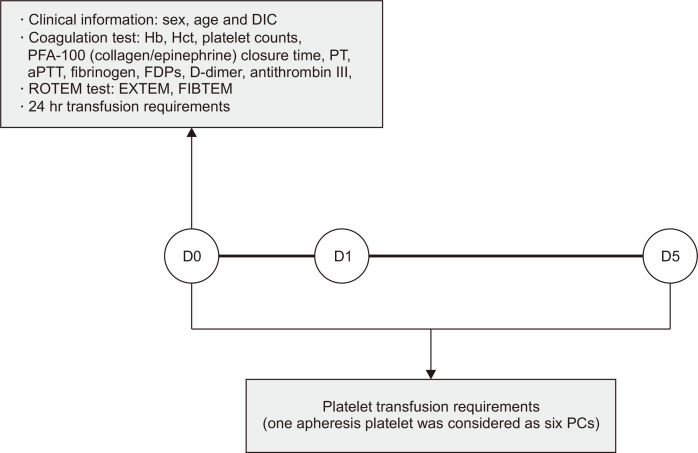
Maximum clot firmness and clot amplitudes after 5, 10, and 15 mins (A5, A10, and A15, respectively) of fibrin-specific ROTEM (FIBTEM) and extrinsically activated ROTEM (EXTEM) were retrospectively collected from 82 hospitalized, stable, non-bleeding trauma patients after successful initial resuscitation. Platelet-specific ROTEM (PLTEM) was calculated by subtracting FIBTEM from EXTEM. Platelet transfusions were reviewed for five days after ROTEM.
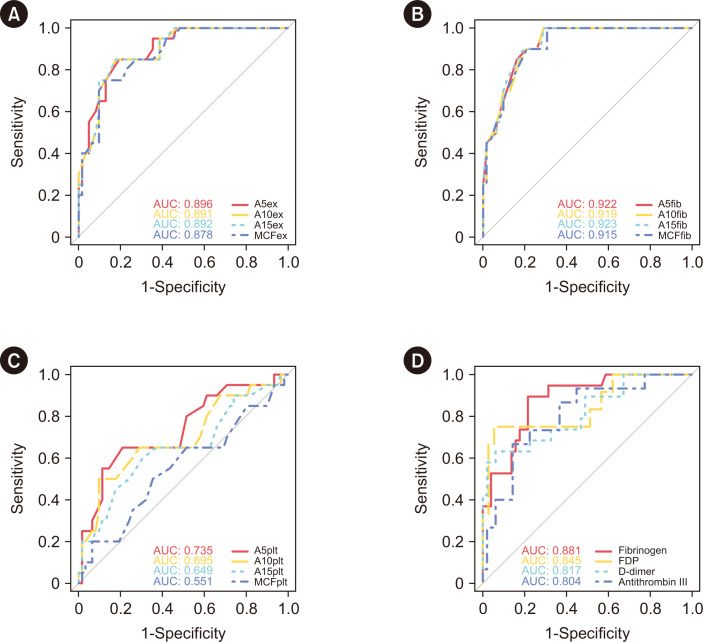
The areas under the curve for FIBTEM, EXTEM, and PLTEM predicting platelet concentrate transfusion of >12 U at mid-term were 0.915-0.923, 0.878-0.896, and 0.551-0.735, respectively. FIBTEM and EXTEM parameters were comparable to those of fibrinogen, fibrin/fibrinogen degradation products, D-dimer, and antithrombin III. Strong correlations (>0.7) were noted between platelet count and EXTEM (A5, A10, and A15) or PLTEM (A5), platelet function (per platelet count) and EXTEM (A10 and A15), and fibrinogen levels and all FIBTEM parameters.
FIBTEM and EXTEM can reliably predict mid-term platelet transfusion in trauma patients. FIBTEM, EXTEM, and PLTEM parameters correlate with conventional coagulation tests (platelets and fibrinogen).
旋转血栓弹性测定法(ROTEM;德国慕尼黑 TEM International GmbH)是一种全球凝血检测方法,可指导创伤患者进行基于证据的血小板输注。我们评估了 ROTEM 参数在预测创伤患者中期(5 天)血小板输注中的作用。
回顾性收集 82 例经初始复苏成功的住院、稳定、非出血性创伤患者的纤维蛋白特异性 ROTEM(FIBTEM)和外源性激活 ROTEM(EXTEM)的最大凝块硬度和 5、10 和 15 分钟后的凝块幅度(分别为 A5、A10 和 A15),通过从 EXTEM 中减去 FIBTEM 计算血小板特异性 ROTEM(PLTEM)。在 ROTEM 后 5 天内回顾血小板输注情况。
FIBTEM、EXTEM 和 PLTEM 预测中期血小板浓缩物输注>12 U 的曲线下面积分别为 0.915-0.923、0.878-0.896 和 0.551-0.735。FIBTEM 和 EXTEM 参数与纤维蛋白原、纤维蛋白/纤维蛋白原降解产物、D-二聚体和抗凝血酶 III 相当。血小板计数与 EXTEM(A5、A10 和 A15)或 PLTEM(A5)、血小板功能(按血小板计数)与 EXTEM(A10 和 A15)以及纤维蛋白原水平与所有 FIBTEM 参数之间存在较强的相关性(>0.7)。
FIBTEM 和 EXTEM 可可靠地预测创伤患者的中期血小板输注。FIBTEM、EXTEM 和 PLTEM 参数与常规凝血检测(血小板和纤维蛋白原)相关。