Department of Nuclear Medicine, Xiangya Hospital, Central South University, Changsha, Hunan, China.
Department of Urology, Xiangya Hospital, Central South University, 87 Xiangya Road, Changsha, 410008, Hunan, China.
Cancer Imaging. 2023 Sep 4;23(1):81. doi: 10.1186/s40644-023-00562-x.
The prostate-specific antigen (PSA) has been widely used in screening and early diagnosis of prostate cancer (PCa). However, in the PSA grey zone of 4-10 ng/ml, the sensitivity and specificity for diagnosing PCa are limited, resulting in considerable number of unnecessary and invasive prostate biopsies, which may lead to potential overdiagnosis and overtreatment. We aimed to predict clinically significant PCa (CSPCa) by combining the maximal standardized uptake value (SUVmax) based on Ga‑PSMA PET/CT and clinical indicators in men with gray zone PSA levels.
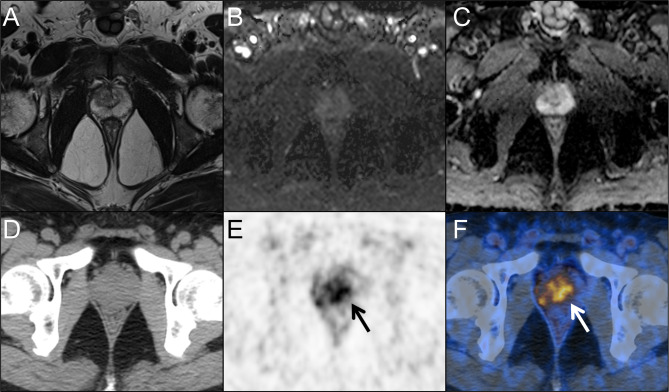
81 patients with suspected PCa based on increased serum total PSA (TPSA) levels of 4 - 10 ng/mL who underwent transrectal ultrasound/magnetic resonance imaging (MRI)/PET fusion-guided biopsy were enrolled. Among them, patients confirmed by histopathology were divided into the CSPCa group and the non-CSPCa group, and data on PSA concentration, prostate volume (PV), PSA density (PSAD), free PSA (FPSA)/TPSA, Prostate Imaging-Reporting and Data System version 2.1 (PI-RADS v2.1) score, Ga-PSMA PET/CT imaging evaluation results and SUVmax were compared. Multivariate logistic regression analysis was performed to identify the independent predictors for CSPCa, thereby establishing a predictive model based on SUVmax that was evaluated by analyzing the receiver operating characteristic (ROC) curve and decision curve analysis.
Compared to non-CSPCa, CSPCa patients had smaller PVs (median, 31.40 mL), lower FPSA/TPSA (median, 0.12), larger PSADs (median, 0.21 ng/mL) and higher PI-RADS scores (P < 0.05). The prediction model comprising Ga-PSMA PET/CT maximal standardized uptake value, PV and FPSA/TPSA had the highest AUC of 0.927 compared with that of other predictors alone (AUCs of 0.585 for PSA, 0.652 for mpMRI and 0.850 for 68Ga-PSMA PET/CT). The diagnostic sensitivity and specificity of the prediction model were 86.21% and 86.54%, respectively.
Given the low diagnostic accuracy of regular PSA tests, a new prediction model based on the Ga-PSMA PET/CT SUVmax, PV and FPSA/TPSA was developed and validated, and this model could provide a more satisfactory predictive accuracy for CSPCa. This study provides a noninvasive prediction model with high accuracy for the diagnosis of CSPCa in the PSA gray zone, thus may be better avoiding unnecessary biopsy procedures.
前列腺特异性抗原(PSA)已广泛用于前列腺癌(PCa)的筛查和早期诊断。然而,在 PSA 灰区 4-10ng/ml 时,诊断 PCa 的敏感性和特异性有限,导致大量不必要和侵入性的前列腺活检,这可能导致潜在的过度诊断和过度治疗。我们旨在通过结合 Ga-PSMA PET/CT 的最大标准化摄取值(SUVmax)和灰区 PSA 水平男性的临床指标来预测临床显著 PCa(CSPCa)。
81 例疑似 PCa 患者的血清总 PSA(TPSA)水平为 4-10ng/ml,行经直肠超声/磁共振成像(MRI)/PET 融合引导活检。其中,经组织病理学证实的患者分为 CSPCa 组和非 CSPCa 组,比较两组 PSA 浓度、前列腺体积(PV)、PSA 密度(PSAD)、游离 PSA(FPSA)/TPSA、前列腺影像报告和数据系统 2.1 版(PI-RADS v2.1)评分、Ga-PSMA PET/CT 影像学评估结果和 SUVmax。采用多因素 logistic 回归分析确定 CSPCa 的独立预测因子,从而建立基于 SUVmax 的预测模型,并通过分析受试者工作特征(ROC)曲线和决策曲线分析进行评估。
与非 CSPCa 相比,CSPCa 患者的 PV 较小(中位数,31.40ml),FPSA/TPSA 较低(中位数,0.12),PSAD 较大(中位数,0.21ng/ml),PI-RADS 评分较高(P<0.05)。与单独其他预测因子(PSA 的 AUC 为 0.585、mpMRI 的 AUC 为 0.652、68Ga-PSMA PET/CT 的 AUC 为 0.850)相比,包含 Ga-PSMA PET/CT 最大标准化摄取值、PV 和 FPSA/TPSA 的预测模型具有最高的 AUC(0.927)。预测模型的诊断灵敏度和特异性分别为 86.21%和 86.54%。
鉴于常规 PSA 检测的诊断准确性较低,本研究建立并验证了一种基于 Ga-PSMA PET/CT SUVmax、PV 和 FPSA/TPSA 的新预测模型,该模型对 CSPCa 具有更高的预测准确性。该研究提供了一种具有高准确性的非侵入性预测模型,可用于诊断 PSA 灰区的 CSPCa,从而可能更好地避免不必要的活检程序。