Dumonteil Eric, Desale Hans, Tu Weihong, Hernandez-Cuevas Nora, Shroyer Monica, Goff Kelly, Marx Preston A, Herrera Claudia
Department of Tropical Medicine, School of Public Health and Tropical Medicine, and Vector-Borne and Infectious Disease Research Center, Tulane University, New Orleans, Louisiana, USA.
Laboratorio de Parasitologia, Centro de Investigaciones Regionales "Dr. Hideyo Noguchi", Universidad Autonoma de Yucatan, Merida, Yucatan, Mexico.
Microbiol Spectr. 2023 Sep 5;11(5):e0423622. doi: 10.1128/spectrum.04236-22.
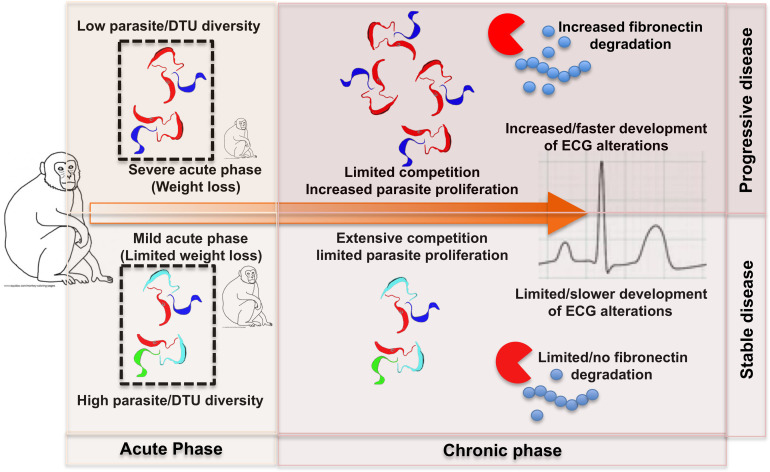
Chronic Chagasic cardiomyopathy develops years after infection in 20-40% of patients, but disease progression is poorly understood. Here, we assessed parasite dynamics and pathogenesis over a 2.5-year period in naturally infected rhesus macaques. Individuals with better control of parasitemia were infected with a greater diversity of parasite strains compared to those with increasing parasitemia over time. Also, the parasite multiplication rate decreased with increasing parasite diversity, suggesting competition among strains or a stronger immune response in multiple infections. Significant differences in electrocardiographic (ECG) profiles were observed in Chagasic macaques compared to uninfected controls, suggesting early conduction defects, and changes in ECG patterns over time were observed only in macaques with increasing parasitemia and lower parasite diversity. Disease progression was also associated with plasma fibronectin degradation, which may serve as a biomarker. These data provide a novel framework for the understanding of Chagas disease pathogenesis, with parasite diversity shaping disease progression.IMPORTANCEChagas disease progression remains poorly understood, and patients at increased risk of developing severe cardiac disease cannot be distinguished from those who may remain asymptomatic. Monitoring of strain dynamics and pathogenesis over 2-3 years in naturally infected macaques shows that increasing parasite diversity in hosts is detrimental to parasite multiplication and Chagasic cardiomyopathy disease progression. This provides a novel framework for the understanding of Chagas disease pathogenesis.
慢性恰加斯病性心肌病在感染数年之后,在20%-40%的患者中出现,但疾病进展情况仍知之甚少。在此,我们评估了自然感染的恒河猴在2.5年期间的寄生虫动态和发病机制。与那些随着时间推移寄生虫血症增加的个体相比,寄生虫血症控制较好的个体感染的寄生虫菌株种类更多。此外,寄生虫增殖率随着寄生虫多样性的增加而降低,这表明菌株之间存在竞争,或者在多重感染中免疫反应更强。与未感染的对照组相比,在恰加斯病猕猴中观察到心电图(ECG)特征存在显著差异,这表明存在早期传导缺陷,并且仅在寄生虫血症增加且寄生虫多样性较低的猕猴中观察到心电图模式随时间的变化。疾病进展还与血浆纤连蛋白降解有关,血浆纤连蛋白降解可能作为一种生物标志物。这些数据为理解恰加斯病发病机制提供了一个新的框架,即寄生虫多样性影响疾病进展。
重要性
恰加斯病的进展情况仍知之甚少,无法将发生严重心脏病风险增加的患者与可能保持无症状的患者区分开来。对自然感染猕猴2至3年期间的菌株动态和发病机制进行监测表明,宿主中寄生虫多样性的增加不利于寄生虫增殖和恰加斯病性心肌病的疾病进展。这为理解恰加斯病发病机制提供了一个新的框架。