Vosegaard Emilie S, Ahlburg Jakob V, Krause Lennard, Iversen Bo B
Center for Integrated Materials Research, Department of Chemistry and Interdisciplinary Nanoscience Center (iNANO), Aarhus University, Aarhus C, DK-8000, Denmark.
Acta Crystallogr B Struct Sci Cryst Eng Mater. 2023 Oct 1;79(Pt 5):380-391. doi: 10.1107/S2052520623006625. Epub 2023 Sep 4.
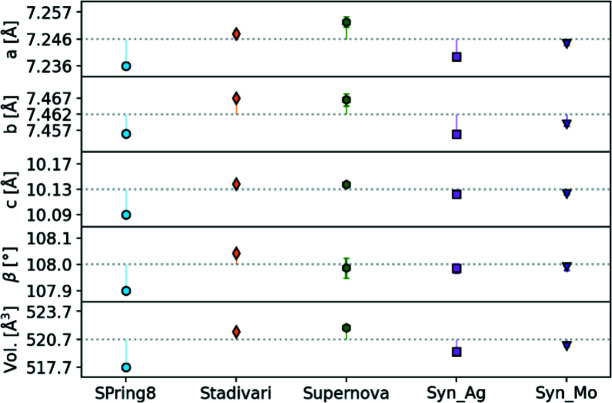
Five different electron density datasets obtained from conventional and synchrotron single crystal X-ray diffraction experiments are compared. The general aim of the study is to investigate the quality of data for electron density analysis from current state-of-the-art conventional sources, and to see how the data perform in comparison with high-quality synchrotron data. A molecular crystal of melamine was selected as the test compound due to its ability to form excellent single crystals, the light atom content, and an advantageous suitability factor of 3.6 for electron density modeling. These features make melamine an optimal system for conventional X-ray diffractometers since the inherent advantages of synchrotron sources such as short wavelength and high intensity are less critical in this case. Data were obtained at 100 K from new in-house diffractometers Rigaku Synergy-S (Mo and Ag source, HyPix100 detector) and Stoe Stadivari (Mo source, EIGER2 1M CdTe detector), and an older Oxford Diffraction Supernova (Mo source, Atlas CCD detector). The synchrotron data were obtained at 25 K from BL02B1 beamline at SPring-8 in Japan (λ = 0.2480 Å, Pilatus3 X 1M CdTe detector). The five datasets were compared on general quality parameters such as resolution, ⟨I/σ⟩, redundancy and R factors, as well as the more model specific fractal dimension plot and residual density maps. Comparison of the extracted electron densities reveals that all datasets can provide reliable multipole models, which overall convey similar chemical information. However, the new laboratory X-ray diffractometers with advanced pixel detector technology clearly measure data with significantly less noise and much higher reliability giving densities of higher quality, compared to the older instrument. The synchrotron data have higher resolution and lower measurement temperature, and they allow for finer details to be modeled (e.g. hydrogen κ parameters).
比较了从传统和同步辐射单晶X射线衍射实验获得的五个不同的电子密度数据集。该研究的总体目标是研究来自当前最先进的传统光源的电子密度分析数据的质量,并观察这些数据与高质量同步辐射数据相比的表现。选择三聚氰胺分子晶体作为测试化合物,是因为它能够形成优质单晶、轻原子含量以及电子密度建模的有利适用性因子3.6。这些特性使三聚氰胺成为传统X射线衍射仪的最佳系统,因为在这种情况下,同步辐射源的固有优势(如短波长和高强度)不太关键。数据是在100 K下从新的内部衍射仪Rigaku Synergy-S(钼和银源,HyPix100探测器)、Stoe Stadivari(钼源,EIGER2 1M碲化镉探测器)以及较旧的牛津衍射Supernova(钼源,Atlas CCD探测器)获得的。同步辐射数据是在25 K下从日本SPring-8的BL02B1光束线(λ = 0.2480 Å,Pilatus3 X 1M碲化镉探测器)获得的。对这五个数据集在分辨率、⟨I/σ⟩、冗余度和R因子等一般质量参数以及更具模型特异性的分形维数图和残余密度图方面进行了比较。提取的电子密度比较表明,所有数据集都能提供可靠的多极模型,总体上传递相似的化学信息。然而,与旧仪器相比,采用先进像素探测器技术的新型实验室X射线衍射仪明显能测量噪声显著更低且可靠性更高的数据,从而得到更高质量的密度。同步辐射数据具有更高的分辨率和更低的测量温度,并且能够对更精细的细节进行建模(例如氢κ参数)。