Clinical Medicine laboratory, Nelson R. Mandela School of Medicine, University of KwaZulu-Natal, 719 Umbilo Road, Durban, 4001, South Africa.
Dept of Nephrology, Div. of Internal Medicine, Nelson R. Mandela School of Medicine, University of KwaZulu-Natal, 719 Umbilo Road, Durban, 4001, South Africa.
BMC Cancer. 2023 Sep 6;23(1):830. doi: 10.1186/s12885-023-11345-9.
Persistent high-risk Human papillomavirus (HR-HPV) infections are the main cause of cervical cancer. Cumulative evidence implicates regulatory T cells (Tregs) as a critical factor in the failure to eliminate HPV-induced cancers leading to their persistence and progression to cancer. Also, the WHO recognised cervical cancer as 100% attributable to persistent HR-HPV infection. The province of KwaZulu-Natal (KZN) in South Africa has a high prevalence of cervical cancer and HIV infection.
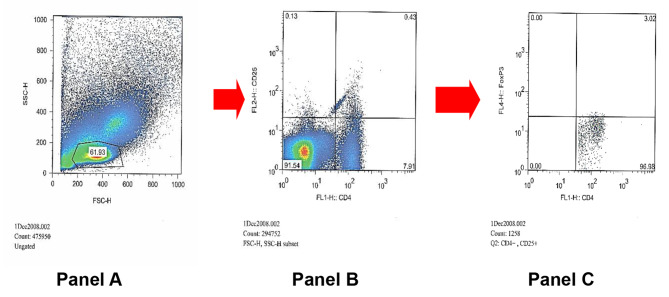
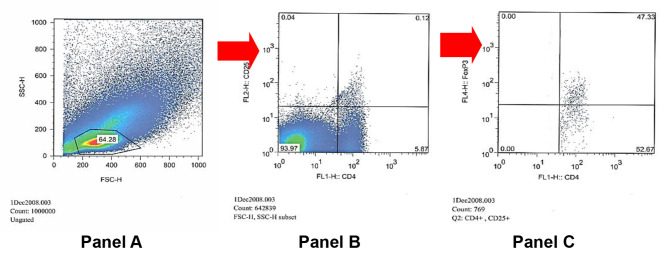
We evaluated Treg frequency in dual infection of HR HPV and HIV coinfection using phenotypic markers, CD4, CD25 and intracellular Foxp3, in the peripheral blood of 51 cervical cancer and 46 non-cervical cancer participants and evaluated the effect of HIV on regulatory T cell proportion. Peripheral blood mononuclear cells were surface stained with a cocktail fluorescent labelled CD4 and CD25 and subsequently with APC anti-human FoxP3 (eBioscience). Flow cytometry was performed with FACS analysis. Statistical analysis of results was done using Instat 3 program (GraphpadR). Tregs results were expressed as median ± interquartile range (IQR). Associations of cervical cancer with demographic, clinical and laboratory variables were evaluated by univariate and multivariate logistic regression analysis using SPSS version 27 (IBM).
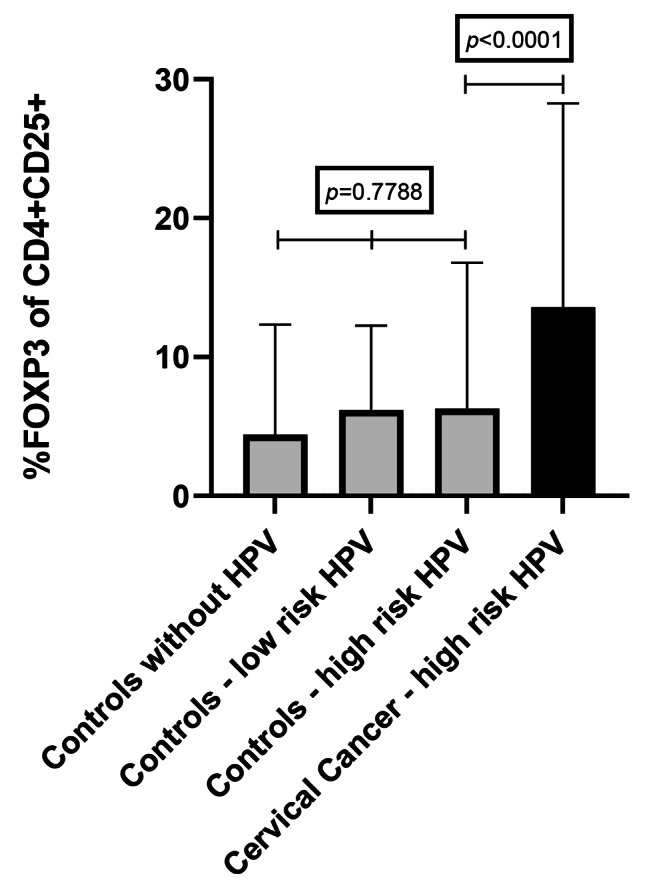
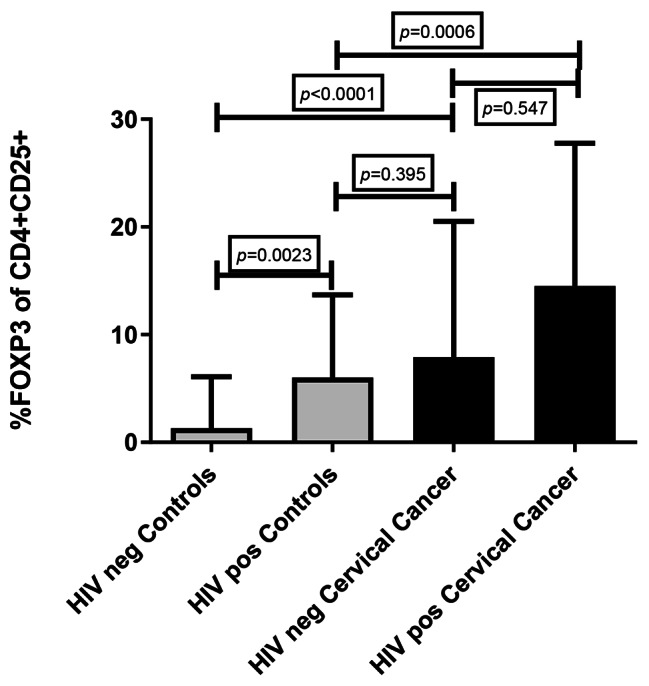
Tregs frequency was significantly higher in individuals with cervical cancer (11.00 ± 19.79%) compared to controls (1.71 ± 8.91%) (p < 0.0001). HIV infection was associated with an increase in Tregs frequency. In controls a significant difference in Tregs frequency was noted between women living with HIV (6.00 ± 10.57%, n = 9) and those without HIV (1.30 ± 6.10%, n = 37), p = 0.0023. In multivariate logistic regression, Tregs frequency was significantly associated with cervical cancer after controlling for age, smoking, weight loss, presence of STI, HIV and HPV genotype.
DISCUSSION/CONCLUSION: Higher Tregs frequency was significantly associated with cervical cancer highlighting the immunosuppressive role of Tregs in cervical cancer. Treg frequency was more strongly associated with cervical cancer than HIV infection. We provide baseline data for monitoring Treg frequencies in response to new preventive and therapeutic strategies in the management of cervical cancer.
持续性高危型人乳头瘤病毒(HR-HPV)感染是宫颈癌的主要病因。越来越多的证据表明调节性 T 细胞(Tregs)是 HPV 诱导的癌症无法消除的关键因素,导致 HPV 持续存在并进展为癌症。此外,世界卫生组织(WHO)已将宫颈癌确认为 100%由持续性 HR-HPV 感染引起。南非夸祖鲁-纳塔尔省(KwaZulu-Natal,KZN)宫颈癌和 HIV 感染的发病率都很高。
我们使用表型标志物 CD4、CD25 和细胞内 Foxp3 评估了 HR HPV 和 HIV 双重感染中的 Treg 频率,研究对象为 51 名宫颈癌患者和 46 名非宫颈癌患者,并评估了 HIV 对调节性 T 细胞比例的影响。外周血单个核细胞用鸡尾酒荧光标记的 CD4 和 CD25 进行表面染色,然后用 APC 抗人 Foxp3(eBioscience)进行染色。用 FACS 分析进行流式细胞术分析。使用 Instat 3 程序(GraphpadR)对结果进行统计分析。Treg 结果以中位数±四分位距(IQR)表示。使用 SPSS 版本 27(IBM)通过单变量和多变量逻辑回归分析评估宫颈癌与人口统计学、临床和实验室变量的相关性。
与对照组(1.71±8.91%)相比,宫颈癌患者的 Treg 频率(11.00±19.79%)显著升高(p<0.0001)。HIV 感染与 Treg 频率的增加相关。在对照组中,HIV 阳性女性(6.00±10.57%,n=9)与 HIV 阴性女性(1.30±6.10%,n=37)的 Treg 频率有显著差异(p=0.0023)。在多变量逻辑回归中,在校正年龄、吸烟、体重减轻、性传播感染、HIV 和 HPV 基因型后,Treg 频率与宫颈癌显著相关。
讨论/结论:Treg 频率的升高与宫颈癌显著相关,提示 Tregs 在宫颈癌中具有免疫抑制作用。Treg 频率与宫颈癌的相关性强于 HIV 感染。我们提供了监测 Treg 频率的基线数据,以便为宫颈癌的管理提供新的预防和治疗策略。