Department of Evidence-Based Medicine and Scientific Management, West Kazakhstan Marat Ospanov Medical University, Aktobe, Kazakhstan.
Department of Law, Buketov Karaganda University, Karaganda, Kazakhstan.
Front Public Health. 2023 Aug 21;11:1247684. doi: 10.3389/fpubh.2023.1247684. eCollection 2023.
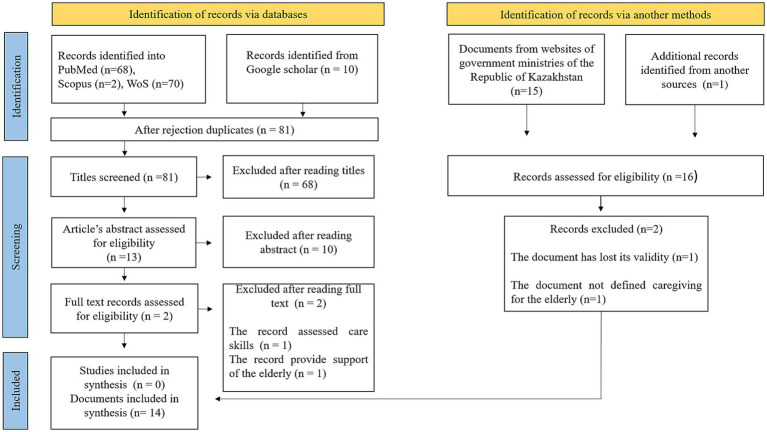
The demand for informal caregivers to support the older adults has grown worldwide in recent decades. However, informal caregivers themselves require support. This article aims to examine existing support measures for caregivers of the older adults in the Republic of Kazakhstan. Relevant articles and grey literature were identified through manual searches on Google and Google Scholar, as well as electronic searches using indexed databases like PubMed, Web of Science, and Scopus. Moreover, the reference lists of identified sources and government ministry websites were meticulously scrutinized. This review highlights the scarcity of research on caregiver support measures in Kazakhstan, supported by the lack of peer-reviewed articles on this subject. A comprehensive analysis of the literature shows that in Kazakhstan's legislative framework, "caregivers" exclusively refers to individuals providing care for a first-degree disability. The responsibility of caring for older adults parents lies with able-bodied children. However, there is a lack of registration and assessment procedures to evaluate the burden and quality of life of caregivers. As a result, the medical and social support provided to caregivers is standardized, failing to adequately address their unique needs and requirements. The analysis of current support measures for informal caregivers highlights the need to develop support mechanisms and recognize individuals providing informal care as key figures in the long-term care system.
近几十年来,全球对支持老年人的非正式照顾者的需求不断增长。然而,非正式照顾者本身也需要支持。本文旨在探讨哈萨克斯坦共和国老年照顾者现有支持措施。通过在 Google 和 Google Scholar 上手动搜索,以及在 PubMed、Web of Science 和 Scopus 等索引数据库上进行电子搜索,确定了相关文章和灰色文献。此外,还仔细审查了已确定来源的参考文献列表和政府部门网站。这篇综述强调了哈萨克斯坦在照顾者支持措施方面研究的匮乏,这一现象反映在缺乏关于这一主题的同行评审文章上。对文献的综合分析表明,在哈萨克斯坦的立法框架中,“照顾者”仅指为一级残疾提供护理的个人。照顾老年父母的责任在于身体健全的子女。然而,缺乏登记和评估程序来评估照顾者的负担和生活质量。因此,向照顾者提供的医疗和社会支持是标准化的,无法充分满足他们的独特需求和要求。对非正式照顾者现有支持措施的分析突出表明,需要制定支持机制,并将提供非正式照顾的个人视为长期护理系统中的关键人物。