Heart Rhythm Management Centre, Postgraduate Program in Cardiac Electrophysiology and Pacing, Universitair Ziekenhuis Brussel-Vrije Universiteit Brussel, European Reference Networks Guard-Heart, Laarbeeklaan 101, 1090 Brussels, Belgium.
Independent Researcher, Helsinki, Finland.
Europace. 2023 Aug 2;25(9). doi: 10.1093/europace/euad252.
Cryoballoon (CB) ablation is the mainstay of single-shot pulmonary vein isolation (PVI). A radiofrequency balloon (RFB) catheter has recently emerged as an alternative. However, these two technologies have not been compared. This study aims to evaluate the freedom from atrial tachyarrhythmias (ATas) at 1 year: procedural characteristics, efficacy, and safety of the novel RFB compared with CB for PVI in patients with paroxysmal atrial fibrillation (AF).
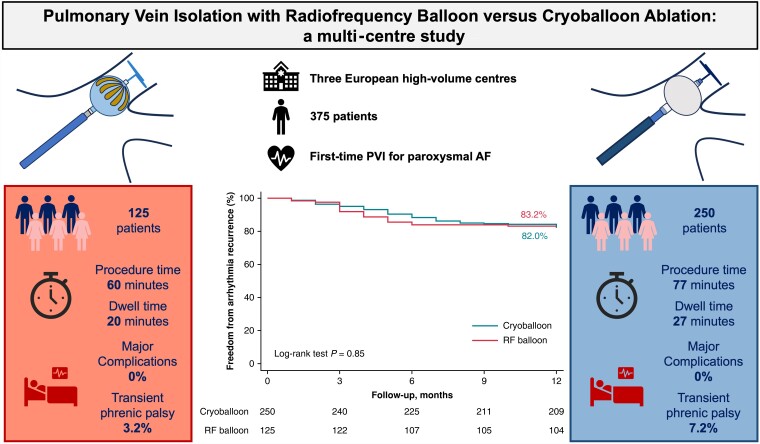
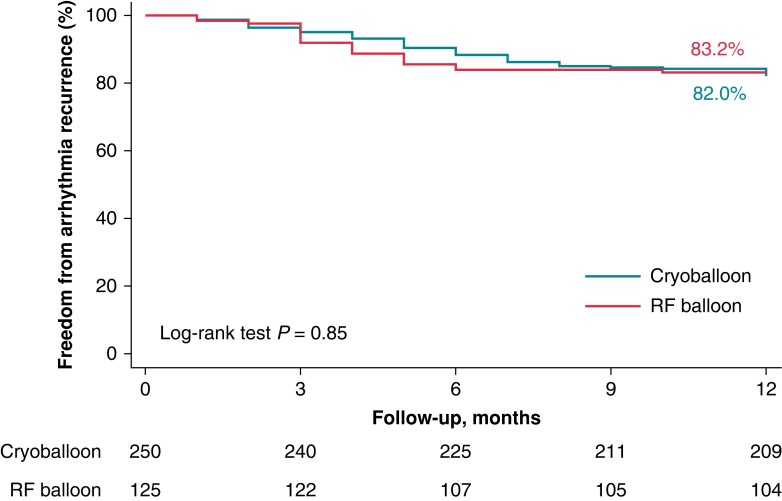
This prospective multi-centre study included consecutive patients with symptomatic drug-resistant paroxysmal AF who underwent PVI with RFB or CB between July 2021 and January 2022 from three European centres. A total of 375 consecutive patients were included, 125 in the RFB group and 250 in the CB. Both groups had comparable clinical characteristics. At 12.33 ± 4.91 months, ATas-free rates were 83.20% and 82.00% in the RFB and CB groups, respectively (P > 0.05). Compared with the CB group, the RFB group showed a shorter procedure time [59.91 (45.80-77.12) vs. 77.0 (35.13-122.71) min (P < 0.001)], dwell time [19.59 (14.41-30.24) vs. 27.03 (17.11-57.21) min (P = 0.04)], time to isolation, and thermal energy delivery in all pulmonary veins (P < 0.001). First-pass isolation was comparable. No major complications occurred in either group, with no stroke, atrio-oesophageal fistula, or permanent phrenic nerve injury. Transient phrenic nerve palsy occurred more frequently with CB than RFB (7.20% vs. 3.20%; P = 0.02). Oesophageal temperature rise occurred in 21 (16.8%) patients in the RFB group, and gastroscopy showed erythema in two of them with complete recovery after 30 days.
The RFB appears to have a safety and efficacy profile similar to that of the CB for PVI. Shorter procedural times appear to be driven by shorter left atrial dwell and thermal delivery times.
冷冻球囊(CB)消融是单次肺静脉隔离(PVI)的主要方法。最近出现了一种射频球囊(RFB)导管作为替代方法。然而,这两种技术尚未进行比较。本研究旨在评估新型 RFB 与 CB 用于阵发性心房颤动(AF)患者 PVI 的 1 年无房性快速性心律失常(ATas)的情况:程序特征、疗效和安全性。
这项前瞻性多中心研究纳入了 2021 年 7 月至 2022 年 1 月期间来自欧洲三个中心的 375 例连续接受 RFB 或 CB 进行 PVI 的有症状药物抵抗阵发性 AF 患者。两组患者的临床特征具有可比性。在 12.33±4.91 个月时,RFB 组和 CB 组的 ATas 无复发率分别为 83.20%和 82.00%(P>0.05)。与 CB 组相比,RFB 组的手术时间更短[59.91(45.80-77.12)比 77.0(35.13-122.71)min(P<0.001)]、停留时间[19.59(14.41-30.24)比 27.03(17.11-57.21)min(P=0.04)]、所有肺静脉的隔离时间和热能量输送(P<0.001)。首次通过隔离是可比的。两组均未发生主要并发症,无卒中、食管-心房瘘或永久性膈神经损伤。CB 组的膈神经麻痹发生率高于 RFB 组(7.20%比 3.20%;P=0.02)。RFB 组 21 例(16.8%)患者发生食管温度升高,其中 2 例胃镜检查显示红斑,30 天后完全恢复。
RFB 似乎具有与 CB 相似的安全性和疗效特征,用于 PVI。手术时间较短可能是由于左心房停留时间和热传递时间较短所致。