Department of Life Sciences, Graduate School of Arts and Sciences, The University of Tokyo, 3-8-1, Komaba, Meguro-ku, Tokyo, 153-8902, Japan.
Department of Science and Technology, Nara Institute of Science and Technology, Nara, 630-0192, Japan.
Nat Commun. 2023 Sep 6;14(1):5288. doi: 10.1038/s41467-023-40867-w.
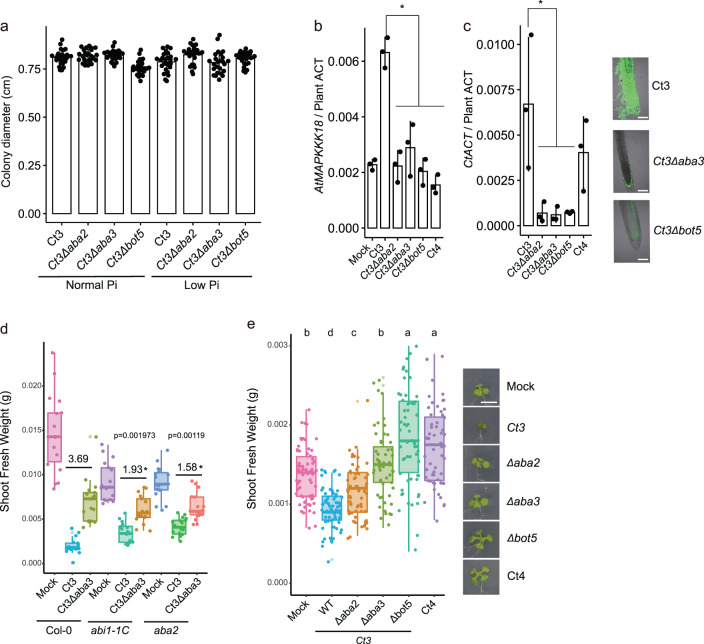
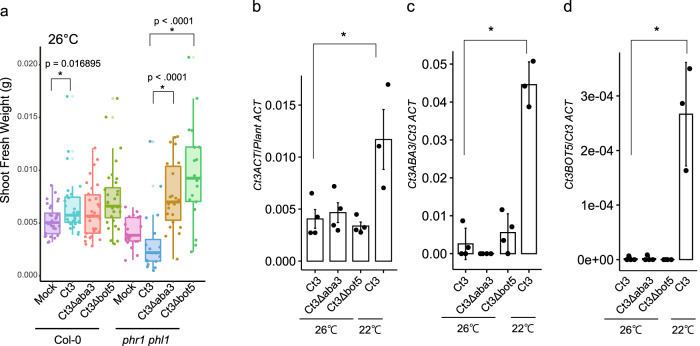
Plant-associated fungi show diverse lifestyles from pathogenic to mutualistic to the host; however, the principles and mechanisms through which they shift the lifestyles require elucidation. The root fungus Colletotrichum tofieldiae (Ct) promotes Arabidopsis thaliana growth under phosphate limiting conditions. Here we describe a Ct strain, designated Ct3, that severely inhibits plant growth. Ct3 pathogenesis occurs through activation of host abscisic acid pathways via a fungal secondary metabolism gene cluster related to the biosynthesis of sesquiterpene metabolites, including botrydial. Cluster activation during root infection suppresses host nutrient uptake-related genes and changes mineral contents, suggesting a role in manipulating host nutrition state. Conversely, disruption or environmental suppression of the cluster renders Ct3 beneficial for plant growth, in a manner dependent on host phosphate starvation response regulators. Our findings indicate that a fungal metabolism cluster provides a means by which infectious fungi modulate lifestyles along the parasitic-mutualistic continuum in fluctuating environments.
植物相关真菌表现出从致病性到互利共生到宿主的多样化生活方式;然而,它们转变生活方式的原则和机制需要阐明。根真菌胶孢炭疽菌(Ct)在磷酸盐限制条件下促进拟南芥的生长。在这里,我们描述了一种 Ct 菌株,命名为 Ct3,它严重抑制植物的生长。Ct3 的发病机制是通过真菌次生代谢基因簇的激活来实现的,该基因簇与倍半萜代谢物(包括 botrydial)的生物合成有关。在根感染过程中,簇的激活抑制了与宿主养分吸收相关的基因,并改变了矿物质含量,这表明它在操纵宿主营养状态方面发挥了作用。相反,簇的破坏或环境抑制使 Ct3 有益于植物的生长,这种方式依赖于宿主的磷酸盐饥饿反应调节剂。我们的研究结果表明,一个真菌代谢群为传染性真菌在波动环境中沿着寄生-互利共生连续体调节生活方式提供了一种手段。