Department of Biology, Duke University, Durham, NC, USA.
Howard Hughes Medical Institute, Duke University, Durham, NC, USA.
Nature. 2023 Sep;621(7978):423-430. doi: 10.1038/s41586-023-06500-y. Epub 2023 Sep 6.
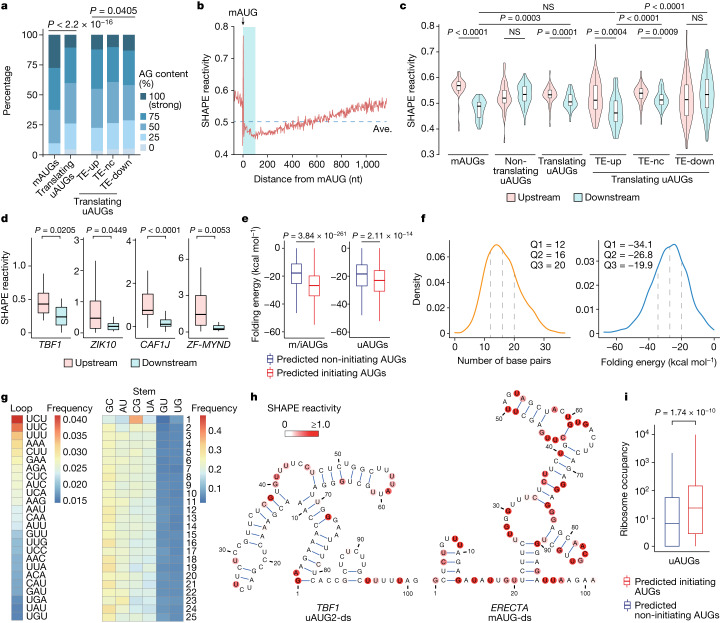
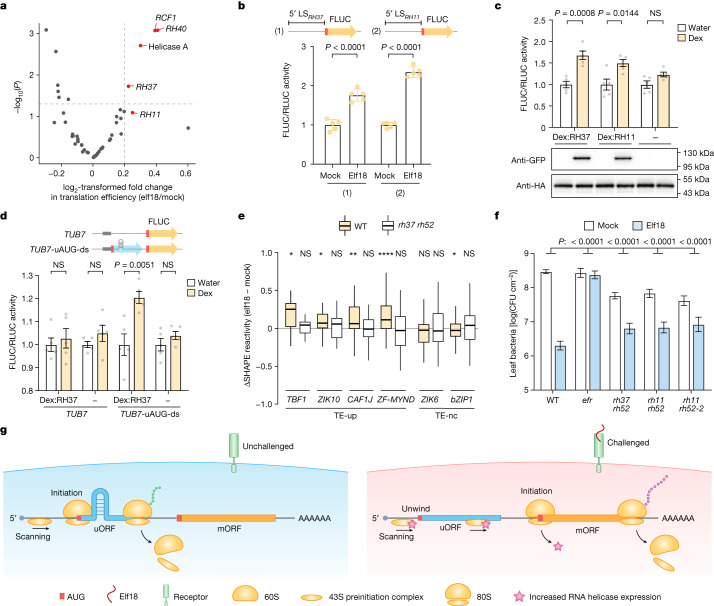
Translational reprogramming allows organisms to adapt to changing conditions. Upstream start codons (uAUGs), which are prevalently present in mRNAs, have crucial roles in regulating translation by providing alternative translation start sites. However, what determines this selective initiation of translation between conditions remains unclear. Here, by integrating transcriptome-wide translational and structural analyses during pattern-triggered immunity in Arabidopsis, we found that transcripts with immune-induced translation are enriched with upstream open reading frames (uORFs). Without infection, these uORFs are selectively translated owing to hairpins immediately downstream of uAUGs, presumably by slowing and engaging the scanning preinitiation complex. Modelling using deep learning provides unbiased support for these recognizable double-stranded RNA structures downstream of uAUGs (which we term uAUG-ds) being responsible for the selective translation of uAUGs, and allows the prediction and rational design of translating uAUG-ds. We found that uAUG-ds-mediated regulation can be generalized to human cells. Moreover, uAUG-ds-mediated start-codon selection is dynamically regulated. After immune challenge in plants, induced RNA helicases that are homologous to Ded1p in yeast and DDX3X in humans resolve these structures, allowing ribosomes to bypass uAUGs to translate downstream defence proteins. This study shows that mRNA structures dynamically regulate start-codon selection. The prevalence of this RNA structural feature and the conservation of RNA helicases across kingdoms suggest that mRNA structural remodelling is a general feature of translational reprogramming.
翻译重编程使生物体能够适应不断变化的环境。上游起始密码子(uAUG)在 mRNA 中普遍存在,通过提供替代的翻译起始位点,在调节翻译方面起着至关重要的作用。然而,决定这种条件之间选择性翻译起始的因素尚不清楚。在这里,通过整合拟南芥模式触发免疫过程中的全转录组翻译和结构分析,我们发现具有免疫诱导翻译的转录本富含上游开放阅读框(uORF)。在没有感染的情况下,由于 uAUG 下游的发夹结构,这些 uORF 被选择性地翻译,可能是通过减缓并结合扫描起始复合物。使用深度学习进行建模为这些 uAUG 下游可识别的双链 RNA 结构(我们称之为 uAUG-ds)负责 uAUG 的选择性翻译提供了无偏的支持,并允许对翻译 uAUG-ds 进行预测和合理设计。我们发现 uAUG-ds 介导的调节可以推广到人类细胞。此外,uAUG-ds 介导的起始密码子选择是动态调节的。在植物受到免疫挑战后,与酵母中的 Ded1p 和人类中的 DDX3X 同源的诱导 RNA 解旋酶可以解决这些结构,使核糖体绕过 uAUG 来翻译下游防御蛋白。这项研究表明,mRNA 结构可以动态调节起始密码子的选择。这种 RNA 结构特征的普遍性以及跨域 RNA 解旋酶的保守性表明,mRNA 结构重塑是翻译重编程的一个普遍特征。