Tsinghua-Peking Center for Life Sciences, State Key Laboratory of Membrane Biology, School of Pharmaceutical Sciences, Tsinghua University, Beijing, China.
State Key Laboratory of Biocatalysis and Enzyme Engineering, Hubei Hongshan Laboratory, Hubei Collaborative Innovation Center for Green Transformation of Bio-Resources, Hubei Key Laboratory of Industrial Biotechnology, School of Life Sciences, Hubei University, Wuhan, China.
Nature. 2023 Sep;621(7980):840-848. doi: 10.1038/s41586-023-06525-3. Epub 2023 Sep 6.
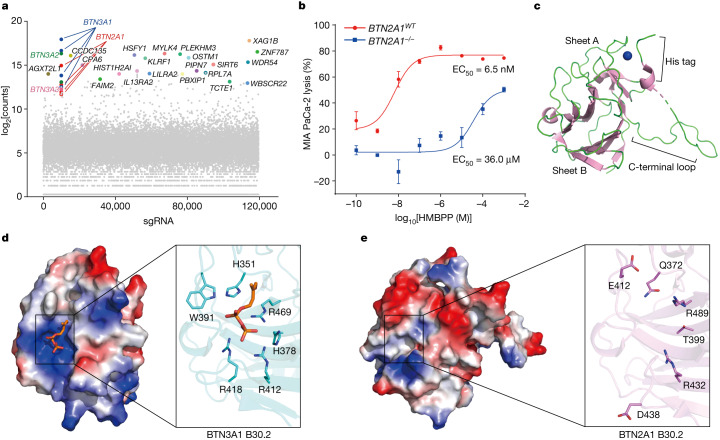
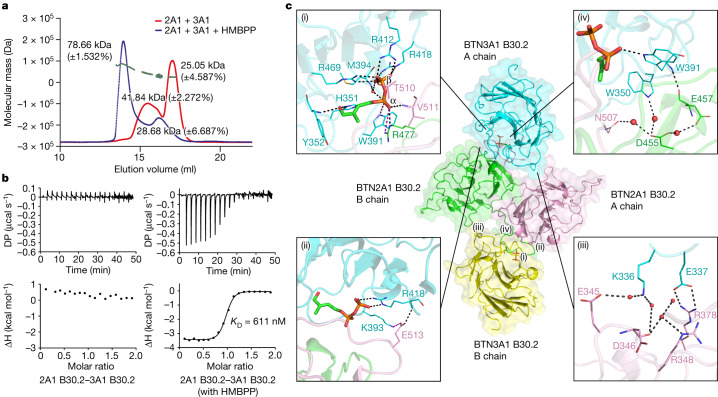
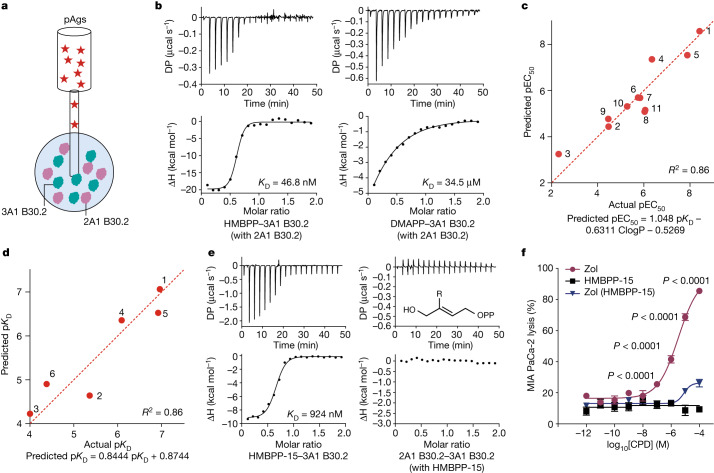
In both cancer and infections, diseased cells are presented to human Vγ9Vδ2 T cells through an 'inside out' signalling process whereby structurally diverse phosphoantigen (pAg) molecules are sensed by the intracellular domain of butyrophilin BTN3A1. Here we show how-in both humans and alpaca-multiple pAgs function as 'molecular glues' to promote heteromeric association between the intracellular domains of BTN3A1 and the structurally similar butyrophilin BTN2A1. X-ray crystallography studies visualized that engagement of BTN3A1 with pAgs forms a composite interface for direct binding to BTN2A1, with various pAg molecules each positioned at the centre of the interface and gluing the butyrophilins with distinct affinities. Our structural insights guided mutagenesis experiments that led to disruption of the intracellular BTN3A1-BTN2A1 association, abolishing pAg-mediated Vγ9Vδ2 T cell activation. Analyses using structure-based molecular-dynamics simulations, F-NMR investigations, chimeric receptor engineering and direct measurement of intercellular binding force revealed how pAg-mediated BTN2A1 association drives BTN3A1 intracellular fluctuations outwards in a thermodynamically favourable manner, thereby enabling BTN3A1 to push off from the BTN2A1 ectodomain to initiate T cell receptor-mediated γδ T cell activation. Practically, we harnessed the molecular-glue model for immunotherapeutics design, demonstrating chemical principles for developing both small-molecule activators and inhibitors of human γδ T cell function.
在癌症和感染中,疾病细胞通过一种“内向外”信号传递过程被人类 Vγ9Vδ2 T 细胞识别,其中结构多样的磷酸抗原(pAg)分子被细胞内结构域的 BTN3A1 识别。在这里,我们展示了在人类和羊驼中,多种 pAg 如何作为“分子胶”促进 BTN3A1 细胞内结构域与结构相似的 BTN2A1 之间的异源二聚体形成。X 射线晶体学研究可视化了 BTN3A1 与 pAg 的结合形成了一个用于与 BTN2A1 直接结合的复合界面,各种 pAg 分子各自位于界面的中心,并以不同的亲和力将 BTN2A1 粘合在一起。我们的结构见解指导了突变实验,导致细胞内 BTN3A1-BTN2A1 相互作用的破坏,从而消除了 pAg 介导的 Vγ9Vδ2 T 细胞激活。使用基于结构的分子动力学模拟、F-NMR 研究、嵌合受体工程和细胞间结合力的直接测量进行的分析揭示了 pAg 介导的 BTN2A1 相互作用如何以热力学有利的方式向外推动 BTN3A1 细胞内波动,从而使 BTN3A1 能够从 BTN2A1 胞外结构域推开,启动 T 细胞受体介导的 γδ T 细胞激活。实际上,我们利用分子胶模型进行免疫治疗设计,展示了开发小分子激活剂和人类 γδ T 细胞功能抑制剂的化学原理。