Rucci Paola, Caporusso Edoardo, Sanmarchi Francesco, Giordano Giulia M, Mucci Armida, Giuliani Luigi, Pezzella Pasquale, Perrottelli Andrea, Bucci Paola, Rocca Paola, Rossi Alessandro, Bertolino Alessandro, Galderisi Silvana, Maj Mario
Department of Biomedical and Neuromotor Sciences, University of Bologna, Bologna, Italy.
Department of Psychiatry, University of Campania 'Luigi Vanvitelli', Naples, Italy.
BJPsych Open. 2023 Sep 7;9(5):e168. doi: 10.1192/bjo.2023.541.
The structure of negative symptoms of schizophrenia is still a matter of controversy. Although a two-dimensional model (comprising the expressive deficit dimension and the motivation and pleasure dimension) has gained a large consensus, it has been questioned by recent investigations.
To investigate the latent structure of negative symptoms and its stability over time in people with schizophrenia using network analysis.
Negative symptoms were assessed in 612 people with schizophrenia using the Brief Negative Symptom Scale (BNSS) at baseline and at 4-year follow-up. A network invariance analysis was conducted to investigate changes in the network structure and strength of connections between the two time points.
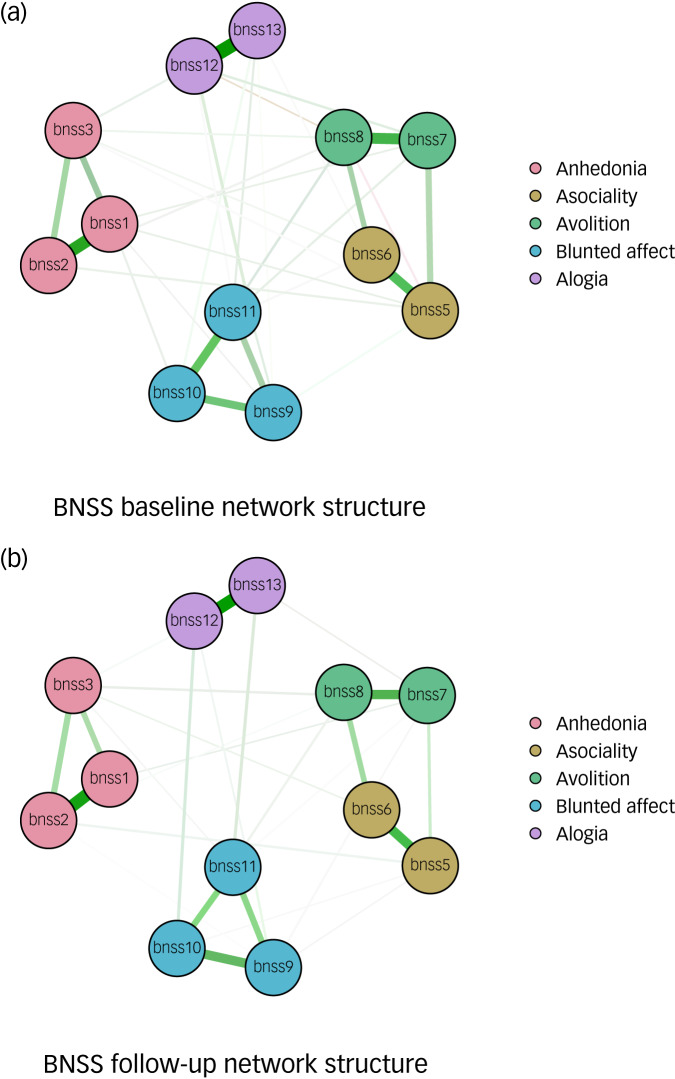
The network analysis carried out at baseline and follow-up, supported by community detection analysis, indicated that the BNSS's items aggregate to form four or five distinct domains (avolition/asociality, anhedonia, blunted affect and alogia). The network invariance test indicated that the network structure remained unchanged over time (network invariance test score 0.13; = 0.169), although its overall strength decreased (6.28 at baseline, 5.79 at follow-up; global strength invariance test score 0.48; = 0.016).
The results lend support to a four- or five-factor model of negative symptoms and indicate overall stability over time. These data have implications for the study of pathophysiological mechanisms and the development of targeted treatments for negative symptoms.
精神分裂症阴性症状的结构仍存在争议。尽管二维模型(包括表达缺陷维度和动机与愉悦维度)已获得广泛认可,但最近的研究对其提出了质疑。
使用网络分析研究精神分裂症患者阴性症状的潜在结构及其随时间的稳定性。
在基线和4年随访时,使用简明阴性症状量表(BNSS)对612名精神分裂症患者的阴性症状进行评估。进行网络不变性分析,以研究两个时间点之间网络结构和连接强度的变化。
在基线和随访时进行的网络分析,在社区检测分析的支持下,表明BNSS的项目聚合形成四个或五个不同的领域(意志缺乏/社交退缩、快感缺失、情感迟钝和言语贫乏)。网络不变性测试表明,尽管其整体强度下降(基线时为6.28,随访时为5.79;全局强度不变性测试得分0.48;P = 0.016),但网络结构随时间保持不变(网络不变性测试得分0.13;P = 0.169)。
结果支持阴性症状的四因素或五因素模型,并表明随时间总体稳定。这些数据对病理生理机制的研究和阴性症状靶向治疗方法的开发具有启示意义。